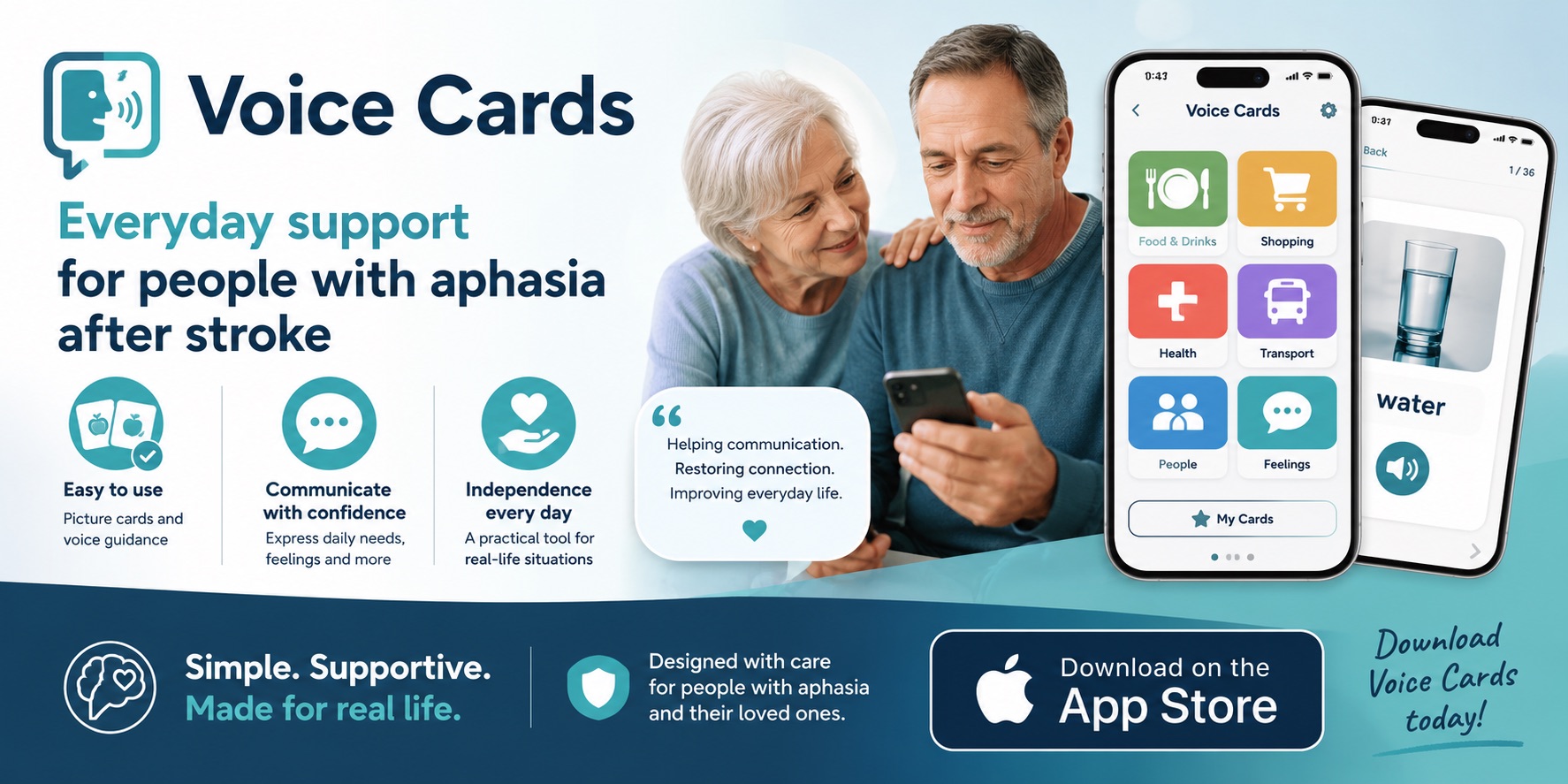
A dental appointment with aphasia can be easier when the patient prepares a short communication plan, shows the dentist how they prefer to answer, uses a visual way to describe pain or location, and agrees on a clear stop signal before the examination or treatment begins. The dentist and staff should speak directly to the patient, ask one question at a time, make important choices visible, allow enough response time, and confirm the plan before moving forward.
Aphasia can affect speaking, understanding, reading, or writing in different combinations. It does not mean that a person has lost their opinions, preferences, or ability to participate in everyday decisions. A dental visit simply creates an unusual communication environment: the room may be unfamiliar, staff may use technical terms, the patient may be reclined, faces may be partly covered, and there are moments when speaking is physically impossible because dental work is taking place.
This guide focuses on communication access and practical preparation. It does not give dental or medical treatment advice. For a broader healthcare preparation plan, see Doctor Appointments With Aphasia: How to Prepare, Ask Questions, and Stay in the Conversation.
Table of contents
The quickest way to prepare for a dentist appointment with aphasia
Why dental visits can be especially difficult with aphasia
Tell the dental office what communication support helps
Make a one-page dental communication card
How to communicate pain, location, and the reason for the visit
Agree on a stop signal before the dentist begins
Make choices and consent easier to confirm
What to do when yes and no are not reliable
How a companion can help without taking over
Discuss costs, insurance, and follow-up in a visible format
Communication access in U.S. dental practices
Three practical dental appointment scenarios
Common communication mistakes to avoid
Dentist appointment checklist for aphasia
Frequently asked questions
A calm next step
The quickest way to prepare for a dentist appointment with aphasia
If you want a simple plan, prepare five things before the visit:
Write the reason for the appointment in one short sentence.
Mark the tooth, side, or area on a simple mouth diagram if location matters.
Write three communication preferences, such as “one question at a time,” “write key words,” and “give me time to answer.”
Choose a clear stop signal that can be used when speaking is not possible.
Ask for the important plan, choices, costs, and next steps in writing so they can be checked without relying on memory from a fast conversation.
This is usually more useful than trying to prepare perfect spoken sentences. The goal is not to perform well in a conversation. The goal is to make it possible for the patient and dental team to exchange accurate information and confirm important choices.
The National Aphasia Association recommends communication supports such as short messages, visual aids, gestures, written key words, clear choices, and confirmation of what was understood. Its healthcare guidance also encourages people with aphasia to prepare for appointments and remain active participants in the conversation. See the NAA resources on communication supports and going to a healthcare appointment.
Why dental visits can be especially difficult with aphasia
A dental visit has communication challenges that do not appear in an ordinary conversation.
The patient may be asked several questions during check-in.
Forms may contain unfamiliar words and many fields.
Dental staff may ask about the location, timing, or intensity of discomfort.
The dentist may need to explain more than one option.
Numbers may matter when discussing cost, insurance, or a treatment estimate.
The patient may be reclined and unable to see a document easily.
Masks can remove some facial information that normally helps communication.
Background equipment and movement can add distraction.
The patient cannot speak normally while instruments are in the mouth.
A quick spoken “yes” may be used at a moment when a more careful confirmation would be better.
These barriers do not make the patient passive. They make preparation and multimodal communication more important.
The American Speech-Language-Hearing Association recommends using clear adult language, short sentences, slower pacing, writing, pictures, gestures, and other visual supports when communicating with adults who have speech or language disorders. ASHA also advises communication partners to ask how the person prefers to communicate and not to make assumptions about intelligence or capability. See ASHA’s communication tips for adults with speech or language disorders.
Tell the dental office what communication support helps
If possible, tell the office before the appointment that the patient has aphasia and what practical support is useful. There is no need to give a long explanation.
I have aphasia. Please speak directly to me, ask one question at a time, write important words, and give me extra time to answer.
If a companion will attend, the message can add:
My support person is coming with me. Please ask me first. They will help when I ask.
When booking, try to obtain the following information in writing:
date and time;
dentist or hygienist name;
office address;
reason or type of appointment;
estimated appointment length;
forms that can be completed in advance;
any documents the office wants the patient to bring.
If phone booking is difficult, use the dental office’s secure portal, online booking system, email, or another method the office offers. A prepared note on a phone can also make the first interaction easier. The guide to using a smartphone with aphasia explains how to keep important messages and communication tools easy to find.
Make a one-page dental communication card
A dental communication card should be short enough to use while the appointment is happening. Do not turn it into a large medical binder. Put the most useful information at the top.
Communication preferences
I have aphasia.
Please speak to me directly.
One question at a time.
Please use short sentences.
Please write key words.
Please show me the choices.
Please give me time to answer.
Please confirm important decisions with me.
Useful dental words
pain;
no pain;
pressure;
sensitive;
left;
right;
top;
bottom;
front;
back;
stop;
wait;
continue;
please explain;
write it down;
I need more time;
not sure.
Large text, white space, short lines, and visible groups of choices make the card easier to scan. For more detail, see How to Make Written Information Aphasia-Friendly.
A general aphasia ID card can explain the communication condition in a few seconds. A more detailed communication board for aphasia can add personalized words, pictures, symbols, or choices that the person already uses successfully.
How to communicate pain, location, and the reason for the visit
Describing a dental problem can be difficult when the patient knows exactly what feels wrong but cannot easily retrieve the words. Do not make the explanation depend on one spoken sentence.
Start with location
Use a simple diagram of the mouth or teeth. The patient can point to:
left or right;
upper or lower;
front or back;
one tooth or a wider area;
gum, cheek, jaw, or another area the dentist identifies visually.
If the patient can point accurately to the location, that information may be more useful than repeated attempts to find the exact dental term.
Make the feeling visible
Offer a small group of words or pictures rather than a long open-ended question. For example:
Question
Visible choices
Where?
left / right / top / bottom / front / back
What?
pain / pressure / sensitive / swelling / not sure
When?
now / sometimes / eating / drinking / night / not sure
How much?
visual scale chosen by the patient and dental team
The National Aphasia Association’s appointment guidance specifically recognizes that visual pain scales, prepared words, pictures, and communication boards may be useful when a person with aphasia needs to communicate in healthcare. The exact tools should fit the individual person rather than being imposed as a generic system.
If the patient has a new or concerning health problem, the dentist or another qualified healthcare professional should evaluate it. This article only addresses how to make the communication clearer.
Agree on a stop signal before the dentist begins
This is one of the most useful differences between a general medical appointment and a dental appointment: there will be times when the patient cannot speak because the dentist is working in the mouth.
Before that happens, agree on a clear physical signal.
For example:
raise the left hand = stop;
open the hand = wait;
thumbs up = okay to continue, if this is reliable for the individual;
point to a STOP card before reclining if a visual signal is easier to remember.
The exact signal matters less than agreeing on it before the patient needs it.
A useful confirmation can be:
If I raise my hand, please stop and let me communicate before continuing.
The dentist can repeat and demonstrate the signal so both people know they mean the same thing. If hand movement is difficult for the patient, choose another reliable signal together.
Make choices and consent easier to confirm
Dental visits can involve decisions. A patient may need to understand what the dentist found, what the next step is, whether there are alternatives, what will happen today, and what may happen later.
For important choices, avoid relying on a fast spoken exchange alone.
Use one decision at a time
Instead of giving several options in one long explanation, separate the conversation:
Identify the topic.
Write the key word.
Show the available choices.
Explain one choice at a time.
Pause.
Let the patient ask or indicate a question.
Confirm the choice using the patient’s reliable communication method.
Keep the topic visible
If the dentist is discussing an X-ray, write “X-RAY.” If the conversation moves to cost, write “COST.” If the next subject is a future appointment, write “NEXT VISIT.” Keeping one subject visible can help the patient understand why a new set of words or numbers is being discussed.
Ask the patient to show understanding, not perform a memory test
Confirmation should not become a quiz. The patient might:
point to the chosen option;
circle a written choice;
use a reliable gesture;
type a question;
ask the dentist to repeat one key point;
ask the companion to help restate the choice;
use a communication board.
If the conversation becomes stuck, switch methods rather than repeating the same sentence. The step-by-step communication rescue plan explains how to identify the topic, offer another communication route, make careful guesses, and verify the message.
What to do when yes and no are not reliable
Yes/no questions can be useful, but they are not automatically reliable for every person with aphasia. Someone may say “yes” when they intend “no,” produce a spoken answer that conflicts with a gesture, or answer differently when the wording changes.
If that happens, an important dental decision should not depend on the first spoken yes or no.
Use another route:
show YES / NO / NOT SURE and ask the patient to point;
show two concrete options;
ask the question in a different short form;
use a gesture or written choice to confirm the spoken answer;
pause if two signals conflict.
For example, instead of:
Do you want to do this today?
the dentist might write:
TODAY
LATER
I NEED MORE INFORMATION
and then allow the patient to indicate the intended choice.
For a fuller explanation, see When “Yes” and “No” Are Not Reliable With Aphasia.
How a companion can help without taking over
A spouse, adult child, friend, or other chosen support person can be very helpful at a dental appointment. The best role is usually agreed before the visit.
A companion can:
help prepare the communication card;
organize questions;
bring the patient’s usual communication tools;
take notes;
point to a prepared word or picture;
help repair a communication breakdown when invited;
ask the dentist to slow down or write a key point;
help review written next steps after the visit.
A companion should not automatically:
answer every question first;
choose an option because it seems more convenient;
tell the patient what they “really mean” without confirmation;
discuss the patient as though they are not present;
approve changes without checking with the patient.
A simple habit helps:
Do you want me to help?
Then wait for the patient’s answer using the communication method that works for them.
Discuss costs, insurance, and follow-up in a visible format
Dental conversations may combine clinical information with numbers, estimates, insurance terms, payment, and scheduling. That can create unnecessary pressure if everything is spoken quickly.
Ask for important numbers to be written down.
Information
Simple format
Estimated cost
$____
Insurance estimate
$____ or pending
Patient estimate
$____
Next appointment
date + time
Next administrative step
one short sentence
The patient should have time to review the numbers before agreeing to a financial arrangement. If an estimate has several parts, show them separately rather than hiding the total inside a long explanation.
The guide to money and numbers with aphasia offers additional strategies for making prices, amounts, dates, and payment decisions easier to verify.
When a treatment plan or follow-up instructions are important, ask whether the dental office can provide a written copy or secure digital summary that can be reviewed later. Written information should still be presented clearly; a dense page of technical language is not automatically accessible simply because it is printed.
Communication access in U.S. dental practices
In the United States, communication access for people with disabilities is not only a matter of politeness. The U.S. Department of Justice explains that businesses and nonprofit organizations covered by the Americans with Disabilities Act must communicate effectively with people who have communication disabilities. The appropriate aid or service depends on the person’s usual communication method and the nature, length, complexity, and context of the interaction.
The Department of Justice also advises businesses to work with the person with a disability when determining an effective communication solution. See Communicating Effectively with People with Disabilities on ADA.gov.
The American Dental Association likewise states in its accessibility resources that covered dental practices must provide effective communication for individuals with disabilities. See the ADA’s Navigating Accessibility resource for dental practices.
What is appropriate in a specific dental appointment can vary. A simple exchange may require a different solution from a complex discussion involving significant choices. A patient can make the process easier by describing what works in practical terms: written key words, a quieter conversation, more response time, a communication board, accessible written information, or another method they use effectively.
This section provides general information, not legal advice. Questions about rights or obligations in a specific situation should be directed to an appropriate qualified source.
Three practical dental appointment scenarios
Scenario 1: Pointing to the problem
Maria knows which tooth has been bothering her but has difficulty naming its location. Before the visit, she prints a simple mouth diagram and circles the upper-left area. At check-in, she gives the receptionist a card that says, “I have aphasia. Please give me time and write important words.”
When the dentist asks what is wrong, Maria points to the diagram, then points to “pain” and “when eating” on her prepared card. The dentist repeats the location and writes one key word at a time. Maria confirms by pointing. The conversation moves forward without requiring her to produce a long spoken description.
Scenario 2: Using a stop signal
David understands conversation well but has difficulty finding words under pressure. Before reclining, he and the dentist agree that raising his left hand means “stop.” The dentist repeats the rule and demonstrates a pause.
During the appointment, David raises his hand. The dentist stops, sits him up enough to communicate comfortably, and gives him the card with “pain,” “wait,” “question,” and “continue.” David points to “question,” then to a written option. The visit resumes only after the message is clear.
Scenario 3: Comparing two next steps
Angela attends with her sister but wants to make her own decisions. The dentist explains two possible next steps. Angela has trouble following the spoken comparison, so the dentist writes OPTION A and OPTION B on separate lines and lists the main practical differences underneath each.
Angela reads the page, points to “I NEED MORE INFORMATION,” and asks her sister to help formulate one question. The dentist answers the question directly to Angela and updates the written page. Angela then circles her choice. Her sister takes a photo of the final written summary with Angela’s permission so they can review it later.
Common communication mistakes to avoid
Asking several questions at once. Separate them and wait for each response.
Speaking louder instead of changing the communication method. Aphasia is not solved by increased volume.
Using only technical dental terms. Add plain words, diagrams, written key terms, or visible choices.
Assuming the companion should answer. Address the patient first.
Starting before the stop signal is clear. Agree on the signal while the patient can communicate comfortably.
Relying on one spoken yes. Confirm important decisions another way when yes/no reliability is uncertain.
Giving cost information only aloud. Make important numbers visible.
Explaining several options in one long paragraph. Compare one option at a time.
Handing over a dense page and calling it accessible. Use headings, short sections, white space, and clear priorities.
Turning the appointment into speech practice. The goal is successful dental communication and patient participation, not perfect language.
Dentist appointment checklist for aphasia
Before the appointment
Write the reason for the visit in one short sentence.
Prepare up to three questions.
Mark a diagram if the location of a problem is difficult to describe.
Prepare a one-page communication card.
Bring the usual communication board, phone tool, glasses, or other aids the person uses.
Tell the office what communication support is useful.
Ask for forms in advance when possible.
Decide whether a companion will attend and what role they should have.
At the beginning of the visit
Show the communication card.
Ask staff to speak directly to the patient.
Keep one topic visible at a time.
Use written words, pictures, diagrams, gestures, or pointing as needed.
Agree on the stop signal before the patient is reclined or speaking becomes difficult.
Before an important decision
Show the topic clearly.
Separate the available choices.
Write important key words or numbers.
Allow enough response time.
Confirm the patient’s choice using a reliable method.
Before leaving
Review what happened today.
Confirm the next step in writing.
Write down the next appointment if one is scheduled.
Review important costs or estimates.
Check where any written instructions or portal messages will appear.
Make sure unanswered questions are visible.
Frequently asked questions
How do I tell a dentist that I have aphasia?
Use a short prepared message: “I have aphasia. Please speak directly to me, ask one question at a time, write important words, and give me time to answer.” The message can be printed, stored on a phone, or included on an aphasia ID card.
What if I cannot explain which tooth hurts?
Use a mouth or tooth diagram and point to the location. Add visible choices such as left/right, top/bottom, front/back, pain/pressure/sensitive, and words that describe when the problem occurs. The dentist can then confirm the location and ask one follow-up question at a time.
Can a person with aphasia go to the dentist alone?
Some people with aphasia attend appointments independently, while others prefer a companion. The useful question is not simply whether the person has aphasia, but what communication support they need for that particular visit. A prepared card, written plan, phone tool, or communication board may be enough for one person. Another person may choose to bring a trusted communication partner.
Can a family member answer the dentist’s questions?
A chosen companion can help when the patient wants assistance, but the dental team should continue to address the patient and support the patient’s participation. A companion can take notes, point to prepared information, or help repair a communication breakdown without automatically becoming the patient’s voice.
What if spoken yes and no are unreliable?
Do not base an important decision on the first spoken answer. Show written YES / NO / NOT SURE, offer two visible choices, ask the question in another short form, or confirm using a reliable gesture, pointing, or communication board.
How can a patient stop the dentist if speaking is impossible?
Agree on a physical stop signal before the examination or procedure begins. Raising a hand is a common example, but the best signal is one the individual patient can use reliably. The dentist and patient should confirm the meaning of the signal in advance.
Should dental costs be given in writing?
Written numbers can make estimates, patient portions, insurance information, and next appointments easier to verify. Ask the office to show important amounts clearly and allow time to review them before making a financial decision.
Does a U.S. dental office have to provide communication support?
Covered dental practices in the United States have effective-communication obligations under disability law. The appropriate communication aid or service depends on the individual, the context, and the complexity of the communication. The U.S. Department of Justice and American Dental Association both publish guidance on effective communication and accessibility.
Is a communication board only for people who cannot speak?
No. A communication board can supplement speech. A person may speak some words and still use pointing, written choices, pictures, or symbols when a word is difficult to find or when an important decision needs to be confirmed.
A calm next step
Before the next dental appointment, make one page with four things: the reason for the visit, three communication preferences, a simple way to show location or discomfort, and the stop signal the patient wants to use. Add space for the dentist to write the main finding, the next step, and any important number or appointment date.
That single page can reduce the amount of information the patient has to produce or remember in real time. More importantly, it helps keep the person with aphasia at the center of the appointment: able to ask, answer, pause, choose, and confirm.
Medical disclaimer: This article provides general educational information about communication and everyday appointment preparation. It is not medical or dental advice and does not replace an individual evaluation, diagnosis, treatment recommendation, or care plan. Questions about symptoms, dental conditions, treatment, medication, or health concerns should be discussed with a qualified dentist, doctor, or other appropriate healthcare professional.