Aphasia activities for adults should be meaningful, respectful, and connected to real life. The best activities are not childish worksheets or random word drills, but structured communication practice that helps a person say what they want, understand others, read, write, make choices, participate in conversations, and stay connected with family, friends, hobbies, work, and community life.
Aphasia can affect speaking, understanding, reading, and writing. It often happens after a stroke or brain injury, but the way it looks can be very different from one adult to another. Some people know exactly what they want to say but cannot find the words. Others speak fluently but use words that do not make sense. Some have trouble understanding spoken language, reading a menu, writing a message, naming everyday objects, or following a conversation in a noisy room.

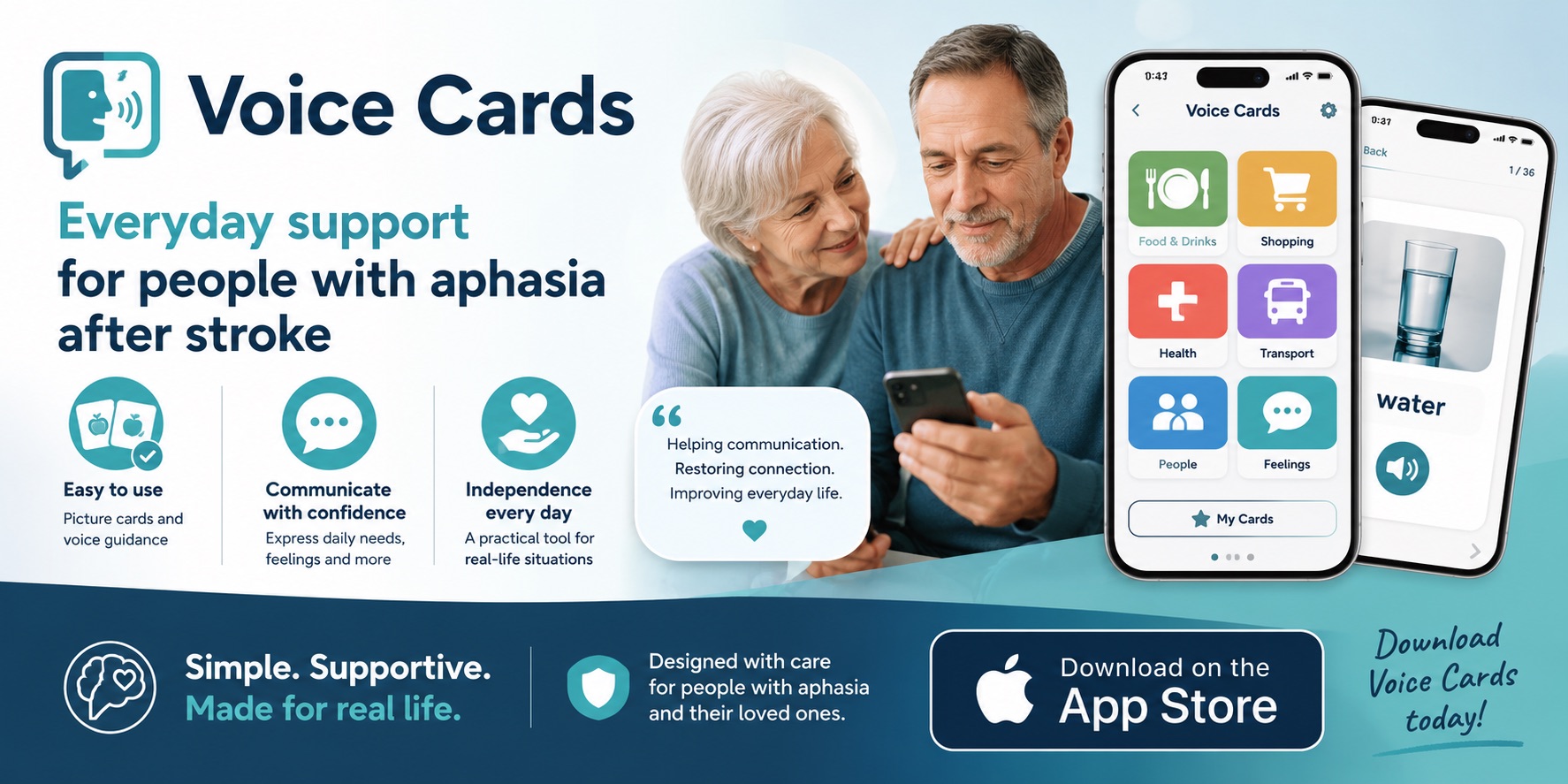
SmallDesk Voice Cards
A simple voice cards app for everyday communication. Currently available for iPhone. Android version coming soon.
This guide explains practical aphasia activities for adults that can be used at home, in therapy sessions, in care settings, or as part of daily communication practice. The activities are designed to support language, confidence, independence, and social participation. They are educational and should not replace individualized care from a licensed speech-language pathologist or another qualified healthcare professional.
What Aphasia Activities for Adults Are Really For
Aphasia activities are not only about saying words correctly. They are about helping an adult communicate more successfully in real situations. A good activity should support at least one useful goal: expressing needs, understanding information, joining conversations, making decisions, reading everyday text, writing useful messages, using gestures or pictures, repairing communication breakdowns, or rebuilding confidence.
For example, naming pictures of random objects can be useful in some therapy contexts, but naming the items in a person’s own kitchen may be more meaningful. Reading isolated sentences can help, but reading a real appointment reminder, text message, recipe, or shopping list may transfer better to daily life. Practicing conversation in a quiet room can be helpful, but practicing how to order coffee, greet a neighbor, or tell a family story can make the exercise more emotionally important.
The most effective aphasia activities for adults usually combine repetition with relevance. Repetition matters because language recovery and communication skill building require practice. Relevance matters because adults are more motivated when the activity connects to their identity, routines, relationships, interests, and personal goals.
Core Principles Before You Start
Before choosing aphasia activities, it is important to remember that aphasia does not mean a person has lost intelligence. An adult with aphasia may understand ideas, emotions, humor, preferences, and social meaning even when speech is difficult. Activities should always be respectful, age-appropriate, and based on adult interests.
“`
Use Adult Materials
Use real photographs, family pictures, recipes, maps, calendars, news headlines, bills, menus, hobby materials, sports schedules, music lyrics, travel brochures, personal objects, and everyday technology. Avoid childish images, babyish language, or activities that make the person feel treated like a child.
Keep the Task Clear
Aphasia can make language processing slower. Give one instruction at a time. Use short sentences, natural pauses, written keywords, gestures, and visual supports. A clear task is not the same as an easy or patronizing task. It simply reduces unnecessary language load so the person can focus on communication.
Allow Enough Time
Many adults with aphasia need extra time to understand, find words, organize a response, point, write, gesture, or use a communication aid. Silence can feel uncomfortable for the conversation partner, but rushing often makes communication harder. Give time before repeating, rephrasing, or offering choices.
Make Success Possible
SmallDesk Voice Cards
A simple voice cards app for everyday communication. Currently available for iPhone. Android version coming soon.
A good activity should be challenging but not humiliating. If the person becomes frustrated, simplify the task, offer a cue, switch to a different communication mode, or take a short break. Success may mean saying the word, pointing to the right picture, writing the first letter, using a gesture, confirming yes or no, or communicating the main idea in any reliable way.
Practice Multiple Ways to Communicate
Speech is only one form of communication. Adults with aphasia may also use writing, drawing, pointing, gestures, facial expression, communication books, photos, maps, calendars, phones, tablets, text-to-speech tools, or yes/no systems. Activities should encourage flexible communication rather than forcing speech only.
“`
Word-Finding and Naming Activities for Adults With Aphasia
Word-finding difficulty is one of the most common challenges in aphasia. A person may know what an object is, understand how it is used, and still be unable to say the word. Word-finding activities help strengthen access to words, improve cueing strategies, and reduce anxiety when a word does not come easily.
“`
Personal Photo Naming
Use personal photos from the person’s life. Choose pictures of family members, friends, pets, favorite places, holidays, meals, hobbies, tools, or meaningful objects. Ask the person to name what they see. If naming is difficult, offer cues in stages.
- Ask what category the word belongs to.
- Ask what the person does with it.
- Give the first sound of the word.
- Write the first letter.
- Offer two written choices.
- Ask the person to point, gesture, or describe instead.
This activity is more powerful than generic flashcards because it connects language to memory, emotion, and identity.
Object Box Activity
Place familiar adult items in a box, such as a key, spoon, wallet, glasses, remote control, phone charger, pen, watch, tea bag, small tool, recipe card, or medication organizer. Take out one item at a time and ask the person to name it, describe it, show how it is used, or match it to a written word.
For a person with more difficulty, start with pointing: “Show me the key.” For a person with milder aphasia, ask for a full sentence: “I use the key to open the front door.”
Semantic Feature Practice
Semantic feature practice helps a person think around a word. Choose one target word and ask questions about meaning. For the word “coffee,” the person might answer that it is a drink, it is hot, it is made in a cup, people drink it in the morning, it can be black or with milk, and it is found in the kitchen or café.
This can be done with spoken answers, written words, drawings, pointing, or a simple chart. The goal is not only to name the word but to strengthen the network of meaning around it.
Category Sorting
Write or print words from everyday categories: foods, clothes, tools, places, people, drinks, animals, transport, hobbies, household items, and emotions. Ask the person to sort them into groups. For a more advanced version, ask them to explain why each word belongs in a category or to add more examples.
Category sorting supports vocabulary, comprehension, reasoning, and word retrieval. It can also become a conversation activity when the categories are personal, such as “foods I like,” “places I have visited,” or “things I need for gardening.”
Opposites and Associations
Say or show a word and ask for an opposite or related word. Examples include hot and cold, up and down, morning and night, doctor and nurse, bread and butter, knife and fork, garden and flowers, music and dancing. This activity can be adapted for different levels by using pictures, written words, verbal choices, or open-ended responses.
“`
Conversation Activities for Adults With Aphasia
Conversation practice is one of the most important aphasia activities because communication is social. Adults with aphasia often want to do more than name objects. They want to share opinions, tell stories, ask questions, joke, complain, reminisce, participate in decisions, and feel included.
“`
Supported Conversation
SmallDesk Voice Cards
A simple voice cards app for everyday communication. Currently available for iPhone. Android version coming soon.
Supported conversation means helping the person communicate without taking over. Choose a simple topic and use supports such as written keywords, drawings, gestures, photos, maps, calendars, yes/no questions, and choice questions. Confirm what you understood before moving on.
For example, if the topic is dinner, write the words “home,” “restaurant,” “chicken,” “fish,” “soup,” and “salad.” Ask simple questions, point to choices, and let the person answer by speaking, pointing, gesturing, or writing. The goal is a real exchange, not a perfect sentence.
Opinion Questions
Adults with aphasia should be invited to express opinions, not only answer factual questions. Use topics that matter to the person: favorite food, sports, music, travel, family traditions, weather, movies, local news, hobbies, or daily routines.
Instead of asking only “What is this?” ask questions such as “Do you like this?”, “Which is better?”, “Would you go there again?”, “Is this important to you?”, or “What do you think?” Provide written choices or rating scales if needed.
Story Retelling With Photos
Use a family photo, holiday picture, wedding photo, birthday photo, work photo, or travel image. Ask the person to tell the story in any way they can. Support the story with written prompts: who, where, when, what happened, how you felt, and what happened next.
If speech is limited, the person can point to people in the photo, choose emotion words, write names, gesture actions, or answer yes/no questions. The activity supports memory, identity, narrative language, and emotional connection.
Role-Play Real Situations
Practice common adult situations in a safe, calm setting. Useful role-plays include ordering food, making a phone call, greeting a neighbor, asking for help in a store, checking in at a clinic, explaining a problem, asking for directions, or telling someone that more time is needed.
Write down key phrases before the role-play. Examples include “Please give me a moment,” “I have aphasia,” “Can you write that down?”, “Yes,” “No,” “I need help,” “I do not understand,” and “Please say that again.” Practicing these phrases can increase independence and reduce stress in public situations.
Conversation Repair Practice
Communication breakdowns are normal in aphasia. Instead of treating them as failures, practice repair strategies. The person can learn to pause, gesture, point, write a keyword, draw, use a similar word, show a photo, ask for choices, or say “not that” when the listener guesses incorrectly.
Conversation partners can practice saying, “Let me check if I understood,” “Are you talking about today or tomorrow?”, “Is it a person, place, or thing?”, or “Can I write down some choices?”
“`
Listening and Understanding Activities
Some adults with aphasia have difficulty understanding spoken language, especially when sentences are long, abstract, fast, or delivered in a noisy environment. Listening activities should begin with meaningful, simple information and gradually increase in complexity.
“`
Yes/No Questions With Real Information
Ask yes/no questions about personal facts, familiar objects, daily plans, or photos. Examples include “Is this your daughter?”, “Are we at home?”, “Do you want tea?”, “Is the appointment today?”, or “Is this your garden?”
Because yes/no responses can sometimes be unreliable in aphasia, confirm important answers using another method. The person can point, gesture, choose from written words, or answer the same question in a different way.
Following One-Step and Two-Step Directions
Use real objects and practical actions. Start with one-step directions such as “Point to the cup,” “Pick up the pen,” or “Touch the calendar.” Move to two-step directions such as “Pick up the spoon and put it next to the plate.”
For daily life practice, use routines such as setting the table, sorting laundry, organizing a drawer, watering plants, or preparing a simple snack. These activities connect comprehension to useful action.
Keyword Listening
Say a short sentence and ask the person to identify the key word. For example, “The doctor appointment is on Monday,” then ask the person to point to “doctor” or “Monday” from written options. This helps with understanding important information even when the full sentence is difficult.
Listening to Short Audio Clips
Use short, clear audio clips such as a voicemail, weather report, family message, or simple news summary. After listening, ask supported questions. Keep the clip short and replay it as needed. Written keywords can help the person follow the main idea.
“`
Reading Activities for Aphasia
Reading can be affected in aphasia even when vision is normal. Some adults can read single words but struggle with paragraphs. Others understand written information better than spoken language. Reading activities should be practical, adult, and connected to daily needs.
“`
Matching Words to Pictures
Use pictures of familiar objects, people, places, foods, or activities. Ask the person to match a written word to the correct picture. Start with two choices and increase to more choices as accuracy improves.
Reading Functional Text
Practice with real-life text: menus, shopping lists, appointment cards, medication labels, greeting cards, text messages, signs, recipes, bills, calendars, emails, and short instructions. Ask the person to find specific information, such as the date, time, price, name, address, or main idea.
Sentence Completion
Write simple adult sentences with one missing word. Examples include “I drink coffee in the ___,” “The appointment is on ___,” or “Please call me at ___.” Offer written choices if needed. This supports reading comprehension, prediction, and word retrieval.
Repeated Reading
Choose a short passage that matters to the person, such as a favorite quote, prayer, poem, song lyric, recipe step, family message, or short news paragraph. Read it several times over multiple days. The person may read silently, read aloud, point to key words, or listen while following the text.
“`
Writing Activities for Aphasia
Writing difficulties can range from trouble spelling single words to difficulty writing full messages. Writing activities should focus on useful communication rather than perfect handwriting or grammar.
“`
Copy and Complete
Write a useful phrase and ask the person to copy it. Then leave out one part for them to complete. Examples include “My name is ___,” “I live in ___,” “Please call ___,” “I need help with ___,” or “My appointment is at ___.”
Personal Word Book
Create a personal word book with names, places, favorite foods, important phone numbers, hobbies, medical words, family relationships, and common phrases. The person can practice reading, copying, pointing to, or saying these words. A personal word book can also become a communication aid.
Text Message Practice
Practice short, realistic messages. Examples include “I am home,” “Please call me,” “Thank you,” “I need a ride,” “I am running late,” or “See you tomorrow.” The person may type, use predictive text, choose from saved phrases, dictate if possible, or copy from a prepared list.
Writing From Pictures
Show a photo and ask the person to write one word, then a phrase, then a sentence if appropriate. A family photo might lead to “daughter,” then “my daughter,” then “My daughter visited on Sunday.” The task can be adjusted to the person’s level.
“`
Daily Life Aphasia Activities
The most useful aphasia activities often happen during ordinary daily routines. These activities help language practice feel natural rather than separate from life.
“`
Meal Planning
Use pictures, recipes, food packages, shopping lists, and menus. Ask the person to choose meals, name ingredients, sort foods by category, read recipe steps, answer yes/no questions, or write a short shopping list. Meal planning supports naming, reading, decision-making, sequencing, and conversation.
Calendar Practice
SmallDesk Voice Cards
A simple voice cards app for everyday communication. Currently available for iPhone. Android version coming soon.
Use a real calendar to discuss today, tomorrow, appointments, birthdays, therapy sessions, family visits, and weekly routines. Ask the person to point to dates, read times, match events to days, or say what is happening next. Calendar work supports orientation, comprehension, reading, and independence.
Money and Shopping Practice
Use coins, bills, receipts, product pictures, or online shopping pages. Practice reading prices, choosing items, asking for help, comparing options, and saying or pointing to payment choices. This can help with real-world participation and confidence.
Hobby-Based Practice
Build activities around the person’s interests. A gardener can name tools, read seed packets, follow planting steps, and talk about favorite flowers. A sports fan can read scores, discuss teams, name players, and predict results. A music lover can choose songs, read lyrics, discuss memories, and sing familiar lines. A cook can read recipes, name ingredients, and explain family dishes.
Community Practice
When the person is ready, practice communication outside the home. Start with predictable situations such as ordering one familiar drink, greeting a cashier, asking for a table, checking in for an appointment, or using a prepared card that explains aphasia. Community practice should be supportive, not overwhelming.
“`
Technology-Based Aphasia Activities
Technology can support aphasia practice, but it should be chosen carefully. The best tool is the one the person can actually use and wants to use. A simple phone photo album, notes app, calendar, voice assistant, or saved phrase list may be more helpful than a complicated app.
“`
Photo Albums for Communication
Create phone albums for family, places, foods, medical information, favorite activities, and important routines. During conversation, the person can show a photo instead of searching for a word. Photos can also be used for naming, storytelling, and choice-making.
Saved Phrases
Save useful phrases in a notes app or communication app. Examples include “I have aphasia,” “Please give me time,” “Can you write it down?”, “I need help,” “I understand more than I can say,” and “Please ask yes or no questions.” Practicing these phrases can help in public and medical situations.
Voice Assistants and Accessibility Features
Some adults with aphasia benefit from phone accessibility features such as larger text, text-to-speech, speech-to-text, reminders, picture-based contacts, or voice commands. These tools should be introduced slowly and practiced in meaningful routines.
Video Calls With Support
Video calls can help adults with aphasia stay socially connected, especially when travel is difficult. Prepare written keywords before the call, keep the call short at first, reduce background noise, and ask family members to give time, use gestures, and confirm understanding.
“`
Activities for Adults With Severe Aphasia
Severe aphasia can make speaking and understanding very difficult, but communication is still possible. Activities should focus on reliable yes/no responses, choices, gestures, pointing, pictures, emotional expression, and participation in meaningful routines.
“`
Reliable Yes/No Practice
Work with a speech-language pathologist when possible to establish the most reliable yes/no method. This may be spoken “yes” or “no,” thumbs up or down, pointing to written words, eye gaze, head movement, or another consistent signal. Practice with obvious questions first, then personal questions, then daily choices.
Choice Boards
Create simple boards with pictures or written words for common needs: food, drink, pain, bathroom, rest, family, TV, music, outside, phone, doctor, and emotions. The person can point to communicate. Keep the board uncluttered and update it based on real needs.
Gesture Practice
Practice gestures for common messages such as drink, eat, sleep, phone, bathroom, pain, hot, cold, stop, more, yes, no, good, bad, and help. Gestures can reduce frustration when speech is limited.
Music and Familiar Phrases
Some adults with aphasia may be able to sing or complete familiar phrases more easily than produce spontaneous speech. Try familiar songs, prayers, greetings, counting, days of the week, or common expressions. Keep the activity relaxed and stop if it becomes frustrating.
Participation Without Pressure
Severe aphasia activities should not turn every moment into a test. Invite the person into real life: choosing music, looking at family photos, sitting outside, helping with simple routines, watching a favorite show, or joining a family meal with supported communication.
“`
Activities for Adults With Mild Aphasia
Mild aphasia can be easy for others to miss, but it can still affect work, relationships, confidence, reading, writing, phone calls, fast conversations, humor, complex ideas, and fatigue. Activities for mild aphasia should focus on higher-level communication and real-life demands.
“`
Summarizing News or Articles
Choose a short article, headline, or video clip. Ask the person to summarize the main idea, give an opinion, explain what happened, or discuss why it matters. This supports comprehension, word retrieval, organization, and conversation.
Debate and Opinion Practice
Discuss adult topics such as travel, food, sports, technology, family decisions, books, films, or current events. Encourage the person to explain reasons, compare options, and ask follow-up questions. Written keywords can help organize thoughts.
Workplace Communication Practice
If the person wants to return to work or volunteering, practice relevant tasks such as writing emails, reading instructions, making calls, explaining a problem, preparing a short presentation, joining a meeting, or using scripts for common conversations.
Phone Call Practice
Phone calls can be difficult because there are no facial expressions, gestures, or written cues. Practice short calls with familiar people. Prepare a script, key words, and repair phrases. Start with predictable calls and gradually increase complexity.
Fatigue Management
Language may become harder when the person is tired, stressed, ill, rushed, or in a noisy environment. Mild aphasia activities should include strategies for planning breaks, asking for written information, reducing noise, and choosing the best time of day for demanding communication.
“`
How Family Members Can Help With Aphasia Activities
Family members, friends, and caregivers play a major role in aphasia recovery and participation. The goal is not to become a therapist, but to become a better communication partner.
“`
Speak Naturally, But Clearly
Use adult language, a respectful tone, and natural facial expression. Speak a little slower if needed, but do not shout unless the person also has hearing loss. Use short sentences and pause between ideas.
Reduce Distractions
Turn off the television, reduce background noise, face the person, and make sure glasses or hearing aids are used if needed. A quiet environment can make a major difference.
Write Down Keywords
Writing one or two key words can help the person follow the topic. For example, during a medical conversation, write “doctor,” “Tuesday,” “10:30,” and “blood test.” Written keywords can support understanding and memory.
Offer Choices Without Overwhelming
Instead of asking an open question that may be too hard, offer two or three clear choices. For example, ask “Tea or coffee?” while showing the items or written words. For important decisions, confirm the answer in more than one way.
Do Not Finish Every Sentence
It can be tempting to finish the person’s sentences, but doing this too often can reduce independence and confidence. Wait first. If the person appears stuck, ask whether they want help. Then offer a cue, written choice, or first sound.
Include the Person in Conversations
Do not talk about the person as if they are not present. Ask for their opinion. Give them time. Use supports. Aphasia can be isolating, and inclusion is part of communication recovery.
“`
A Simple Weekly Aphasia Activity Plan
Aphasia practice does not need to be long to be useful. Short, consistent, meaningful practice is often easier to maintain than occasional long sessions. The plan below can be adjusted based on the person’s energy, goals, and speech-language therapy recommendations.
“`
| Day | Main Activity | Communication Goal |
|---|---|---|
| Monday | Name and describe personal photos | Word-finding, storytelling, family connection |
| Tuesday | Read a menu or recipe | Reading comprehension, choice-making, daily independence |
| Wednesday | Practice supported conversation about a hobby | Conversation, opinions, confidence |
| Thursday | Write or type short useful messages | Functional writing, texting, independence |
| Friday | Role-play a real situation | Community communication, repair strategies |
| Saturday | Use music, photos, or a favorite film clip | Engagement, memory, emotional expression |
| Sunday | Review the week and plan next week | Calendar use, sequencing, personal goals |
A 20-Minute Home Practice Session
A simple session might begin with five minutes of warm-up using familiar greetings, names, or automatic phrases. The next ten minutes can focus on one main activity, such as naming kitchen items, reading a short message, or practicing a conversation script. The final five minutes can be used for a real-life communication task, such as choosing dinner, sending a text, reviewing the calendar, or calling a family member with support.
Practice should stop before the person becomes exhausted. Aphasia work can be mentally tiring. A shorter successful session is usually better than a long frustrating one.
“`
How to Choose the Right Aphasia Activity
The right activity depends on the person’s type of aphasia, severity, interests, goals, fatigue level, emotional state, and daily communication needs. A person who wants to return to work may need email, phone, and meeting practice. A person who feels isolated may benefit most from supported conversation and community activities. A person with severe aphasia may need reliable yes/no systems, picture choices, and communication partner support.
When choosing activities, ask what communication situations matter most. Is the person trying to talk with grandchildren, order food, manage appointments, read messages, join social events, return to work, or express pain and needs? The answer should guide the activity plan.
Common Mistakes to Avoid
One common mistake is using materials that feel childish. Adults with aphasia need adult topics, adult respect, and activities connected to real life. Another mistake is making every interaction a test. Constant correction can make communication stressful. Practice is important, but so are natural conversation, humor, rest, and emotional connection.
It is also important not to assume that speech is the only goal. If a person communicates successfully by pointing, writing, drawing, gesturing, or using a device, that is real communication. The purpose of aphasia activities is not perfection. The purpose is connection, independence, participation, and quality of life.
FAQ About Aphasia Activities for Adults
“`
What are the best aphasia activities for adults?
The best aphasia activities for adults are meaningful, practical, and connected to daily life. Useful examples include naming personal photos, practicing supported conversation, reading menus or messages, writing short texts, using calendars, role-playing real situations, sorting words by category, and using gestures, pictures, or technology to support communication.
Can aphasia improve with activities at home?
Home activities can support communication practice, confidence, and daily participation, especially when they are consistent and matched to the person’s needs. However, aphasia is different for every person, and a licensed speech-language pathologist can help create a safer and more effective plan.
How long should adults practice aphasia activities?
Many adults do better with short, regular practice rather than long exhausting sessions. A 15- to 30-minute session may be enough for some people, while others may tolerate more or less. Fatigue, frustration, attention, and motivation should guide the length of practice.
What activities help with word-finding in aphasia?
Word-finding activities include naming familiar objects, describing word features, sorting words into categories, completing sentences, using first-letter cues, practicing opposites and associations, and talking about personal photos. The most useful words are often names, places, objects, foods, hobbies, and phrases the person actually needs.
Are worksheets good for adult aphasia practice?
Worksheets can be useful when they are adult, relevant, and matched to the person’s level. However, real-life materials such as photos, calendars, recipes, menus, text messages, maps, and personal word books are often more meaningful and easier to transfer into daily communication.
How can family members communicate better with someone who has aphasia?
Family members can help by speaking clearly, giving extra time, reducing background noise, writing down key words, using gestures and pictures, asking yes/no or choice questions, confirming understanding, and including the person in adult conversations. Patience and respect are essential.
What should you avoid when doing aphasia activities?
Avoid rushing, shouting, using childish materials, correcting every error, pretending to understand, ignoring the person, or making every conversation feel like a test. It is better to support successful communication in multiple ways than to demand perfect speech.
Can technology help adults with aphasia?
Yes, technology can help when it is simple and relevant. Useful tools may include photo albums, notes apps, saved phrases, calendars, reminders, text-to-speech, speech-to-text, communication apps, video calls, and accessibility settings. The best technology is the one the person can use comfortably in real situations.
“`
Final Thoughts
Aphasia activities for adults should support more than language drills. They should help a person communicate needs, share opinions, tell stories, make choices, understand information, stay socially connected, and participate in daily life. The most helpful activities are respectful, personalized, flexible, and built around real communication.
Whether the activity involves naming family photos, reading a menu, practicing a phone call, using a communication board, writing a text message, singing a familiar song, or talking about a favorite hobby, the goal is the same: helping the person with aphasia be heard, understood, and included.
Further Reading