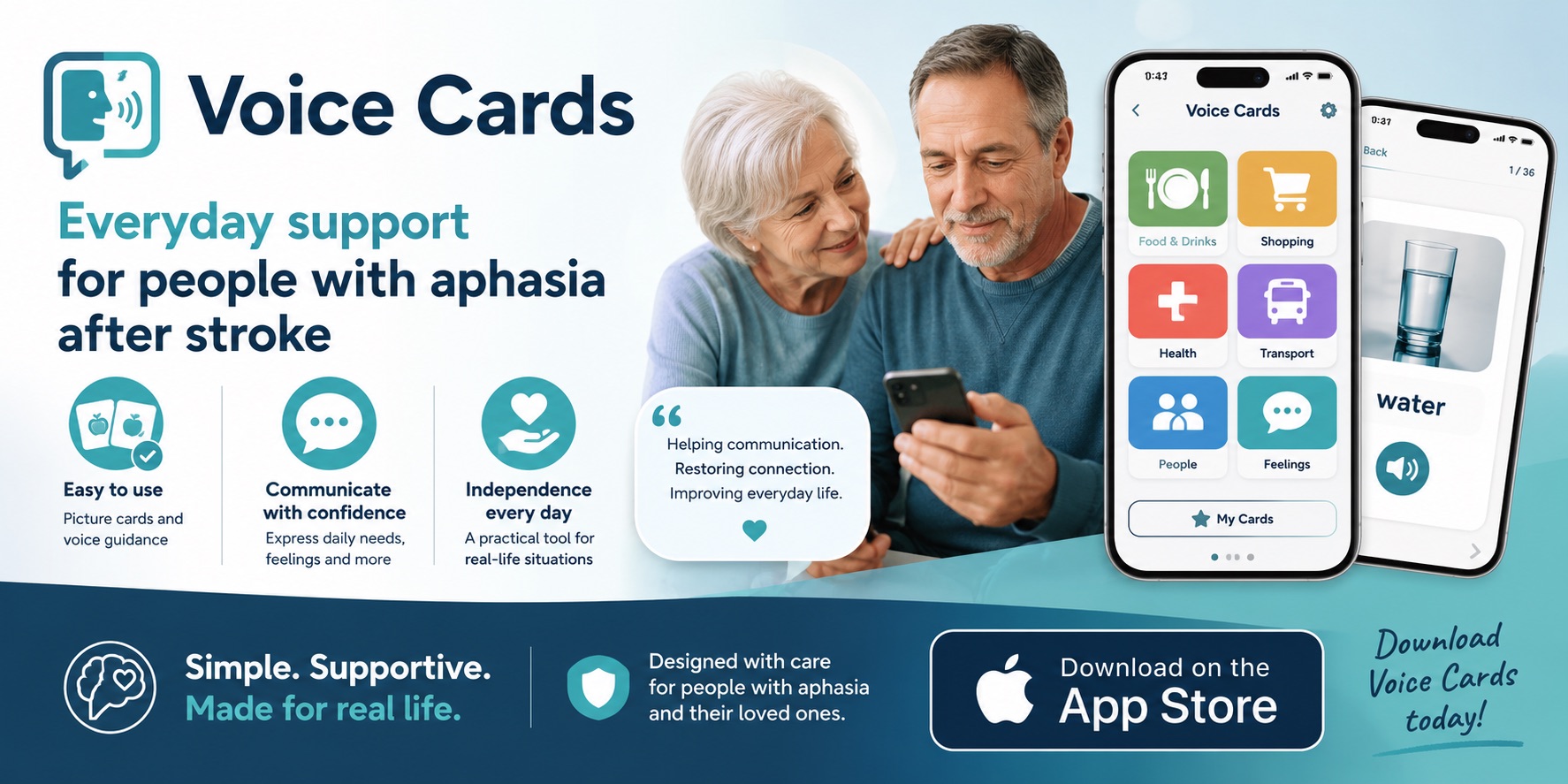
Quick answer: progress with aphasia is not only about saying more words correctly. A useful goal is being able to take part in the conversations and activities that matter: ordering coffee, talking with family, making an appointment, joining a group, handling a phone call, or explaining a need when a word will not come. Recent aphasia research is increasingly looking at communication in real-life settings, not only performance on clinic-based language tasks.
Why real-life participation deserves its own goal
Aphasia can affect speaking, understanding, reading, and writing in different combinations. Two people can have a similar difficulty on a language test and still experience everyday life very differently. One may confidently use gestures and a phone note to order food but avoid group conversations. Another may speak in full sentences at home yet struggle when a receptionist asks several questions quickly.
A 2026 study published in the American Journal of Speech-Language Pathology examined real-world, at-home communication and daily activity participation in people with aphasia and age-matched adults without brain injury. The research reflects an important practical idea: the impact of aphasia is tied to what happens in ordinary life, not only to isolated language performance. Earlier work on life participation in aphasia has likewise emphasized meaningful communication goals chosen with the person, rather than goals defined only by impairment scores.
This does not mean word-finding, naming, reading, or sentence practice is unimportant. It means those skills are most useful when they connect to a real purpose. “I want to be able to call my daughter,” “I want to order my own lunch,” or “I want to participate in my book club” can be more actionable than a vague goal such as “improve communication.”
Start with a real-life communication audit
Instead of asking only, “What words are difficult?”, list the situations that occur during a normal week. For each one, note what works, what causes trouble, and what fallback method could help.
| Situation | Possible barrier | Useful fallback |
|---|---|---|
| Phone call | No visual cues; speech may feel rushed | Prepared script, speakerphone with a trusted partner, text or secure messaging when available |
| Medical appointment | Long questions, unfamiliar vocabulary | Written keywords, yes/no choices, extra response time, list of priorities |
| Shop or restaurant | Pressure from a queue or background noise | Photo, pointing, short written phrase, saved order on a phone |
| Family gathering | Several people speaking at once | One speaker at a time, quieter seat, smaller side conversations |
| Travel | Unexpected questions and time pressure | Destination written down, map, identification/communication card |
The goal is not to eliminate every difficult moment. It is to give the person more than one route to successful communication. Speech can be one route; writing, drawing, gesture, pointing, photos, maps, and communication boards can be others.
Build a three-part communication kit
1. A short “how I communicate” card
A pocket card or phone screen can briefly explain that the person has aphasia and may need extra time. It can also say what helps, such as “Please ask one question at a time,” “Yes/no choices help,” or “I understand more than I can say.” Keep it short enough that another person can read it in seconds.
2. Personal keywords and pictures
Generic communication boards can help, but personal information is often more useful. Include names of important people, common destinations, medications or health contacts if the person wants them included, favorite places, transportation options, and frequent requests. A photo of a family member or a screenshot of a destination can be faster than searching for the perfect word.
3. A fallback ladder
Agree on what to try when speech stalls. For example: pause → gesture → give a first-letter cue if that is helpful → offer two choices → write a keyword → use a photo. The order should be based on the person’s preferences. The purpose is to preserve autonomy, not to take over the conversation.
What conversation partners can do
A supportive partner can make communication easier without speaking for the person. The American Speech-Language-Hearing Association recommends practical strategies such as getting the person’s attention before speaking, reducing competing noise, using a natural adult tone, and giving adequate time to respond.
- Slow the interaction, not necessarily every word. Use shorter chunks and pause between ideas.
- Ask one thing at a time. A sequence of three questions can be much harder than three separate questions.
- Confirm the message. “You mean Tuesday afternoon, right?” can prevent an incorrect assumption.
- Use choices when open questions get stuck. “Coffee or tea?” may be easier than “What do you want?”
- Keep the person in the conversation. Direct questions to them rather than automatically addressing the family member beside them.
- Do not treat slower language as slower thinking. Aphasia affects language; it does not automatically indicate reduced intelligence.
Measure progress by what became possible
Useful progress can be small and specific. Keep a list of activities that were previously avoided or required full assistance and note when they become easier. Examples include independently ordering a meal, contributing one idea in a group conversation, completing a familiar purchase, sending a meaningful text, or attending a community activity for longer.
A simple rating can help: 0 = unable even with support, 1 = possible with substantial support, 2 = possible with some support, 3 = mostly independent. Revisit the same situations every few weeks. This is not a clinical assessment; it is a practical way to notice whether daily participation is changing.
It can also reveal that the barrier is environmental rather than purely linguistic. A person may communicate well in a quiet room but struggle in a noisy café. The solution might therefore be a quieter table, a different time of day, written backup, or a conversation partner strategy rather than simply “more practice.”
When to involve a speech-language pathologist
A speech-language pathologist (SLP) can help identify strengths, communication barriers, and strategies that match the individual person. Participation goals can be incorporated into therapy alongside work on language skills. If communication has suddenly changed or new neurological symptoms appear, seek urgent medical evaluation rather than treating the change as a routine aphasia issue.
This article is for general education and is not individual medical or speech-language therapy advice.
Frequently asked questions
Does successful communication have to be spoken?
No. A successful message can use speech, writing, gesture, drawing, pictures, a communication board, or several methods together. The practical question is whether the person can express or understand what matters in that situation.
Should family members finish sentences?
Ask the person what they prefer. Some people appreciate a cue after a pause; others find sentence-completion frustrating. A useful habit is to wait first and then ask whether help is wanted.
Are yes/no questions always best?
They can reduce language load, but they should not replace opportunities to express preferences. When possible, combine yes/no confirmation with choices, gesture, written keywords, and time for the person to add information.
Can a communication card help outside the home?
Yes. It can be useful in shops, transport, appointments, emergency situations, and any unfamiliar interaction where there is little time to explain aphasia.
Sources and further reading
- American Journal of Speech-Language Pathology: real-world communication, daily activities, and quality of life in aphasia
- ASHA Practice Portal: Aphasia
- ASHA: Collaborative Goals for Communicative Life Participation in Aphasia
- Aphasia.com: downloadable communication resources
See more practical aphasia resources on AphasiaGuide.com.