Fatigue can make aphasia feel noticeably worse even when the person’s underlying language abilities have not suddenly changed. A conversation that is manageable in the morning may become much harder later in the day because speaking, understanding, reading and writing can require sustained concentration, self-monitoring and repeated attempts to repair communication.
Fatigue after stroke is common, and emerging research is paying more attention to how it interacts specifically with aphasia. A 2026 study in Archives of Physical Medicine and Rehabilitation reported that post-stroke fatigue in people with aphasia is both prevalent and understudied, and found a relationship between self-reported fatigue and aphasia severity. The practical message is not that every difficult conversation is caused by fatigue. It is that energy level can be an important part of the communication picture.
This article is educational and does not diagnose fatigue, stroke complications or any individual communication condition. New, sudden or unexplained changes in communication or alertness require appropriate medical assessment.
What does “aphasia fatigue” mean?
There is no single symptom called aphasia fatigue. The phrase is useful for describing the way tiredness can reduce a person’s available capacity for language tasks. Aphasia itself is an acquired language disorder that may affect speaking, understanding, reading and writing. When the brain has to work harder to retrieve a word, follow a sentence or formulate a response, a long conversation can demand more effort than it did before aphasia.
That effort may be invisible. A person can look physically comfortable while internally working through several stages: recognizing the topic, processing the other person’s words, holding information in mind, finding the intended words, checking whether the answer sounds right and repairing it if it does not.
Why conversation can become more difficult when energy drops
Everyday conversation is fast. It combines language with attention, turn-taking, memory, social cues and decision-making. Aphasia can make one or more of those language steps less automatic. Fatigue can then reduce the amount of mental energy available for compensating.
- Word-finding pauses may become longer.
- The person may need more repetitions.
- Long sentences may be harder to follow.
- Reading a message may take several attempts.
- Writing may contain more omissions or substitutions.
- Noise and several people talking at once may become much harder to manage.
- The person may stop trying to repair every misunderstanding because the effort is too high.
None of these signs proves that fatigue is the cause. They are patterns to notice. If performance changes with time of day, sleep, illness, stress or the length of an activity, energy may be one factor worth discussing with the person and their clinical team.
Fatigue does not mean loss of intelligence or interest
A short answer late in the day can easily be misread as lack of interest. A person may also withdraw from a group conversation because keeping up has become exhausting, not because they do not want company. This distinction matters socially. Communication partners often see only the final response, while the person with aphasia experiences the work required to produce it.
It is therefore useful to separate communication capacity at that moment from assumptions about intelligence, personality, motivation or understanding.
Look for a pattern rather than one difficult moment
A simple way to understand the role of fatigue is to compare situations. For a week or two, note when communication feels easiest and hardest. The aim is not to create a medical score. It is to find practical patterns.
| Situation | What to notice | Possible adjustment |
|---|---|---|
| Morning vs evening | Word finding, comprehension, speed | Schedule demanding conversations at the stronger time |
| One-to-one vs group | Interruptions, missed turns, overload | Reduce the number of simultaneous speakers |
| Quiet vs noisy room | Need for repetition | Move to a quieter environment |
| Short vs long conversation | Errors increasing over time | Use breaks or split the discussion |
| Spoken vs written support | Whether keywords or choices help | Add writing, pictures or gestures |
Plan important communication around energy, not convenience alone
If a person consistently communicates more effectively at a particular time, that can influence when to discuss appointments, finances, travel, family decisions or other complex topics. A ten-minute conversation at the person’s best time may be more successful than a forty-minute conversation when they are already tired.
It can also help to separate information from decision-making. For example, send or show a short written summary first, allow time to process it, then discuss the choice later. This reduces the pressure to understand, remember and respond to everything at once.
Use more than speech when speech is expensive
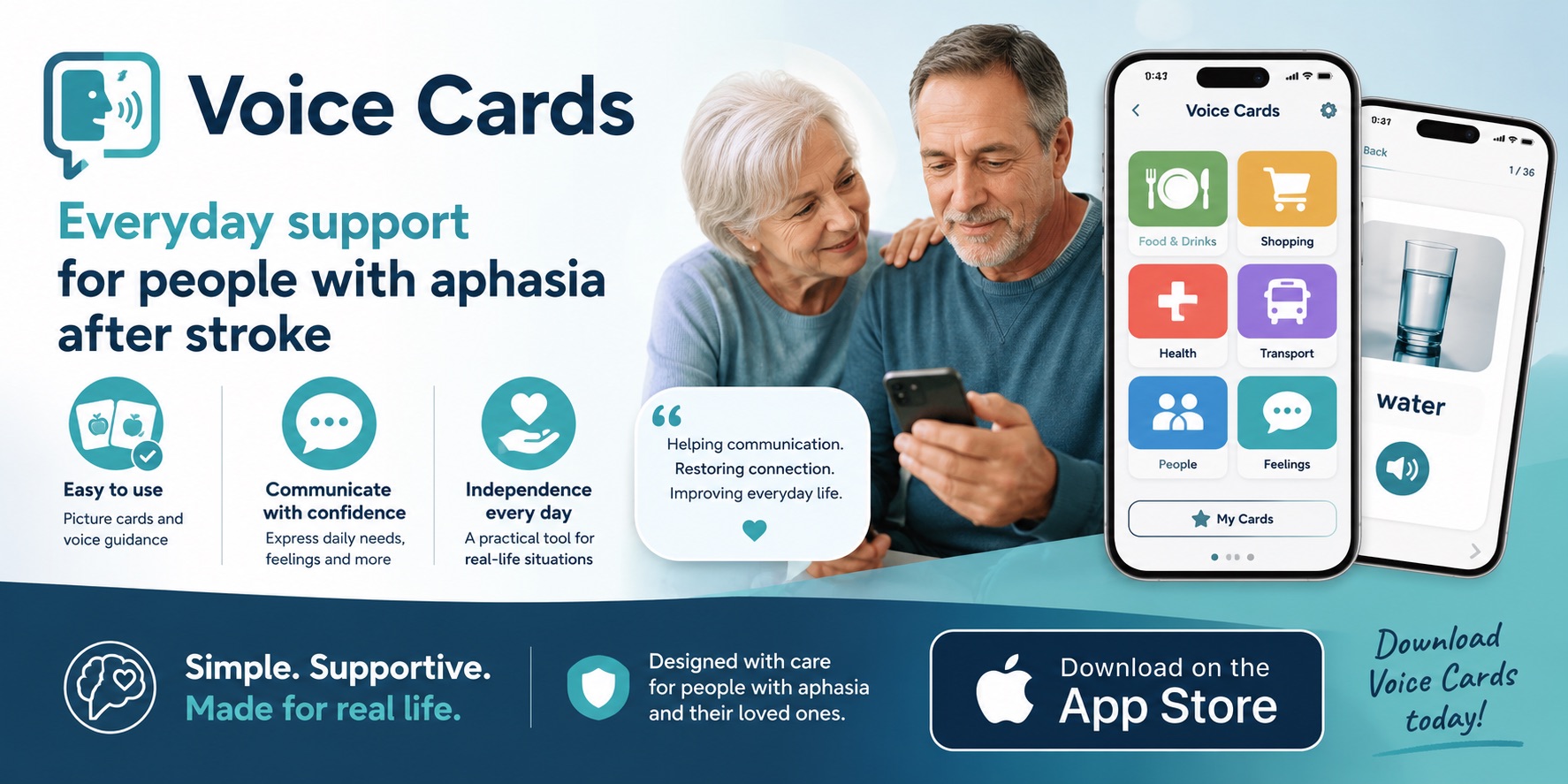
Augmentative and alternative communication does not have to mean a dedicated electronic device. The National Aphasia Association describes AAC broadly: gestures, writing, drawing, photographs, keywords, communication books and apps can all support expression and understanding.
When fatigue is high, these supports can reduce the amount of spoken language needed. A person might point to a written choice instead of constructing a full sentence, show a photograph, type one key word, or use a familiar communication card.
The goal is not to replace speech. The goal is successful communication.
Five practical changes for a tiring conversation
- Reduce speed. Leave enough time for the person to process and respond without filling every pause.
- Reduce competing information. One topic and one speaker are often easier than several simultaneous threads.
- Use short written keywords. Names, times, prices and choices can be easier to revisit when visible.
- Offer a break before communication fails completely. Stopping for ten minutes can be more productive than pushing through another half hour.
- Confirm the important part. For a decision, appointment or instruction, check the final meaning rather than judging success by fluency.
When fatigue deserves clinical attention
Persistent or severe fatigue can have many causes, including sleep problems, pain, mood changes, medication effects and other medical issues. A person with aphasia may also find it difficult to describe fatigue precisely. If tiredness is new, worsening, limiting daily activity or accompanied by other changes, it is reasonable to raise it with the relevant healthcare professional rather than assuming it is simply part of aphasia.
A sudden new change in speech, understanding, weakness, facial movement, vision, balance or alertness should not be treated as ordinary fatigue.
A useful communication principle
Do not measure a person’s language ability from their most exhausted moment. Aphasia can fluctuate with context, and energy is one part of that context. Better timing, fewer distractions, shorter exchanges and access to multiple communication methods can reveal abilities that are difficult to see during a long, pressured conversation.
References
- American Speech-Language-Hearing Association: Aphasia Practice Portal
- Archives of Physical Medicine and Rehabilitation: post-stroke fatigue and aphasia severity, 2026
- National Aphasia Association: AAC for Aphasia — It’s More Than a Device