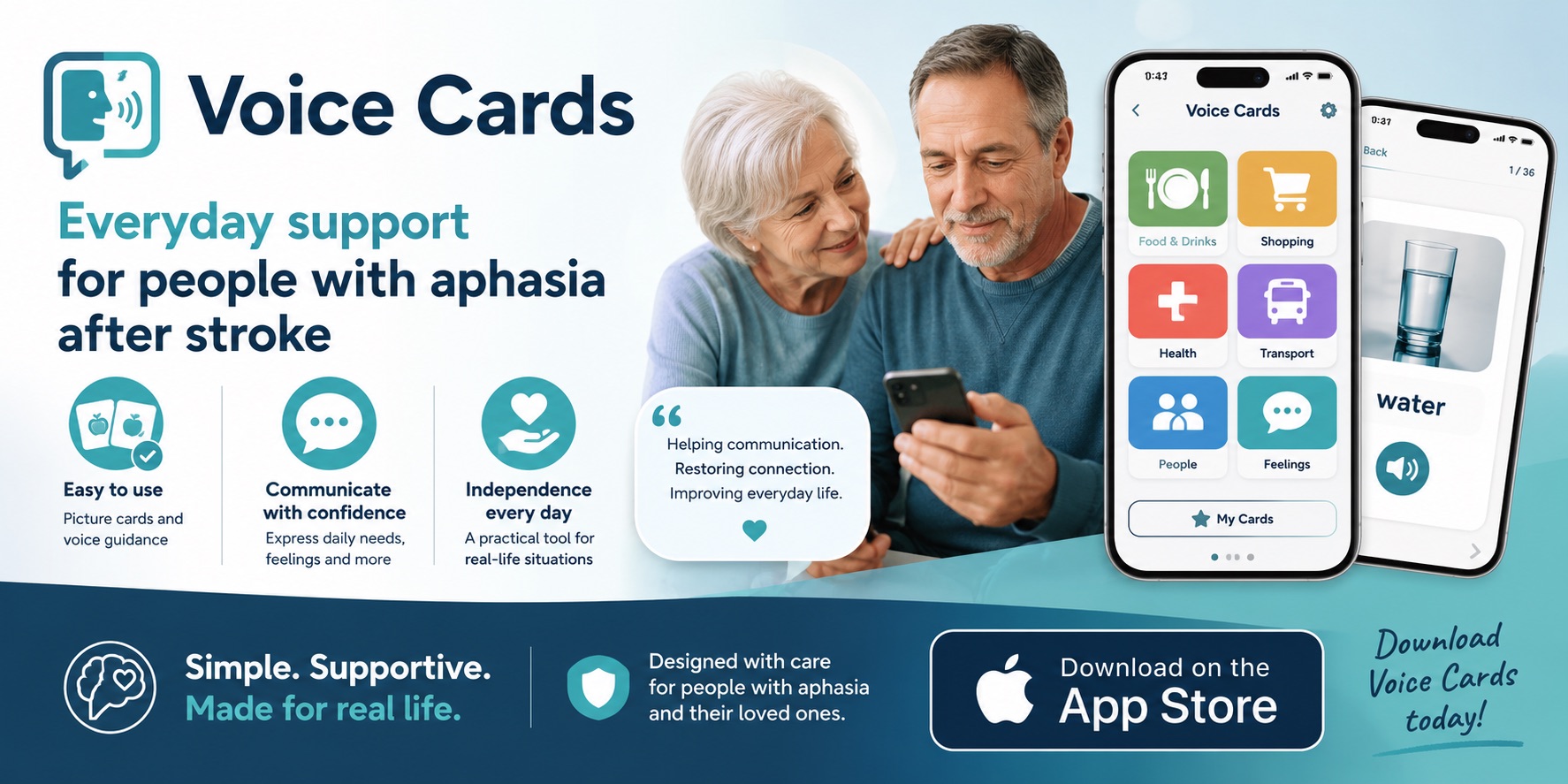
Apps for aphasia can help make everyday communication calmer, simpler and more comfortable when speaking is difficult. A good communication app does not need to feel complicated, clinical or overwhelming. In everyday life, the most useful tool is often the one that helps a person quickly show a message, tap a phrase, answer a simple question or let the iPhone speak a short sentence aloud.
This guide explains how simple communication apps can support daily conversation at home, with family, outside the home and in ordinary social situations. It focuses on practical communication support, not medical treatment. As a clear example, this article presents SmallDesk Voice Cards, a simple voice cards app currently available for iPhone. The Android version is coming soon.

SmallDesk Voice Cards
A simple voice cards app for everyday communication. Currently available for iPhone. Android version coming soon.
What are apps for aphasia?
Apps for aphasia are digital communication tools that can help a person express simple messages when speaking is hard. They may use short phrases, large buttons, custom cards, typed text or voice output. The purpose is simple: to make communication easier in real moments, especially when finding the right words takes time or when speaking aloud feels difficult.
For everyday use, the best communication app is usually not the most advanced one. It is the one that is easy to open, easy to read and easy to understand. A person should be able to tap a card and communicate something useful without moving through confusing menus. In daily life, short phrases such as “Please wait”, “I need water”, “I do not understand”, “Please speak slowly” or “I need help” can make a big difference.
Why simple communication tools can be useful in everyday life
Everyday communication is made from small moments. A person may want to answer yes or no, ask for help, choose between two options, greet a visitor, say that they are tired, ask someone to repeat something or explain that speaking is difficult right now. These are not complicated messages, but they can be very important.
A simple communication app can reduce pressure because the person does not have to produce every word aloud. Instead, they can use a prepared card, show the screen or let the phone speak the message. This can also help family members, friends and caregivers understand more quickly without guessing or asking too many questions at once.
SmallDesk Voice Cards as a simple aphasia communication app
SmallDesk Voice Cards is designed as a simple everyday communication tool for iPhone. It helps users create and use voice cards with useful phrases that can be shown on screen or spoken aloud by the iPhone. This can be helpful when a person knows what they want to communicate but cannot say it comfortably in that moment.
The app is based on a practical idea: create clear cards, tap a phrase and let the phone help share the message. This makes it suitable for everyday situations such as home routines, family conversations, going outside, asking for help, expressing basic needs or using prepared phrases when conversation becomes difficult.
SmallDesk Voice Cards is currently available for iPhone. The Android version is planned and will be available soon.
Useful features in an aphasia communication app
A good app for aphasia should support communication without making the person feel tested, rushed or overwhelmed. The interface should be clear, the buttons should be large and the messages should be easy to find. The app should help the person communicate faster, not create another barrier.
Large and clear voice cards
Large cards can make a communication app easier to use. When buttons are clear and simple, the person does not need to search through small menus or crowded screens. This is especially important when communication needs to happen quickly or when the person is tired.
Short everyday phrases
Short phrases are often more useful than long sentences. A phrase such as “Please repeat” or “I need a quiet place” can communicate the most important message quickly. The goal is not to create perfect conversation. The goal is to make the next step easier.
Voice output
Voice output can help when showing the screen is not enough. If the iPhone can speak the selected phrase aloud, another person can hear the message clearly. This can be useful at home, in a shop, during a visit or in any situation where a spoken message is easier to understand than a displayed one.
Custom cards
Custom cards are important because real communication is personal. A person may need cards with names, favorite foods, daily routines, common places, personal needs or familiar phrases. The more closely the app matches real life, the more useful it can become.
Simple yes and no answers
Yes and no cards may look basic, but they can be very helpful. They allow a person to answer quickly, make choices and stay involved in conversation. They can also help family members ask clearer, simpler questions.
How SmallDesk Voice Cards can help at home
At home, communication often depends on small practical messages. A person may want to say that they need water, want to rest, feel cold, need help, do not understand something or want someone to wait. These messages are ordinary, but they matter because they help the person stay involved in daily life.
SmallDesk Voice Cards can be used to prepare cards for common home situations. For example, cards can be created for daily needs, comfort, meals, rest, family names, simple answers and personal preferences. When the person needs to communicate, they can tap the card instead of struggling to say the words aloud.
How a voice cards app can help with family and friends
Conversations with family and friends can sometimes move too fast. People may ask several questions at once or finish sentences too quickly. A simple communication app can help slow things down in a respectful way. A person can use a card to say “Please speak slowly”, “Give me a moment” or “Please repeat”.
This can make conversations calmer. Instead of guessing, family members can wait for the person to choose a card or show a message. The app becomes a shared communication support tool, not a replacement for natural conversation.
Try SmallDesk Voice Cards on iPhone
SmallDesk Voice Cards helps users create simple voice cards, tap useful phrases and let the iPhone speak the message aloud. It is designed for everyday communication moments when speaking is difficult.
Currently available for iPhone. Android version coming soon.
View SmallDesk Voice Cards on the App Store
How an aphasia communication app can help outside the home
Outside the home, simple communication support can be especially useful. In a shop, café, car, park or public place, a person may need to ask for help, show a basic need, explain that speaking is difficult or choose between options. Having prepared cards on an iPhone can make these situations easier.
A voice card can be used to say something direct and clear. For example, it can help the person ask someone to wait, repeat, speak slowly or help with a simple task. This kind of practical communication support can make everyday activities feel less stressful.
Examples of useful voice card phrases
The most useful cards are often simple, direct and personal. A person using SmallDesk Voice Cards may create phrases such as:
- I cannot speak right now.
- Please wait.
- Please repeat.
- Please speak slowly.
- I do not understand.
- I need water.
- I need help.
- I am tired.
- I need a quiet place.
- Yes.
- No.
These phrases are not complicated, but they can be very useful. In many situations, a short phrase is enough to reduce confusion and help the other person understand what is needed.
Why customization matters
No two people communicate in exactly the same way. A useful communication app should allow personal phrases because real life is personal. A person may want cards for family members, favorite drinks, daily routines, feelings, familiar places or common situations.
Customization can also make the app feel more familiar. Instead of using only general phrases, the person can use words and messages that match their own life. This can make the app easier to accept and more useful in daily communication.
Apps for aphasia and AAC in simple words
Some people search for AAC apps for aphasia. AAC means augmentative and alternative communication. In everyday language, it simply means extra ways to communicate when speaking is difficult. This can include gestures, writing, printed cards, picture cards, communication boards or a voice cards app on a phone.
SmallDesk Voice Cards can be used as a simple everyday communication aid. It is not meant to make communication complicated. It is meant to help a person show or speak useful phrases from an iPhone when speaking is hard.
How families can use a communication app without pressure
A communication app should be used gently. It should not become a test. It should not make the person feel rushed. The best approach is to keep it available as an option and give the person enough time to use it.
Family members can help by preparing useful cards together, keeping questions simple and allowing enough time for a response. Instead of asking many questions at once, it is often better to ask one clear question and wait. Instead of correcting, it is better to listen and support the message.
The app works best when it becomes part of a calm communication routine. It can sit on the iPhone and be used only when needed. The person does not have to use it in every conversation. It is simply another way to communicate.
What a communication app cannot do
A communication app cannot replace patience, listening, time or human connection. It cannot understand every emotion or solve every communication challenge. It should not be presented as a cure, diagnosis tool or replacement for individual professional support when that support is needed.
What it can do is more practical. It can help a person express a message. It can reduce pressure. It can give family members a clearer way to understand everyday needs. It can support small moments of independence and make communication less frustrating.
How to choose an aphasia app for everyday communication
When choosing an app for aphasia, start with real life. Think about where communication becomes difficult. Is it at home? With family? Outside the home? During visits? When answering simple questions? When tired or stressed? The right app should match those situations.
Look for a clear layout, large cards, short phrases, custom messages and voice output. Avoid tools that feel too crowded or require too many steps. The person should be able to communicate a useful message quickly.
For iPhone users, SmallDesk Voice Cards is a simple option built around voice cards and everyday phrases. It is currently available for iPhone, and the Android version is coming soon.
FAQ about apps for aphasia
What are apps for aphasia?
Apps for aphasia are communication tools that can help a person show or speak simple messages when speaking is difficult. They can use cards, phrases, text or voice output to support everyday conversation.
Can an aphasia app speak messages aloud?
Yes. A voice cards app can let the iPhone speak selected phrases aloud. This can help when another person needs to hear the message clearly.
Is SmallDesk Voice Cards available for iPhone?
Yes. SmallDesk Voice Cards is currently available for iPhone on the App Store.
Is SmallDesk Voice Cards available for Android?
SmallDesk Voice Cards is currently available for iPhone. The Android version is coming soon.
Can family members help create cards?
Yes. Family members can help create useful cards with everyday phrases, names, needs, routines and familiar words. The best cards are often the ones that match the person’s real life.
Is a communication app only for formal therapy?
No. A communication app can also be used as a simple everyday tool at home, with family, outside the home or whenever speaking is difficult.
Final thoughts
Apps for aphasia do not need to be complex to be helpful. In everyday life, simple communication often matters most. A clear card, a short phrase and a voice button can help a person express a message when speaking is difficult.
SmallDesk Voice Cards follows this simple idea: create useful voice cards, tap a phrase and let the iPhone help share the message. The app is currently available for iPhone, with an Android version coming soon.
Important note: This article is for general everyday communication information only. SmallDesk Voice Cards is a communication support tool, not a medical service, diagnosis tool or treatment replacement.