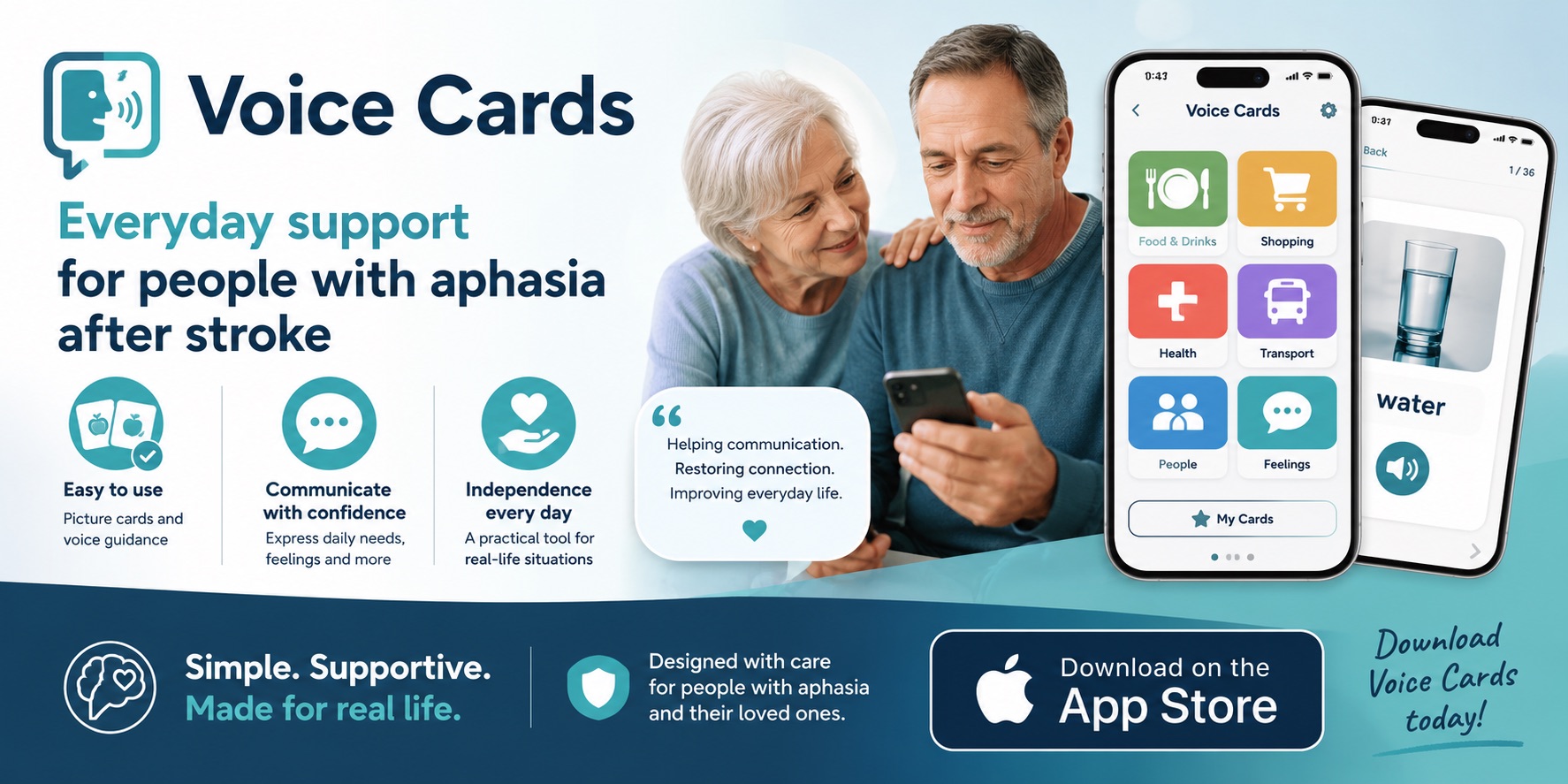
Shopping with aphasia can become easier when the trip is broken into simple steps: prepare a clear list, keep useful words or pictures ready, ask store staff specific questions, and make payment as predictable as possible. A phone, written note, picture-based list or aphasia ID card can provide backup when speaking, reading or finding the right word becomes difficult.
The goal is not to make someone else do the shopping or speak on the person’s behalf. The goal is to make everyday shopping more manageable while allowing the person with aphasia to make choices, communicate and participate as independently as possible.
Why Can Shopping Be Difficult With Aphasia?
A shopping trip involves much more communication than it may seem.
A person may need to:
- read a shopping list;
- recognize product names;
- read aisle signs;
- compare prices;
- understand special offers;
- ask where something is located;
- answer questions from store staff;
- choose between different products;
- communicate at a deli, bakery or service counter;
- understand numbers;
- use a self-checkout;
- pay with cash or a card;
- check a receipt.
A busy supermarket can also involve noise, announcements, queues and people speaking quickly.
Different people with aphasia experience different communication difficulties. One person may speak easily but find reading product labels difficult. Another may understand what they want to buy but have difficulty saying the product name. Someone else may prefer written words, pictures, gestures or pointing.
For this reason, there is no single correct way to shop with aphasia.
The most useful approach is usually to identify which parts of shopping are difficult and create simple backup methods for those situations.
Prepare Before Leaving Home
A little preparation can remove many communication decisions from the shopping trip itself.
Before leaving home, consider preparing:
- a shopping list;
- pictures of unfamiliar products;
- a preferred payment method;
- a store loyalty card;
- coupons if they will be used;
- a phone with useful notes or photos;
- a pen and small notebook;
- an aphasia ID or communication card if useful.
If possible, decide in advance which store to visit.
A familiar supermarket may be easier because the location of common products is already known. Repeating the same route through a familiar store can also reduce the number of new decisions required during each trip.
Choose a quieter time when possible
If noise, queues or time pressure make communication harder, shopping outside the busiest periods may help.
A quieter store may make it easier to:
- find products;
- read signs;
- ask staff questions;
- take time at checkout;
- use communication aids without feeling rushed.
There is no need to finish the trip quickly. A successful shopping trip is one in which the person can get what they need and communicate in a way that works for them.
Make an Aphasia-Friendly Shopping List
A shopping list does not have to be a traditional list of written product names.
It can contain:
- words;
- pictures;
- brand logos;
- photos of familiar products;
- quantities;
- simple categories;
- check boxes.
For example, instead of writing:
wholegrain sliced bread
the list could include:
BREAD
with a photo of the usual package.
If identifying numbers is difficult, quantities can also be represented visually.
For example:
- 🍎 🍎 🍎 🍎
- 4 apples
Use whichever version is easier for the individual person.
Keep the list visually simple
A long page filled with small text can make finding individual items unnecessarily difficult.
A simpler list might use:
- one item per line;
- larger text;
- short product names;
- clear spacing;
- pictures beside important items;
- a check box next to each item.
Removing unnecessary information can make the important information easier to locate.
Organize the List by Store Section
Instead of writing products in the order they come to mind, arrange them approximately in the order they appear in the store.
For example:
Fruit and vegetables
- bananas;
- apples;
- tomatoes.
Bakery
- bread;
- rolls.
Dairy
- milk;
- cheese;
- yogurt.
Household
- dish soap;
- paper towels.
This reduces the need to repeatedly search through the entire list.
It may also reduce unnecessary walking back and forth through a large supermarket.
Use Pictures When Words Are Difficult
A picture can communicate information without requiring the product name to be spoken.
If there is a specific item you want, take a photo of it before the next shopping trip.
You can then show the picture to a member of staff and ask:
Where can I find this?
If producing that sentence is difficult, showing the photograph and saying:
Where?
may be enough.
You can also point to the picture without speaking.
Pictures are especially useful for:
- specific brands;
- unfamiliar ingredients;
- household products;
- clothing styles;
- replacement products;
- items that are difficult to describe.
There is no requirement to communicate using complete spoken sentences. The purpose of communication is to make the message understood.
Finding Products in the Store
Large stores can require a surprising amount of reading.
Useful strategies include:
- following familiar store sections;
- using overhead aisle signs;
- looking for product pictures;
- using the store’s app if it shows product locations;
- showing a shopping-list item to a member of staff;
- showing a photo of the product;
- pointing to a related item and asking for help.
If a store has an online catalog, it may help to look up an unfamiliar product before leaving home.
Save a screenshot of:
- the product;
- the product name;
- the package;
- the size;
- the price if relevant.
That screenshot can become a communication tool inside the store.
How to Ask Store Staff for Help
Store employees answer short questions all day. You do not need a complicated explanation.
Useful questions include:
Where is the milk?
Where can I find this?
Do you have this?
What aisle?
Can you show me?
Can you write it down?
Please give me a moment.
If the product name is difficult to say, show it instead.
You might:
- point to the item on your list;
- show a photo;
- type the word on your phone;
- write the word on paper;
- use a communication app;
- gesture;
- show an aphasia communication card.
Do not worry about perfect sentences
Consider this situation:
You want olive oil but cannot produce the complete question:
Could you please tell me which aisle contains the olive oil?
You may be able to say:
Olive oil. Where?
That message is still clear.
Effective communication does not require perfect grammar.
Use a Smartphone as a Shopping Communication Tool
A smartphone can combine several useful shopping tools in one place.
It can hold:
- shopping lists;
- product photos;
- screenshots;
- notes;
- typed questions;
- a calculator;
- store apps;
- digital loyalty cards;
- maps;
- communication apps.
Create one note called something simple such as:
SHOPPING
Inside it, save frequently used phrases:
- I have aphasia.
- Please give me time.
- Can you show me where this is?
- Please write the price.
- I understand, but speaking can be difficult.
- Please ask me one question at a time.
Instead of recreating the same message during every shopping trip, simply show the saved note when needed.
Consider Carrying an Aphasia ID Card
An aphasia ID or communication card can quickly explain why communication may take longer.
A simple card might say:
I have aphasia. I may need more time to speak, read or understand words. Please be patient and give me time to respond.
It can also include individual preferences such as:
- Please write important information down.
- Please show me the options.
- Please ask yes/no questions.
- Please speak one sentence at a time.
- Please let me use my phone to communicate.
The card is particularly useful when speaking with someone who has never met the person before.
Showing the card may also remove the need to repeatedly explain aphasia during short everyday interactions.
Making Checkout Easier
The checkout can be one of the fastest parts of a shopping trip.
Questions may include:
- Do you have a loyalty card?
- Would you like a bag?
- Cash or card?
- Would you like your receipt?
- Would you like to donate?
Preparing for these predictable questions can make the interaction easier.
Useful short responses include:
- Yes.
- No.
- Card.
- Cash.
- One bag, please.
- Receipt, please.
- Please repeat.
- Please show me.
Put important items where they are easy to reach
Before entering the checkout line, it may help to prepare:
- payment card;
- cash;
- loyalty card;
- coupons;
- phone.
This avoids having to search through a wallet or bag while also trying to understand questions from the cashier.
Self-checkout may work better for some people
Some people may prefer self-checkout because it can reduce spoken interaction.
Others may find the instructions, screens and unexpected prompts confusing.
There is no universally easier option.
If a staffed checkout works better, use it. If a familiar self-checkout gives the person more time and independence, use that instead.
Prices, Money and Numbers
Shopping often involves numbers as well as words.
A person may need to understand:
- prices;
- quantities;
- weights;
- discounts;
- card PINs;
- cash;
- change;
- totals.
If numbers are difficult, reduce the amount of mental calculation required during the trip.
Possible strategies include:
- using a calculator;
- using a phone to display a number;
- asking staff to write down the price;
- using contactless or card payment when preferred;
- checking the displayed total before paying;
- keeping a simple spending limit written on the shopping list.
For example, instead of trying to remember a spending limit, write:
BUDGET: $50
or:
BUDGET: £40
at the top of the shopping list.
Ask for numbers to be written down
If understanding a spoken price is difficult, say:
Please write the price.
A written number may be easier to verify than a number heard once in a noisy environment.
Understanding Receipts and Checking Purchases
You do not have to review a long receipt while standing at the checkout.
Keep the receipt and check it later in a quieter place.
You may want to check:
- the total;
- expensive items;
- discounts;
- quantities;
- unexpected charges.
If something appears wrong, mark or circle the item before speaking to customer service.
Then you can show the receipt and say:
I have a question about this.
or:
I think this price is wrong.
Pointing to the exact line on the receipt gives the other person immediate context.
Shopping for Clothes and Other Products
Shopping for clothes introduces additional vocabulary such as:
- size;
- color;
- style;
- fit;
- price;
- changing room;
- returns.
Prepare the most important information before asking for help.
For example:
Blue shirt. Large.
or:
These shoes. Size 9.
You can also take a screenshot of a product seen online and show the picture to staff.
Useful questions include:
Do you have this in large?
Do you have this in blue?
Where are the changing rooms?
Can I return this?
The same approach works in hardware stores, electronics stores, garden centers and other retail environments: prepare the key word, image, size, model or product name before starting the conversation.
Online Shopping With Aphasia
Online shopping removes some spoken communication but introduces more reading and navigation.
It may be useful when:
- crowded stores are tiring;
- spoken interactions are difficult;
- the same products are purchased regularly;
- product pictures make choices easier;
- shopping can be completed slowly without pressure.
Use favorites and previous orders
If a store allows products to be saved, create a list of frequently purchased items.
Previous orders can also be useful for groceries because they reduce the need to search for every product again.
Do not rush the payment stage
Before confirming an online order, check:
- products;
- quantities;
- delivery address;
- delivery date;
- total price.
If another person is helping, they can review these details without taking over the entire shopping process.
Be careful with unfamiliar messages
Shopping websites and delivery services may send emails or text messages about orders.
If a message asks unexpectedly for passwords, banking credentials, security codes or an additional payment, do not act quickly.
Check the message carefully or ask a trusted person to help verify it.
How Family Members Can Help Without Taking Over
Shopping together can be helpful, but support should not automatically mean doing everything for the person with aphasia.
Whenever possible, let the person:
- choose the products;
- hold the shopping list;
- decide where to go next;
- ask staff for help;
- answer checkout questions;
- choose the payment method;
- make the final decision.
A family member can remain available as backup.
Wait before stepping in
If communication takes longer, give the person time.
Do not immediately finish the sentence or answer the employee’s question for them.
If help appears necessary, ask:
Would you like me to help?
This keeps the person involved in the interaction.
Confirm rather than assume
If you are unsure what the person wants, show the options.
For example:
This one or this one?
Point to each option.
Simple visual choices can sometimes be more effective than repeatedly asking a long verbal question.
How Store Staff Can Make Communication Easier
If you work in a shop and a customer tells you they have aphasia, the most useful response is usually to give them time and communicate directly with them.
Helpful approaches include:
- face the customer when speaking;
- use clear, short sentences;
- ask one question at a time;
- wait for an answer;
- write important words or numbers down;
- show products or choices;
- allow the person to point, gesture, write or use their phone;
- confirm what you understood.
Avoid assuming that difficulty speaking means the person does not understand the situation.
Do not automatically direct every question to the accompanying family member.
Speak to the customer first.
Create a Simple Shopping Communication Kit
A small collection of familiar tools can be kept ready for every shopping trip.
A shopping communication kit might include:
- smartphone;
- shopping list;
- product photos;
- aphasia ID card;
- pen;
- small notebook;
- payment card;
- loyalty card;
- a few saved phrases.
The entire kit does not need to be used every time.
It simply provides alternatives when one method of communication is not working.
Create a backup plan
It can help to decide in advance what to do if communication becomes difficult.
For example:
- Try saying the word.
- Point to the shopping list.
- Show a picture.
- Type the word on the phone.
- Show the communication card.
- Ask a companion for help if needed.
Having alternatives can reduce the pressure to make spoken language work every time.
Useful Shopping Phrases for Aphasia
Save the phrases that are useful to you on your phone or print them on a small card.
Finding products
- Where is this?
- Can you show me?
- What aisle?
- Do you have this?
- I am looking for this.
Clothes and sizes
- Do you have a larger size?
- Do you have a smaller size?
- Do you have this in blue?
- Where is the changing room?
Prices and payment
- How much?
- Please write the price.
- Card, please.
- Cash.
- Receipt, please.
When communication is difficult
- I have aphasia.
- Please give me time.
- Please say that again.
- Please speak more slowly.
- Please write it down.
- Can you show me?
- Yes or no?
- One question at a time, please.
Shopping With Aphasia: Quick Checklist
Before leaving home:
- Make a clear shopping list.
- Add pictures for difficult product names.
- Organize the list by store section.
- Charge the phone.
- Prepare the payment method.
- Take an aphasia ID or communication card if useful.
- Save important phrases on the phone.
- Choose a familiar or quieter store when possible.
In the store:
- Follow the list one section at a time.
- Check off products as they are found.
- Show pictures when words are difficult.
- Ask short, specific questions.
- Use pointing, writing or gestures when useful.
- Take time to respond.
At checkout:
- Have the payment method ready.
- Prepare the loyalty card before reaching the cashier.
- Ask for questions or prices to be repeated if necessary.
- Ask for numbers to be written down if that helps.
- Keep the receipt and check it later if needed.
Frequently Asked Questions About Shopping With Aphasia
Can a person with aphasia shop independently?
Many people with aphasia can shop independently, although the amount and type of support needed varies greatly from person to person. A written or picture-based list, smartphone, communication card and familiar shopping routine can make some parts of the trip easier.
What is an aphasia-friendly shopping list?
An aphasia-friendly shopping list is a list designed around the communication preferences of the individual person. It may use large text, short product names, pictures, brand photos, categories and check boxes instead of a dense list of written information.
Can pictures help someone with aphasia while shopping?
Yes. Product photographs can be particularly useful when the person recognizes what they want but finds the product name difficult to say, read or write. A picture can simply be shown to store staff.
What should someone say to store staff if they have aphasia?
A short explanation may be enough, such as: “I have aphasia. Please give me time.” A person can also show an aphasia ID card or a prepared message on their phone.
What if the person cannot say the name of a product?
They can point to a written word, show a picture, use a gesture, type the word, show the product on a website or use another communication aid. Complete spoken sentences are not necessary for successful communication.
Is self-checkout easier for someone with aphasia?
It depends on the individual. Self-checkout reduces some spoken interaction but requires reading and responding to instructions on a screen. Some people prefer it, while others find a staffed checkout easier.
How can someone with aphasia ask about a price?
Simple phrases such as “How much?” or “Please write the price” may be useful. The person can also point to the price display or use a calculator or phone when working with numbers.
Should a family member speak for someone with aphasia in a store?
Not automatically. Give the person with aphasia time to communicate first. If help is needed, ask whether they want assistance rather than immediately answering for them.
Can a smartphone help with shopping and aphasia?
Yes. A smartphone can store shopping lists, photos, written phrases, screenshots, calculator tools, store apps and communication aids. It can provide several different ways to communicate when speaking is difficult.
Can online grocery shopping be easier with aphasia?
For some people it can. Online shopping removes the need for many face-to-face conversations and allows more time to make choices. However, it can involve significant reading and screen navigation, so it is not necessarily easier for everyone.
What should store employees know about aphasia?
A customer with aphasia may need additional time or another way to communicate. Staff should speak directly to the person, use clear questions, allow time for responses and accept communication through writing, pointing, pictures, gestures or technology.
Shopping Is a Communication Activity, Not Just a Task
Buying groceries may look like a simple everyday activity, but it combines reading, speaking, listening, numbers, decision-making and interaction with unfamiliar people.
When aphasia makes one of those communication steps difficult, the solution does not have to be complicated.
A photograph can replace a difficult product name. A written number can replace a spoken price. A saved message can explain aphasia. A short question can replace a long sentence. A familiar shopping list can reduce the need to search for words.
Most importantly, communication support should help the person participate rather than remove them from the activity.
The best shopping strategy is the one that helps the person with aphasia make their own choices, communicate in their preferred way and remain as involved as they want to be.