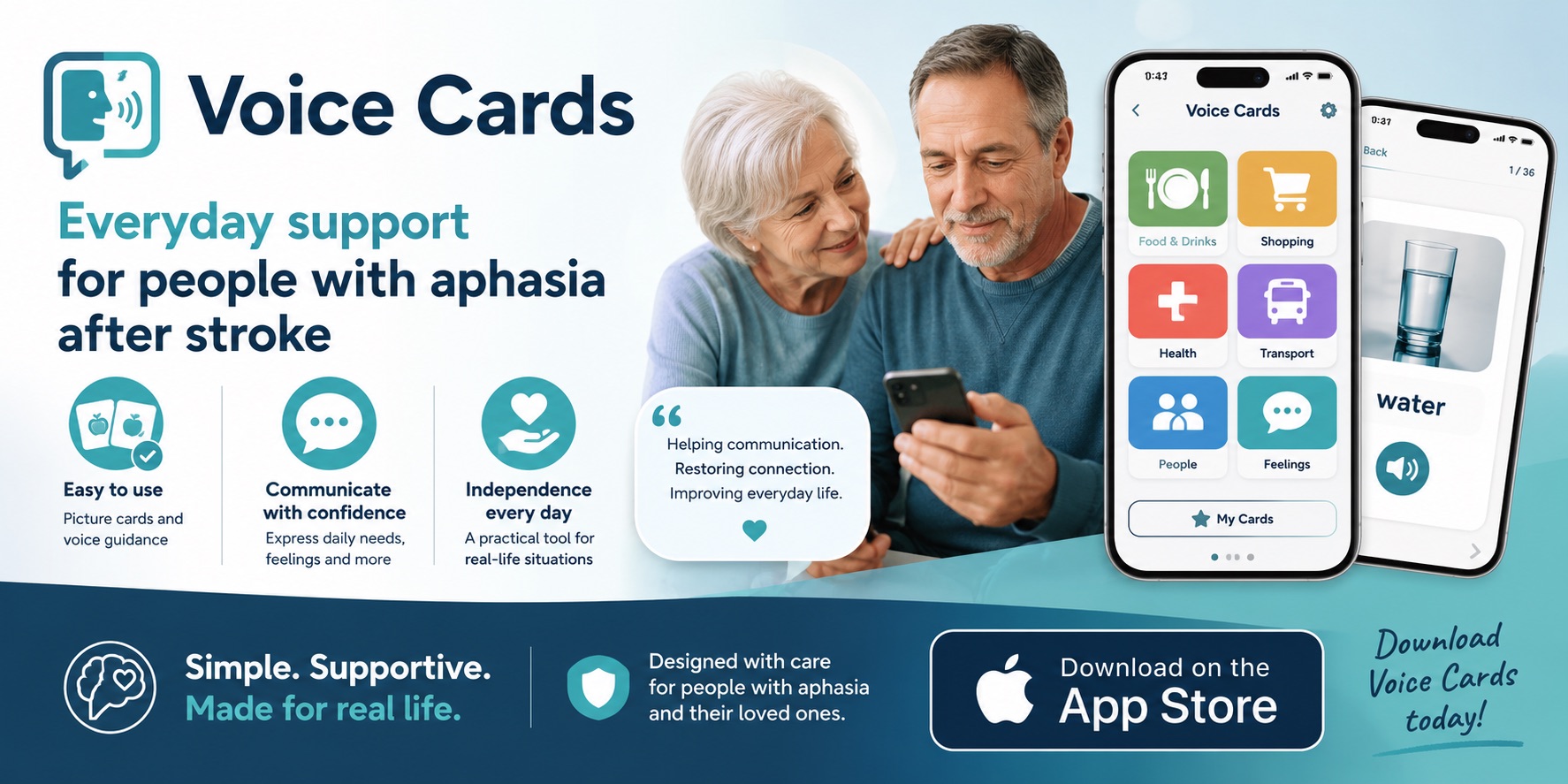
When you cannot understand what a person with aphasia is trying to tell you, stop guessing, identify the general topic, reduce the number of choices, and switch from speech to another communication method such as pointing, gestures, writing, pictures, objects, or a communication board. If frustration keeps increasing and the situation is not urgent, it is often better to pause the conversation and return to it later than to continue asking question after question.
For caregivers and family members, communication breakdowns can be among the most frustrating parts of everyday life with aphasia. The person may clearly know what they want to communicate, while the caregiver tries one guess after another without finding the right answer.
A useful goal is not to make the person produce the missing word. The goal is to discover the message together.
The First Rule: Stop Guessing After a Few Attempts
A common communication breakdown starts like this:
The person with aphasia tries to say something.
The caregiver guesses.
“Do you want water?”
No.
“Coffee?”
No.
“Are you hungry?”
No.
“Do you want the TV?”
No.
“Your phone?”
No.
After ten or fifteen guesses, both people may be frustrated and the original message may be even harder to communicate.
This approach feels logical because the caregiver is trying to help. But unlimited guessing can turn communication into a game of twenty questions in which the person with aphasia has very little control.
A better rule is simple:
After a few unsuccessful guesses, change the strategy.
Do not continue searching randomly for individual words. Move backward and find the general subject first.
Step 1: Find the General Topic
Before trying to identify the exact message, determine what the person is talking about.
You can ask short category questions such as:
- “A person?”
- “Something here?”
- “Food?”
- “Phone?”
- “Outside?”
- “Today?”
- “Money?”
- “Appointment?”
- “Something you need?”
- “Something happened?”
Say one category at a time and allow enough time for a response.
You can support the categories with gestures. Point around the room for “something here.” Point toward the door for “outside.” Hold up the phone for “phone.” Show a family photo for “person.”
Do not worry about finding the perfect word immediately. If you can establish that the message is about a person rather than food, you have already eliminated many possibilities.
Start Broad, Then Narrow the Search
Suppose the person is repeatedly saying a word you cannot understand.
You ask:
“Is this about a person?”
They indicate yes.
Now you can narrow the category:
- family?
- friend?
- neighbor?
- doctor?
- someone on the phone?
If they indicate family, show photographs or written names rather than trying to guess every relative verbally.
Instead of searching the entire language for one missing word, you are now searching inside a small, understandable category.
Step 2: Narrow the Message Into a Category
Once the general topic is known, find out what kind of message the person is trying to communicate.
If the subject is a person, are they asking:
- where the person is?
- whether the person is visiting?
- to call the person?
- something the person said?
- something that happened earlier?
If the subject is food, are they communicating:
- hungry?
- not hungry?
- wanting a particular food?
- finished eating?
- wanting something from the kitchen?
If the subject is the phone:
- call someone?
- read a message?
- find a photo?
- charge the phone?
- something is not working?
This process can feel slower than guessing at first. In practice, it is often much faster because every confirmed category reduces the number of possible meanings.
Step 3: Offer Two Clear Choices
Open-ended questions can be difficult during a communication breakdown.
Instead of asking:
“What do you want?”
offer two visible possibilities:
“Kitchen or bedroom?”
“Call John or call Sarah?”
“Now or later?”
“Go or stay home?”
“TV or music?”
Whenever possible, do not rely only on spoken choices. Show the objects, write the words, display photographs, or point to the locations.
Two choices are often easier to process than a long list. Once one branch is selected, you can offer another pair.
Do Not Accidentally Choose for the Person
Present both choices neutrally.
Avoid:
“You probably want to stay home, right?”
Instead try:
“Stay home or go outside?”
The difference matters. Communication support should help reveal the person’s preference rather than lead them toward the caregiver’s preferred answer.
If spoken yes and no are sometimes inconsistent, the strategies in When “Yes” and “No” Are Not Reliable With Aphasia can help you confirm choices without relying on one spoken response.
Step 4: Switch Communication Methods
If speech is not working, more speech is not always the solution.
Communication can happen through several channels:
- speaking,
- pointing,
- gestures,
- facial expressions,
- writing,
- drawing,
- photographs,
- objects,
- maps,
- calendars,
- communication boards,
- smartphones or tablets.
You do not need to choose one method and use it exclusively. The most effective conversations often combine several.
Try Writing One Keyword
Write down the word you think is important:
CAR
JOHN
DINNER
TOMORROW
Ask the person to point to the word if it matches their message.
If writing is difficult for them, you can do the writing. They may still be able to recognize the correct word even when saying or writing it themselves is difficult.
Try Drawing
The drawing does not need to be attractive.
A rough car, house, phone, clock, plate, person, or arrow may be enough to establish the topic.
You can also give the pen to the person with aphasia. A simple line or shape may provide the clue you were missing.
Try Gestures
Mime drinking, sleeping, driving, calling someone, opening a door, putting on a jacket, paying, eating, or using a phone.
Encourage the person to gesture too.
The question is not, “Can we say the correct word?”
The question is, “Can we understand the message?”
Step 5: Confirm What You Think You Understood
Finding a likely answer is not the end of the process.
Confirm it.
Suppose you eventually determine that the person is talking about their daughter, Lisa.
You think they want to call her.
Summarize:
“Lisa. You want to call Lisa now.”
Then show the phone and Lisa’s photograph or name.
Give the person a chance to confirm or reject your interpretation.
Confirmation is particularly important after a long communication breakdown because caregivers can become so relieved at finding a plausible explanation that they stop checking whether it is actually correct.
A useful habit is:
“I think you mean ________. Is that right?”
Then confirm through whatever response method works best for that individual.
Step 6: Know When to Pause
Not every message must be solved immediately.
If the conversation is not urgent and both people are becoming frustrated, pausing may be the most productive communication strategy available.
You can say:
“I know you’re trying to tell me something. I’m not getting it yet. Let’s come back to it.”
This is very different from dismissing the person or pretending the message does not matter.
You are acknowledging that:
- there is a message,
- you have not understood it,
- you still intend to return to it.
A short break can reduce pressure. Sometimes the missing word or alternative way to communicate appears naturally a few minutes later.
Fatigue also matters. A conversation that is manageable in the morning may become much harder later in the day. Quiet surroundings, fewer people talking, and less background noise can make communication easier.
What If the Message May Be Urgent?
If you believe the person may be trying to communicate an immediate health or safety problem, do not turn the situation into a prolonged guessing exercise.
Use direct, simple questions and visual or physical choices where appropriate.
Try to establish the essential information first:
- Is something wrong?
- Is help needed?
- Is there pain or discomfort?
- Did something happen?
- Does the person need immediate assistance?
If there are new or sudden communication changes, new neurological symptoms, a suspected medical emergency, or any situation in which the person’s health or safety may be at risk, seek appropriate emergency or medical assistance rather than assuming the difficulty is simply their usual aphasia.
Questions That Can Make a Communication Breakdown Worse
Some natural caregiver reactions unintentionally increase pressure.
“Just tell me what you want.”
If the person could easily say it, they probably would.
Replace the open request with categories, choices, writing, objects, pictures, or gestures.
“Say it again.” Repeated Ten Times
Repeating a word once can sometimes help. Requiring the person to make the same unsuccessful attempt over and over can increase frustration without adding new information.
After a few attempts, change channels.
“Is It This? Is It This? Is It This?”
A rapid stream of guesses requires the person to process and reject each new option.
Slow down and establish the category first.
Finishing Every Sentence
Sometimes the caregiver guesses correctly, but constantly completing someone’s sentences can gradually remove their opportunity to communicate independently.
Wait first. Help when needed.
Speaking Louder
Aphasia is a language disorder, not automatically a hearing problem. Louder speech does not make language simpler.
Use shorter sentences, clear pauses, visual supports, and adequate time instead.
Talking About the Person Instead of With Them
If another relative enters the room during a difficult conversation, it is tempting to say:
“I can’t figure out what he wants.”
Try to keep the person with aphasia involved:
“We’re trying to figure this out together.”
That small change preserves the person’s role as a participant rather than turning them into the subject of someone else’s conversation.
Use the Room and Everyday Objects as Communication Tools
You already have many communication aids in your home.
If the message may concern breakfast, go to the kitchen.
If it concerns clothing, open the closet.
If it involves a person, show family photographs.
If it concerns a date, open the calendar.
If it involves a location, use a map.
If it involves a television program, show the program guide.
If it concerns something bought recently, show the object or receipt.
Moving closer to the subject of the conversation can turn an abstract language problem into a concrete choice.
Pointing Can Be More Efficient Than Naming
Imagine that the person cannot say the word “charger.”
You could spend several minutes trying to discover the missing word.
Or you could ask:
“Something in this room?”
When they indicate yes, let them point toward the table.
Move closer.
They point toward the phone.
You show the phone and charger.
They point to the charger.
The message has been communicated even though nobody needed to produce the word.
Use Photos and a Smartphone When Words Are Not Working
A smartphone can be an excellent communication backup because it already contains information that matters personally to the user.
Useful resources may include:
- family photographs,
- contact names,
- recent text messages,
- calendar appointments,
- maps,
- photos of frequently visited places,
- screenshots of important information,
- notes containing frequently used words or phrases.
If the person is trying to talk about somebody but cannot retrieve the name, opening the Contacts or Photos app may allow them to point.
If they are trying to explain where they want to go, a map can transform a difficult verbal explanation into a visible location.
If they want to talk about something that happened earlier, recent photographs may provide context.
Caregivers should still avoid turning the phone into something only they operate. Whenever possible, support the person in navigating and selecting information themselves. See How to Help Someone With Aphasia Use a Smartphone Without Taking Over for practical ways to keep the device useful without removing the user’s independence.
Create a Backup Communication System Before You Need It
The easiest time to prepare for a communication breakdown is when you are not in the middle of one.
A simple home communication board might contain:
- YES
- NO
- NOT SURE
- HELP
- STOP
- WAIT
- MORE
- FINISHED
- FOOD
- DRINK
- BATHROOM
- PHONE
- FAMILY
- HOME
- OUTSIDE
- NOW
- LATER
It can also include photographs of important people and places.
There is no requirement for a communication board to look clinical or contain hundreds of symbols. A personalized board with twenty useful choices may be more valuable at home than a complicated board containing vocabulary the person rarely needs.
If you want to build one around the person’s real daily routine, see How to Make a Communication Board for Aphasia.
Keep a Portable Version
A smaller version can stay in:
- a wallet,
- a purse,
- a phone photo album,
- a vehicle,
- a jacket pocket,
- a folder used for appointments.
Communication breakdowns do not happen only at home. Having the same familiar options available elsewhere can make restaurants, stores, visits, travel, and appointments easier.
Help Without Taking Over the Conversation
A caregiver may become extremely skilled at understanding a person with aphasia. That is valuable, but it can also create a new problem.
The caregiver starts translating everything.
Someone asks the person with aphasia a question, and the caregiver answers immediately.
The person points toward something, and the caregiver explains what they mean before they have finished.
The caregiver becomes the communication system.
Support should work differently.
Try this order:
- Give the person time to respond independently.
- Wait before offering help.
- Ask whether another method would help.
- Offer visual or written support.
- Help interpret only when necessary.
- Confirm the interpretation with the person.
This approach can take a little longer, but it preserves participation.
The purpose of a communication rescue plan is not to make the caregiver faster at speaking for the person. It is to make both people better at reaching the message together.
Teach the Same System to Family Members and Visitors
Communication can become confusing when every person uses a different strategy.
One relative gives plenty of time.
Another finishes every sentence.
Someone else asks ten questions in a row.
A visitor speaks loudly.
Another family member directs every question to the caregiver.
A simple family approach can help:
- one person speaks at a time,
- use short sentences,
- allow time for a response,
- do not interrupt immediately,
- use gestures and visual information,
- offer choices when needed,
- confirm the final message,
- do not exclude the person from the conversation.
This becomes particularly important during meals, holidays, parties, and other situations where several people are talking. The guide How to Keep Someone With Aphasia in a Group Conversation explains how family members can make group conversations easier without treating the person like a passive observer.
A Complete Communication Rescue Example
Imagine a man with aphasia repeatedly says something that sounds like “Mary.” His wife assumes he is talking about their friend Mary.
She asks:
“Mary?”
He becomes frustrated and indicates no.
1. Stop Guessing Names
Instead of listing more people, she goes back to the topic:
“Person?”
No.
“Something here?”
Yes.
2. Narrow the Location
She points:
“Kitchen?”
Yes.
They go to the kitchen.
3. Let the Environment Help
He points toward a cabinet.
She opens it.
He points toward a shelf containing several items.
She removes two at a time.
He rejects the first pair.
Then he points at a mug.
4. Find the Message, Not Just the Object
She holds up the mug:
“Mug?”
Yes.
But he is still trying to communicate something.
She offers:
“Drink?”
No.
“Broken?”
No.
She notices that it is a mug their daughter gave him.
She shows the daughter’s photograph.
He indicates yes.
She asks:
“The mug from Anna?”
Yes.
Then:
“Anna comes today?”
He strongly indicates yes.
5. Confirm
She opens the calendar and shows that Anna is visiting tomorrow.
The intended message was not about Mary, a drink, or the mug itself. The mug was a route to the person he wanted to discuss.
That is why communication rescue works best when caregivers remain flexible. An object, gesture, sound, or partial word may be a clue rather than the entire message.
A Five-Minute Communication Rescue Plan for Caregivers
When you are stuck, remember this sequence:
- Stop random guessing.
- Find the topic: person, place, object, activity, need, event.
- Narrow the category.
- Offer two choices.
- Switch from speech to pointing, writing, pictures, gestures, objects, or a phone.
- Summarize what you think the person means.
- Ask them to confirm.
- Pause and return later if the situation is not urgent and frustration is increasing.
A caregiver does not need to become a speech-language professional to use these basic habits. The most important skills are patience, flexibility, observation, and willingness to change the communication method when the current one is not working.
Frequently Asked Questions About Communication Breakdowns and Aphasia
What should I do when I cannot understand someone with aphasia?
Stop random guessing after a few attempts. Identify the general topic, narrow it into a category, offer two choices, and use alternative communication methods such as pointing, gestures, writing, pictures, objects, or a communication board. Once you think you understand, confirm the message with the person.
Should I keep asking questions until I figure out what the person means?
Not necessarily. Too many rapid questions can increase frustration and make communication harder. If several attempts fail, change the strategy. If the issue is not urgent and both people are becoming frustrated, pause and return to it later.
Should I guess the word someone with aphasia is trying to say?
A limited number of guesses can be helpful, especially when the context is obvious. If the guesses are repeatedly wrong, stop searching randomly and identify the general topic first. This usually gives the person more control and reduces frustration.
Is it okay to finish the sentences of someone with aphasia?
Sometimes assistance is welcome, but do not automatically finish every sentence. Give the person time first. If they appear stuck, ask or signal whether they want help. Communication preferences differ from person to person.
What communication tools can caregivers keep at home?
Useful low-tech tools include pen and paper, a whiteboard, a calendar, family photographs, written names, maps, picture cards, and a personalized communication board. Smartphones and tablets can provide photos, contacts, maps, notes, and other visual information.
What if the person keeps repeating the same word?
The repeated word may not be the exact word they intend. Treat it as a possible clue and use context, categories, gestures, writing, objects, and pictures to identify the broader message rather than focusing only on correcting or interpreting that one word.
What if I understand part of the message but not all of it?
Repeat the part you believe you understood. For example, say, “I understand that this is about John. I don’t understand what happened with John.” Preserving the confirmed part prevents you from restarting the entire conversation and helps narrow what remains unknown.
Does difficulty communicating mean the person does not know what they want?
No. Aphasia can make it difficult to express or understand language, but communication difficulty should not automatically be interpreted as an inability to have preferences, thoughts, or decisions. Alternative communication methods may allow the person to express a message that spoken language does not reveal easily.
When Communication Gets Stuck, Change the Route
A communication breakdown with aphasia does not have to become an endless sequence of guesses.
Start with the topic. Narrow the possibilities. Offer simple choices. Use the environment. Write keywords. Draw. Point. Show photographs. Open the calendar or map. Use a communication board. Give the person time.
Then confirm what you understood.
If the first route to the message does not work, try another. Speech is only one way people communicate.
The most useful question for a caregiver is often not:
“What word are they trying to say?”
but:
“What other way can we use to find the message?”
Important Note
This article is for general educational purposes and is not medical advice. Aphasia and communication abilities vary significantly from person to person. A speech-language pathologist or other qualified healthcare professional can provide individualized communication strategies. If communication changes suddenly, new symptoms appear, or there is any concern about the person’s health or safety, contact an appropriate healthcare professional or emergency service.