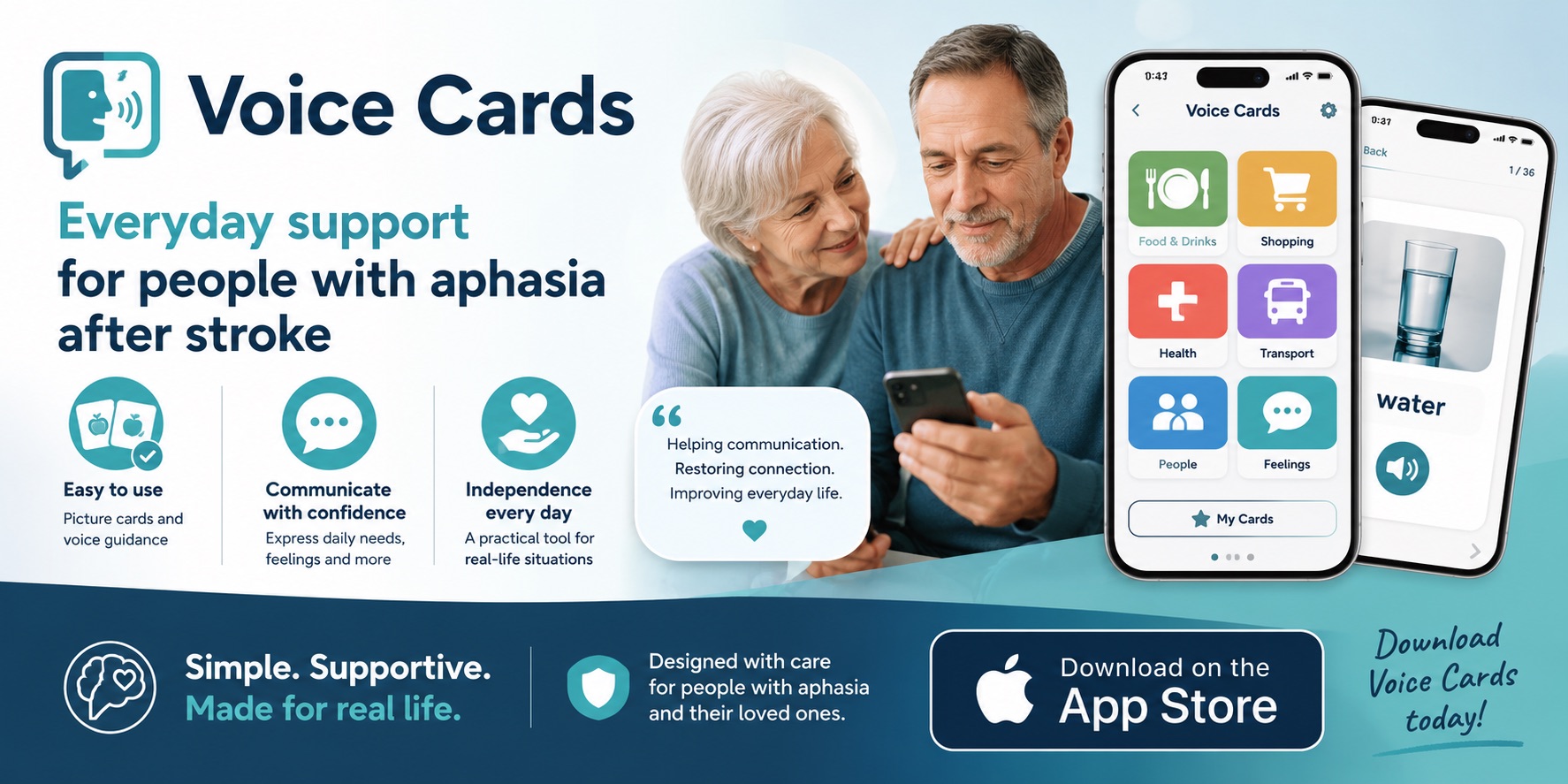
Every household where someone lives with aphasia should have a simple emergency communication plan prepared before it is needed. At minimum, the plan should include a wallet-sized aphasia identification card, an emergency contact, the person’s preferred way of answering yes/no questions, a short explanation of how to communicate with them, essential information stored on their phone, and a one-page emergency sheet that can be handed to paramedics, emergency department staff, police officers, firefighters, or other first responders.
This preparation matters because an emergency is exactly the situation in which communication becomes hardest. There may be unfamiliar people, flashing lights, background noise, rapid questions, stress, pain, fatigue, and very little time. A person who normally communicates successfully at home may have much more difficulty making themselves understood in those conditions.
For caregivers in the United States, planning also means thinking about what would happen if the person with aphasia had to call 911 without you, answer questions from an EMT, arrive at an emergency room alone, or explain to a police officer why their speech sounds unusual.
Why People With Aphasia Need an Emergency Communication Plan
Emergency responders and hospital staff are trained to gather information quickly. They may ask questions such as:
- “What happened?”
- “What is your name?”
- “Where does it hurt?”
- “Do you live here?”
- “Is anyone else inside?”
- “Who should we call?”
- “Can you understand me?”
For someone with aphasia, answering these questions may be difficult even when they understand exactly what is happening.
The problem can become more serious when an unfamiliar responder does not recognize aphasia. Speech may be slow, incomplete, repetitive, contain unintended words, or be difficult to understand. Reading and writing may also be affected.
A responder who has never met the person has no way of knowing what their usual communication looks like.
A simple written statement can immediately change that situation:
“I have aphasia. Aphasia affects my communication. Please give me time to answer. Speak to me directly and use short questions.”
The purpose of an emergency plan is therefore not to create a complicated medical file. It is to give unfamiliar people the information they need to communicate more successfully within seconds.
Create an “I Have Aphasia” Emergency Card
A person with aphasia should consider carrying a simple identification card whenever they leave home.
The front can say:
I HAVE APHASIA
Aphasia affects my ability to communicate. It does not mean that I cannot understand what is happening.
Then include only the most useful communication instructions.
For example:
- Please speak directly to me.
- Use short, simple sentences.
- Ask one question at a time.
- Give me extra time to respond.
- Do not speak louder unless I ask you to.
- I may use pointing, gestures, writing, pictures, or my phone.
- Please confirm that you understood my answer.
Add an Emergency Contact
The card should include:
- the person’s name,
- the name of an emergency contact,
- the emergency contact’s phone number,
- a second contact if appropriate.
Keep the design simple. In an emergency, a responder should be able to understand the important information in a few seconds.
Do Not Put Everything on One Tiny Card
The wallet card does not need to contain a complete personal history. Its primary purpose is to identify aphasia and explain how to communicate.
More detailed information can be kept on a separate emergency sheet at home, in a bag, or on the person’s phone.
Consider keeping copies:
- in the wallet,
- in a purse or backpack,
- inside a phone case,
- in the vehicle,
- with appointment paperwork.
Prepare a One-Page Emergency Communication Sheet
A one-page sheet can give paramedics or emergency department staff much more useful information than a caregiver trying to explain everything while under stress.
Use a clear heading:
APHASIA COMMUNICATION INFORMATION
Then organize the information into short sections.
1. Identification
- Name
- Preferred name
- Date of birth if appropriate for the document
- Home address
2. Emergency Contacts
- Primary caregiver or family contact
- Phone number
- Secondary contact
- Phone number
3. Communication
Include practical statements such as:
- “I understand short spoken sentences better than long explanations.”
- “Please give me time to answer.”
- “I communicate best by pointing.”
- “Please show me written choices.”
- “I use thumbs up for YES and thumbs down for NO.”
- “My spoken yes/no answers sometimes need confirmation.”
- “I can use pictures on my phone.”
- “I may understand more than I can say.”
Only include strategies that actually work for that person.
4. Useful Communication Tools
Tell responders where to find them:
- communication board in bag,
- YES/NO card in wallet,
- family photos on phone,
- written names in Notes,
- glasses or hearing aids if normally used,
- other familiar communication aid.
A personalized communication board for aphasia can also include a small emergency section containing words such as HELP, PAIN, HOME, PHONE, FAMILY, YES, NO, STOP, WAIT, and CALL.
Prepare the Phone for a Possible 911 Call
Many people assume that the caregiver will always be available during an emergency. A safer plan assumes that one day they may not be.
The person’s phone should be prepared so that important information can be reached with as few steps as possible.
Save the Home Address Where It Is Easy to Find
Create a note containing:
MY ADDRESS:
[home address]
I HAVE APHASIA.
I MAY HAVE DIFFICULTY SPEAKING.
Someone who can read but struggles to produce the words may be able to read the address aloud or show the screen to another person.
Make Emergency Contacts Easy to Recognize
Instead of relying on a long contact list, consider identifying important contacts clearly.
For example:
- EMERGENCY – ANNA
- EMERGENCY – JOHN
The exact setup depends on how the individual uses their phone. The important part is that emergency contacts should be easy for both the person with aphasia and another helper to find.
Keep an Aphasia Message on the Phone
A saved note can say:
I HAVE APHASIA.
I HAVE DIFFICULTY SPEAKING.
PLEASE GIVE ME TIME.
ASK SHORT QUESTIONS.
I CAN POINT TO ANSWERS.
PLEASE CALL: [name and number]
This can be shown to a neighbor, security guard, police officer, paramedic, hospital receptionist, taxi driver, or anyone else who needs to understand why communication is difficult.
For people who use their phone independently or with some support, the strategies in How to Help Someone With Aphasia Use a Smartphone Without Taking Over can help keep important functions accessible without turning the device into something only the caregiver can operate.
How to Prepare for Calling 911 With Aphasia
In the United States, 911 operators need enough information to determine where help is needed and what type of emergency response may be required.
A person with aphasia may not be able to give a long explanation. That does not mean preparation is impossible.
Practice the shortest useful information first:
- Location.
- That there is an emergency.
- That the caller has aphasia and may have difficulty speaking.
A prepared script could be:
“Emergency. My address is [address]. I have aphasia. Please ask yes-or-no questions.”
Not everyone with aphasia will be able to say this. The script can instead be printed beside the phone, stored on a smartphone, or practiced in whatever form works for the individual.
Teach the Address as a Separate Piece of Information
Trying to explain an entire emergency can be overwhelming.
Communicating an address is a smaller task.
Keep the address:
- printed beside a home phone,
- on the refrigerator,
- inside the emergency communication folder,
- in a smartphone note,
- on the home communication board.
If the person can communicate only a limited amount, the exact location may be one of the most useful pieces of information they can provide.
Can Someone With Aphasia Text 911?
Text-to-911 is available in many parts of the United States, but it is not available everywhere. A caregiver should therefore not assume that sending a text will always reach the local 911 center.
Where Text-to-911 is supported, texting may be useful for someone who can type or use prepared text more effectively than they can communicate during a voice call.
However, emergency planning should not depend entirely on this option.
If the person may use Text-to-911, check availability in the places where they normally live or spend time before an emergency occurs through the appropriate local public-safety or 911 authority.
Do not send a test message to 911 simply to see whether it works.
Prepare the First Text in Advance
If Text-to-911 is available locally and appropriate for the person, a simple prepared format can reduce the amount they need to compose under stress:
EMERGENCY
ADDRESS: [full address or location]
I HAVE APHASIA AND HAVE DIFFICULTY COMMUNICATING.
I NEED [POLICE / FIRE / AMBULANCE if known].
The exact information required will depend on the emergency, but location should be communicated as clearly as possible.
If a text to 911 cannot be delivered because the local service does not accept it, the sender should normally receive a bounce-back message indicating that another method of contacting emergency services is needed.
For emergency preparation, think of Text-to-911 as a possible additional route, not the only route.
Make the Home Address Impossible to Miss
People who have lived at the same address for decades may normally say it without thinking. Aphasia can make retrieving those familiar words unexpectedly difficult.
Do not rely on memory alone.
Print the full address clearly:
- beside the telephone,
- on an emergency sheet,
- on a communication board,
- inside the person’s phone,
- in an emergency folder.
If the home is difficult to locate, make sure house numbers are visible from the street where practical.
Caregivers can also think about information that might matter to responders entering the property, such as:
- an apartment or unit number,
- building entrance instructions,
- gate information,
- which floor the person is on,
- whether another person may be inside.
The goal is simple: reduce the number of things the person with aphasia needs to explain during the emergency.
What First Responders Need to Know Immediately
When paramedics, police officers, or firefighters arrive, communication may begin immediately.
If a caregiver is present, one of the most useful first statements is:
“They have aphasia. Please speak directly to them, use short questions, and give them extra time to answer.”
Then provide the emergency communication card or sheet.
Do Not Let Aphasia Become the Entire Conversation
Responders need to understand the communication difference quickly, but they still need to communicate with the person rather than only with the caregiver.
The caregiver can support the interaction by saying:
“Please ask them first. I can help if they need me.”
This preserves the person’s involvement while making help available.
Explain Unusual Speech Before It Is Misinterpreted
Aphasia can cause speech that sounds confused, incomplete, repetitive, or unrelated to the intended meaning.
A responder who does not know the person may misunderstand this.
A card stating that the person has aphasia provides important context immediately.
It may also be useful to state:
“This is how they usually communicate.”
But only say that if it is true.
If their communication is suddenly different from their normal pattern, that information is important and should be communicated to emergency professionals.
Establish a Reliable Way to Answer Yes and No
Emergency responders commonly use yes/no questions because they allow information to be gathered quickly.
But not every person with aphasia has consistently reliable spoken yes/no responses.
Before an emergency happens, determine which method works best.
Possible systems include:
- thumbs up for YES and thumbs down for NO,
- pointing to printed YES and NO cards,
- nodding and shaking the head,
- pointing to two colored or labeled options,
- using a communication device or smartphone.
Put the chosen system on the emergency communication sheet.
For example:
MY MOST RELIABLE ANSWER:
Thumbs up = YES
Thumbs down = NO
If spoken yes and no can sometimes be inconsistent, make that clear:
“Please confirm my spoken yes/no answers by asking me to point.”
This is particularly important during high-stakes conversations. More detailed strategies are available in When “Yes” and “No” Are Not Reliable With Aphasia.
Prepare for Communication in the Emergency Room
An emergency department can be one of the most challenging communication environments for someone with aphasia.
There may be:
- multiple unfamiliar staff members,
- repeated questions,
- background noise,
- interruptions,
- rapid changes of location,
- forms and written information,
- fatigue,
- stress.
The emergency communication sheet can follow the person from one staff member to another.
Start Every New Interaction With the Same Information
Do not assume that because one nurse knows about the aphasia, every clinician who enters the room also knows.
The person or caregiver can show the card again:
“I have aphasia. Please give me time to communicate.”
Keep Questions Short
When possible, ask staff to present one idea at a time.
Instead of a long question containing several pieces of information, break it into separate questions.
This is especially useful when confirming:
- names,
- people,
- places,
- events,
- dates,
- choices.
Use Written Keywords, but Do Not Assume Reading Is Easier
Some people with aphasia benefit greatly from seeing written words.
Others also have difficulty reading.
The emergency sheet should say what actually helps the individual.
For example:
“Written keywords help me.”
or:
“Pictures and pointing work better for me than written instructions.”
Bring Familiar Communication Tools
If circumstances allow, take:
- the communication board,
- glasses normally used for reading,
- the smartphone or tablet,
- a charger,
- pen and paper,
- the emergency communication sheet.
In a communication breakdown, the techniques described in What to Do When You Cannot Understand Someone With Aphasia can also help caregivers move from guessing to pointing, choices, pictures, writing, and confirmation.
Plan for an Emergency When the Caregiver Is Not There
This may be the most important part of the entire plan.
Ask:
“What happens if the emergency occurs when the person with aphasia is home alone?”
Then work through realistic situations.
Can They Contact 911?
Consider:
- Can they dial 911?
- Can they communicate their address?
- Can they say or show that they have aphasia?
- Can they use a prepared card?
- Can they access an emergency contact?
- Is Text-to-911 available locally if they communicate more effectively through text?
Can They Communicate With Someone at the Door?
A first responder may arrive and immediately ask questions.
Keep an emergency communication card somewhere the person can access quickly.
A second copy can be placed near the main entrance if appropriate for the household.
Would a Trusted Neighbor Know What to Do?
Some households choose to tell a trusted nearby person that someone in the home has aphasia.
The neighbor does not need a detailed personal history. They may simply need to know:
- that the person has difficulty communicating,
- how they indicate yes and no,
- who the emergency contact is.
Whether this is appropriate depends on the person’s preferences and circumstances. Aphasia should not mean automatically sharing private information with everyone nearby.
Keep Emergency Communication Information in the Home
Emergency information is not useful if nobody can find it.
Choose one predictable location and use it consistently.
Possible locations include:
- the refrigerator,
- inside a clearly marked emergency folder,
- beside the home phone,
- near the main entrance,
- with other important household emergency information.
The sheet can begin with large text:
PERSON IN THIS HOME HAS APHASIA
Then provide:
- their name,
- a short explanation of aphasia,
- the best communication method,
- YES/NO method,
- emergency contacts,
- location of the communication board or other aid.
The National Aphasia Association specifically recommends preparing household communication information that can help emergency responders or other visitors understand how to communicate with the person.
Use the Smartphone as an Emergency Communication Tool
A smartphone can carry several emergency communication tools without requiring the person to explain anything verbally.
Create an Emergency Photo Album
A small album might include:
- home,
- family members,
- important places,
- communication card,
- emergency contact information.
Save Frequently Needed Phrases
Possible phrases include:
- I HAVE APHASIA.
- I NEED HELP.
- PLEASE CALL MY FAMILY.
- PLEASE GIVE ME TIME TO ANSWER.
- PLEASE ASK ONE QUESTION AT A TIME.
- PLEASE SHOW ME YES AND NO.
- THIS IS MY HOME ADDRESS.
Keep the Phone Charged
This sounds obvious, but a phone that functions as a communication aid becomes much less useful when its battery is nearly empty.
A charging routine, charger in a commonly used bag, and an additional charger in the vehicle can make the phone a more dependable communication tool.
Practice the Plan Before an Emergency Happens
An emergency plan should be familiar, not something discovered for the first time during a crisis.
Practice does not need to be frightening or complicated.
Try a calm household exercise:
“Imagine you need help and I am not home. Show me what you would do.”
Then see what happens.
Can the person:
- find the phone?
- dial 911?
- find the address?
- find the aphasia card?
- show the communication note?
- contact the emergency person?
The purpose is not to test them.
The exercise tests the plan.
If the card is too difficult to find, move it.
If the text is too small, enlarge it.
If there are too many steps on the phone, simplify them.
If the address is hard to communicate, provide another route.
Practice With the Actual Communication System
If the person uses pictures, practice with pictures.
If they point to written YES and NO, use those cards.
If they rely on their phone, practice with the phone.
An emergency is not the ideal time to introduce a completely new communication technique.
Common Emergency-Planning Mistakes to Avoid
Assuming the Caregiver Will Always Be Present
Build a plan that still works when the usual caregiver is at work, shopping, asleep, traveling, or temporarily unreachable.
Putting Too Much Information on the Aphasia Card
Emergency responders need the most important communication information first. Keep the wallet card readable.
Depending Only on Spoken Communication
Stress may make speaking more difficult. Have another route available.
Depending Only on Written Communication
Aphasia can affect reading and writing too. Use the communication method that works for the individual.
Assuming Every Spoken Yes or No Is Reliable
Know in advance whether spoken yes/no answers need another form of confirmation.
Preparing Information but Never Updating It
Phone numbers change. People move. Communication abilities can change. Review the emergency information periodically.
Hiding the Emergency Information Somewhere “Safe”
A perfectly prepared sheet inside a filing cabinet may not help an EMT standing in the living room.
Emergency information must be easy to find.
Making the Caregiver the Only Person Who Knows the System
Other people who regularly spend time with the person should understand the basic communication method.
This can include close relatives, trusted friends, or other regular support people.
Aphasia Emergency Preparation Checklist
A practical emergency setup can be completed one item at a time.
- Prepare a wallet-sized “I HAVE APHASIA” card.
- Add one or two emergency contacts.
- Write down the person’s best communication methods.
- Identify the most reliable YES/NO method.
- Prepare a one-page communication sheet for first responders.
- Print the complete home address near the phone.
- Save the home address in an easy-to-find smartphone note.
- Save a short aphasia explanation on the phone.
- Make emergency contacts easy to locate.
- Keep a communication board or simple choice card accessible.
- Place a copy of emergency communication information in the home.
- Keep another copy in a regularly used bag if appropriate.
- Check whether Text-to-911 is available locally if it could be useful.
- Do not rely on Text-to-911 as the only emergency contact method.
- Practice finding and using the emergency materials.
- Explain the system to appropriate family members or support people.
- Review phone numbers and other information periodically.
The best emergency plan is usually not the most sophisticated one.
It is the one that the person with aphasia can actually use and that a stranger can understand quickly.
Frequently Asked Questions About Aphasia and Emergency Communication
What should an aphasia emergency card say?
It should clearly state that the person has aphasia, briefly explain that aphasia affects communication, list the person’s preferred communication strategies, and provide an emergency contact. Keep the information short enough for a first responder to understand quickly.
Should someone with aphasia carry identification explaining aphasia?
An aphasia identification card can be extremely useful when communicating with unfamiliar people, including paramedics, police officers, hospital staff, transportation workers, and others who may otherwise misunderstand unusual or limited speech.
What should caregivers tell paramedics about aphasia?
Explain immediately that the person has aphasia and describe the communication method that works best. Ask responders to speak directly to the person, use short questions, allow extra response time, and confirm answers when necessary.
Can a person with aphasia call 911?
Many people with aphasia can call 911, but their ability to communicate during the call varies greatly. Preparing the address, a short emergency script, an aphasia identification message, and an alternative way of answering questions can make the call easier.
Can someone text 911 if aphasia makes speaking difficult?
Text-to-911 is available in many U.S. communities but not everywhere. Where it is supported, it may provide an additional communication option for someone who can communicate more effectively through text. Caregivers should check local availability in advance and should not rely on texting as the only way to reach emergency services.
Should I test Text-to-911 to see if it works?
No. Do not send a non-emergency test message to 911. Check availability through local 911 authorities, public-safety agencies, or other official local information instead.
What if a 911 operator cannot understand the caller with aphasia?
A prepared opening message can help establish the location and explain aphasia immediately. If possible, the caller can say or show that they have aphasia and ask for short or yes/no questions. A clearly displayed home address and prepared communication materials can also help once responders arrive.
What if the person’s communication suddenly seems much worse than usual?
A sudden or unexplained change from the person’s normal communication should not automatically be assumed to be their usual aphasia. If there are new symptoms, a sudden change in communication, or concern about the person’s immediate health or safety, seek appropriate emergency medical assistance.
Should the caregiver answer all questions in the emergency room?
Not automatically. When possible, staff should communicate directly with the person with aphasia and allow them to participate. The caregiver can provide communication support, clarify established information, and help when needed without replacing the person in every conversation.
What if the person with aphasia lives alone?
Emergency preparation becomes especially important. The person should have an accessible aphasia card, clearly displayed address, emergency contacts, a usable method of reaching 911, familiar communication supports, and a plan for communicating with responders who arrive at the home.
Prepare the Communication Before the Emergency
During an emergency, nobody wants to search for a phone number, explain aphasia from the beginning, remember where the communication board is, or discover that the person cannot communicate their home address.
Prepare those things in advance.
Create the card.
Print the address.
Choose a reliable YES/NO method.
Put emergency contacts on the phone.
Prepare the one-page communication sheet.
Keep communication tools somewhere obvious.
Practice what would happen if the caregiver were not there.
The purpose is not to anticipate every emergency. That is impossible.
The purpose is to make sure that if an emergency occurs, aphasia does not prevent the person from being recognized, heard, and included in what happens next.
Important Note
This article provides general educational information for people with aphasia, caregivers, families, and care partners in the United States. It is not medical advice and does not replace guidance from a physician, speech-language pathologist, emergency service, or other qualified professional. Emergency services and Text-to-911 availability vary by location. If there is an immediate emergency, call 911. If a person develops a sudden or unexplained change in communication or other concerning new symptoms, seek appropriate emergency medical assistance.