A communication board for aphasia is a simple visual tool that helps a person share needs, choices, feelings, topics and everyday messages when spoken or written language is difficult. It can be as simple as a printed page with pictures and words, a set of aphasia picture cards, a notebook with personal photos, or a digital board on a phone or tablet. The goal is not to speak for the person. The goal is to give communication more than one path.
This article is for general everyday communication information only. It is not personal advice, it does not judge anyone’s abilities, and it should not be used to decide what any individual person needs. Every person with aphasia is different. A tool that feels helpful for one person may feel confusing, too simple, too busy or unnecessary for someone else. The best communication support is the one that respects the person, fits real daily life and makes conversation easier rather than more stressful.
What is a communication board for aphasia?
A communication board for aphasia is a page, screen or set of cards that gives a person visible choices. Instead of relying only on spoken words, the person can point to a picture, touch a word, choose between options, look at a symbol, show a photo, or use a saved phrase. A board can include common words such as yes, no, water, food, bathroom, tired, family, outside, phone, music, quiet, help, stop and I need more time.
An aphasia communication board can be printed on paper, laminated, placed in a folder, kept on a table, attached to a fridge, stored in a bag or used as a digital tool. It can be very small, with only a few essential choices, or more detailed, with categories for people, places, food, feelings, hobbies and everyday routines. A good board is not measured by how many words it contains. It is measured by whether it is clear, usable and meaningful to the person.
Why visual communication support can help in everyday life
Aphasia can make it difficult to find words, say words, understand spoken language, read, write or keep up with fast conversation. That does not mean the person has nothing to say. It means the usual language route may be harder to use. Visual support can reduce pressure because the person does not have to depend on one form of communication only.

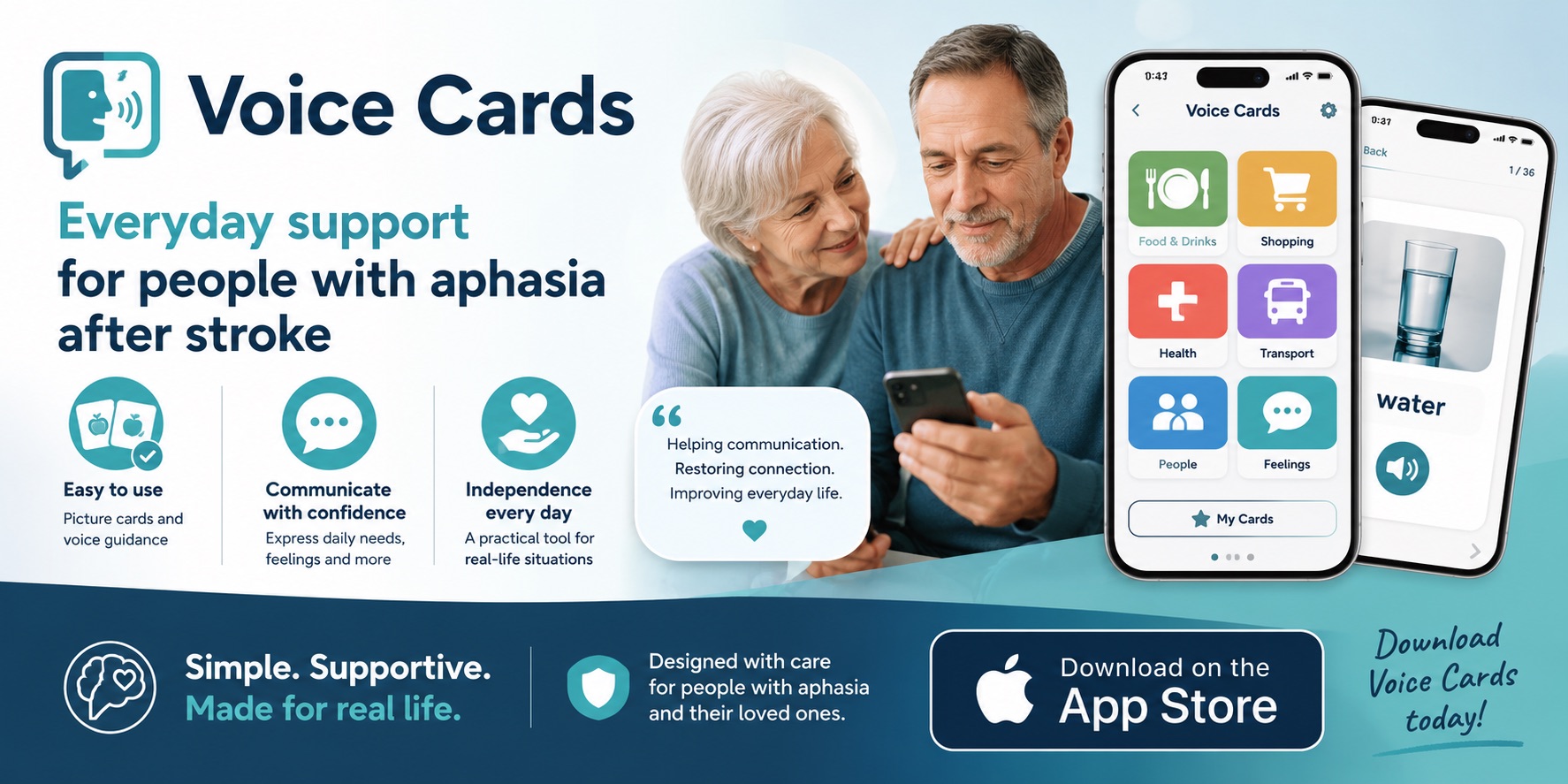
SmallDesk Voice Cards
A simple voice cards app for everyday communication. Currently available for iPhone. Android version coming soon.
Pictures, written keywords, gestures, pointing, personal photos and simple choices can make a message more concrete. When someone can point to “tea,” “outside,” “music,” “tired” or “not now,” communication becomes less like guessing and more like shared understanding. A board can also help the communication partner slow down, offer choices and confirm meaning without rushing.
Communication board, aphasia cards and communication aids: what is the difference?
The terms communication board, aphasia cards, picture cards and communication aids are often used together, but they do not always mean the same thing. A communication board is usually a single page, screen or panel with several options. Aphasia cards are individual cards with pictures, words or phrases. Communication aids is a wider phrase that can include boards, cards, notebooks, alphabet pages, photos, drawing tools and digital apps.
| Term | Plain English meaning | Everyday example |
|---|---|---|
| Communication board for aphasia | A page or screen with words, pictures, choices or topics. | A printed board with yes, no, food, drink, feelings, people and activities. |
| Aphasia picture cards | Separate cards that show one idea at a time. | A card with a photo of a cup, phone, bed, jacket, family member or favorite hobby. |
| Aphasia communication aids | Any practical tool that supports communication. | A notebook, whiteboard, photo album, printed chart, phone app or tablet screen. |
| Printable aphasia communication board | A board designed to be printed and used on paper. | A PDF page with large text, simple icons and everyday phrases. |
| Digital communication tool | A communication support used on a phone, tablet or computer. | A screen with large buttons, saved phrases, photos and personal categories. |
What should a simple aphasia communication board include?
A simple aphasia communication board should include useful everyday choices. It should not be crowded with too many words just because there is space available. A board with fewer clear options can be more useful than a board packed with tiny icons, complicated categories and unfamiliar symbols.
The most useful starting areas are usually basic answers, common needs, feelings, people, places, activities and personal topics. These categories support ordinary conversation, not just urgent messages. A person may want to say they are thirsty, but they may also want to talk about music, family, a favorite show, a pet, a memory, a visitor, the weather or something they enjoyed that day.
Basic answers
Every board should make it easy to answer yes and no. Many people also benefit from options such as maybe, I do not know, ask again, write it down, slower, stop, not that, I agree and I need more time. These choices help the person control the conversation instead of only reacting to what someone else says.
Common needs
Common needs may include water, tea, coffee, food, bathroom, rest, phone, glasses, blanket, chair, outside, home, lights, quiet, hot, cold and help. These words are useful because they appear often in everyday routines. The board should use words that match the person’s real life, not generic vocabulary that feels distant or unnatural.
Feelings and comfort
Feelings are important because communication is not only about objects. A person may want to show that they are happy, sad, frustrated, bored, worried, calm, tired or annoyed. A board can include simple feeling words with clear faces or icons. It can also include comfort words such as too loud, too bright, uncomfortable, better, fine and not now.
People and names
Names and personal photos can make a communication board more meaningful. Instead of using only general words like family, friend or neighbor, a board may include real names and familiar photos if the person wants them there. This can help the person ask for someone, talk about a visit or connect a message to a specific person.
Places and daily routines
Places may include home, garden, kitchen, bathroom, bedroom, car, shop, park, church, café or another location that matters to the person. Daily routines may include breakfast, shower, clothes, walk, television, music, reading, visitors, phone call, rest and going outside. These words help the board fit daily life instead of feeling like a generic worksheet.
Aphasia picture cards for adults
Aphasia picture cards for adults should look respectful, clear and practical. They should not feel childish unless the person specifically enjoys a playful style. Adult communication cards usually work best when they use clean images, readable words, familiar objects and realistic topics. The design should support dignity as much as clarity.
Picture cards can be used one at a time or grouped into categories. For example, a food group may include water, tea, coffee, bread, soup, fruit and favorite meals. A people group may include family members, friends and familiar visitors. An activity group may include music, television, walking, garden, games, reading, prayer, crafts or another personal interest.
SmallDesk Voice Cards
A simple voice cards app for everyday communication. Currently available for iPhone. Android version coming soon.
The best aphasia cards are often personal. A generic picture of a dog may be useful, but a photo of the person’s own dog may be much more meaningful. A generic picture of music may work, but a photo connected with a favorite singer, instrument or playlist may open a better conversation. Personal images can make communication warmer and more natural.
Pictures for aphasia: what makes a good image?
Pictures for aphasia should be easy to recognize. A simple, clear image is usually better than a decorative image with too many details. The picture should match the word as closely as possible. If the card says “water,” the image should clearly show water. If the card says “phone,” the image should clearly show a phone. If the card says “outside,” the image should not be so abstract that it becomes confusing.
Real photos can be helpful when the person recognizes them easily. Simple icons can also work when they are clean and consistent. What matters most is not whether the image is beautiful. What matters most is whether the image is understandable. A communication picture should reduce effort, not create another puzzle.
| Image type | Strength | Possible weakness |
|---|---|---|
| Real personal photos | Very familiar and meaningful. | Can become visually busy if the photo has too many background details. |
| Simple object photos | Clear and concrete. | May feel less personal than real-life photos. |
| Clean icons | Consistent and easy to print. | Some symbols may not be obvious to every person. |
| Words only | Simple for people who read them comfortably. | Not useful if written words are hard to process. |
| Words plus pictures | Gives two ways to understand the same option. | Needs enough spacing to stay readable. |
Printable aphasia communication board: when paper is enough
A printable aphasia communication board can be one of the easiest starting points. It does not need a battery, internet access, account, password or device. It can be printed in large size, placed in a visible location and used immediately. Some people prefer paper because it feels direct and does not require technology during conversation.
A printable board should have large text, strong contrast, enough space between items and simple categories. It should be easy to point to. If the board is too small, crowded or visually noisy, it may become difficult to use. A good printable board often uses fewer options per page and separates topics into different sheets.
A printable aphasia communication board may include one general everyday page, one food and drink page, one people page, one feelings page and one activity page. It may also include a blank area where personal names, favorite places or custom phrases can be added. The more the board reflects real life, the more natural it may feel.
Aphasia communication board PDF: what to look for
Many people search for an aphasia communication board PDF because they want something they can print quickly. A PDF can be useful when it is simple, readable and easy to customize. However, not every printable page is equally helpful. Some PDFs contain too many tiny icons. Others use words that do not fit the person’s daily life. Some look organized but are not easy to use in a real conversation.
A practical PDF communication board should be clear at a glance. It should have enough white space, readable labels, simple images and logical categories. It should not assume that every person needs the same words. A strong PDF can work as a starting template, but personal details often make it more useful.
When using any printable board, it is worth thinking about where the board will actually be used. A kitchen board may need food, drinks and routines. A living room board may need visitors, television, music, comfort and conversation topics. A travel board may need car, home, stop, wait, restroom, phone, money, bag and directions. A board works best when it matches the moment.
Communication cards for aphasia
Communication cards for aphasia can be easier to manage than a full board when the person only needs a small number of options. Cards can be placed on a table, held in the hand, grouped by topic or used during a specific activity. They can also be changed more easily than a fixed board.
For example, during breakfast, only food and drink cards may be needed. During a visit, cards with names, feelings and conversation topics may be more useful. During a walk, cards with outside, stop, home, tired, bench, shop and weather may make more sense. Cards allow the conversation partner to reduce clutter and show only the choices that fit the situation.
A card set can also grow slowly. It does not need to be perfect on the first day. A few useful cards may be better than a large set that no one uses. Over time, cards can be added, removed, renamed or replaced with more personal images.
How to communicate with someone with aphasia using a board
A communication board is only part of the conversation. The way people use it matters. The person with aphasia should not feel tested, corrected or rushed. The board should support conversation, not turn every exchange into a task.
A helpful communication partner usually slows down, uses short clear sentences, gives one idea at a time and waits. Waiting is important. Many people speak too quickly because silence feels uncomfortable. But silence can give the person more time to understand, choose, point or respond in another way.
It can help to point while speaking. For example, instead of asking a broad question such as “What do you want now?”, the partner can show a few options and say, “Tea, water or coffee?” while pointing to each choice. The person can point, look, gesture or reject the options. If the answer is unclear, the partner can confirm gently: “You chose tea. Is that right?”
Good communication also means accepting correction. If the person points to no, shakes their head or shows that the guess is wrong, that response should be respected. The goal is not to finish quickly. The goal is shared meaning.
Supported conversation for adults with aphasia
Supported conversation for adults with aphasia means building a conversation in a way that gives the person more chances to participate. It is not about speaking louder, taking over or treating the person as if they cannot understand. It is about making the conversation easier to enter.
Visual supports can help because they turn invisible language into something visible. A written keyword, a picture, a gesture, a drawing or a choice can hold the topic in place. This can make it easier to follow the conversation and respond. A communication board can be part of that support, especially when it is used naturally and respectfully.
SmallDesk Voice Cards
A simple voice cards app for everyday communication. Currently available for iPhone. Android version coming soon.
Supported communication should include real topics, not only basic needs. Adults want to talk about opinions, memories, interests, relationships, news, music, faith, humor, food, weather, pets, plans and daily life. A board that only includes urgent needs may be useful, but it may not support the whole person. Communication is also about identity, preference and connection.
Low-tech boards versus digital communication tools
Low-tech boards and digital communication tools can both be useful. A paper board is simple, visible and easy to access. A digital tool can store more words, photos and categories. One is not automatically better than the other. The best option depends on comfort, setting, attention, vision, motor control, personal preference and how the tool fits ordinary life.
| Option | Best for | What to watch for |
|---|---|---|
| Printed communication board | Simple daily choices, visible support, no technology needed. | Can become crowded if too much is added to one page. |
| Picture cards | Specific activities, small sets of choices, flexible use. | Cards can be lost or mixed unless organized well. |
| Notebook or folder | Personal photos, names, routines and topic pages. | May need regular updates to stay useful. |
| Phone or tablet app | Portable categories, saved phrases, photos and digital organization. | May feel confusing if the interface is too busy. |
| Whiteboard or paper pad | Writing keywords, drawing, confirming choices and changing topics quickly. | Requires someone to create the visual support in the moment. |
Apps for aphasia and digital communication boards
Apps for aphasia can be useful when they are simple, readable and easy to personalize. A digital communication board may include large buttons, picture categories, personal photos, common phrases and saved messages. Some tools may also allow the person to tap a phrase and have it spoken aloud by the device.
The biggest advantage of a digital tool is flexibility. Categories can be changed, pictures can be replaced, and personal vocabulary can be added. A phone or tablet can hold far more than one printed page. This can be useful for people who want more topics available in one place.
The biggest risk is overload. A digital tool with too many screens, tiny buttons, complicated menus or distracting design can make communication harder. A good digital tool should feel calm, predictable and easy to scan. It should help the person communicate in real moments, not impress the viewer with features.
How to make a communication board feel personal
A personal communication board is usually more engaging than a generic one. It can include real names, familiar photos, favorite foods, places, hobbies, pets, routines, music, sports, family words and phrases the person actually uses. Personal content makes the board feel connected to life rather than like a random template.
For example, instead of only adding “food,” the board might include the person’s favorite meals. Instead of only adding “music,” it might include favorite genres or artists. Instead of only adding “family,” it might include real names. Instead of only adding “outside,” it might include garden, park, porch, walk or another familiar place.
Personalization also means removing what does not fit. A board does not need categories the person never uses. If a page is full of irrelevant choices, it becomes slower and less natural. A smaller board with meaningful words can work better than a large board filled with generic vocabulary.
Design tips for a simple aphasia communication board
A simple aphasia communication board should be easy to see, easy to scan and easy to point to. Large text, clear spacing and strong contrast matter. Each item should have enough room around it. Pictures should not be too small. Similar items should be grouped together. The board should avoid clutter, decorative backgrounds and confusing symbols.
Words and pictures together can be helpful because they provide two ways to understand the same choice. A person may recognize the picture first, the word first or both together. Consistency also helps. If every category has a different style, the board may feel visually noisy. A calm and predictable layout can make the board easier to use.
| Design choice | Why it matters |
|---|---|
| Large text | Makes the board easier to read and point to. |
| Clear pictures | Helps the meaning stand out quickly. |
| Enough spacing | Reduces confusion between nearby options. |
| Simple categories | Makes the board easier to scan. |
| Personal words | Makes the board more relevant to real life. |
| Limited choices per page | Prevents the board from feeling overwhelming. |
Example categories for an aphasia communication board
A communication board can be organized in many ways. The best structure depends on the person and the setting. For a general everyday board, the following categories often make sense: answers, needs, feelings, people, places, food and drink, activities, comfort, time and conversation topics.
| Category | Example words or phrases |
|---|---|
| Answers | Yes, no, maybe, I do not know, ask again, not that, I need more time. |
| Needs | Water, food, bathroom, rest, phone, glasses, help, blanket, chair. |
| Feelings | Happy, sad, worried, frustrated, tired, calm, bored, annoyed. |
| Comfort | Hot, cold, too loud, too bright, quiet, uncomfortable, better, stop. |
| People | Family names, friends, visitors, neighbors, familiar people. |
| Places | Home, garden, kitchen, bedroom, bathroom, car, shop, park. |
| Activities | Music, television, walk, reading, game, cooking, prayer, hobby, outside. |
| Conversation topics | Weather, family, pets, memories, plans, food, sports, news, photos. |
Common mistakes with aphasia communication boards
One common mistake is making the board too crowded. A page with dozens of tiny icons may look complete, but it can be hard to use. Another mistake is using symbols that are not obvious to the person. A third mistake is creating a board that focuses only on basic needs and leaves out personality, interests and conversation.
Another mistake is using the board as a test. A communication board should not become a way to quiz someone or prove what they can or cannot do. It should support meaningful exchange. If the person does not use the board right away, that does not automatically mean the board is useless. It may be too crowded, too unfamiliar, too abstract, badly placed or not connected to topics that matter.
A board can also fail when it is kept out of reach. A printed board hidden in a drawer will not support conversation. A digital app buried inside menus may not be used at the right moment. Communication tools should be easy to find when conversation is actually happening.
How family and friends can make communication more respectful
Respect is the foundation of communication support. A person with aphasia should be spoken to as an adult, included in conversation and given time to respond. Simple language does not mean childish language. Clear communication means reducing unnecessary complexity while keeping dignity.
Family and friends can help by slowing down, reducing background noise, using natural gestures, writing key words, offering visible choices and checking understanding without pressure. They can also avoid talking over the person or answering every question for them. A communication board works best when it supports the person’s own message.
SmallDesk Voice Cards
A simple voice cards app for everyday communication. Currently available for iPhone. Android version coming soon.
It is also helpful to keep real conversation alive. Ask about preferences, memories, interests and opinions. Use photos, music, objects, familiar places and shared routines. A communication board should not narrow life down to “yes,” “no,” “food” and “bathroom.” It should help the person stay connected to the people and topics that matter.
Communication board for adults with aphasia: dignity matters
A communication board for adults with aphasia should feel adult in language, design and purpose. It should not use childish cartoons, babyish wording or oversimplified topics unless the person genuinely prefers that style. Adult communication support should include adult life: relationships, choices, privacy, humor, routines, opinions, memories and personal interests.
Dignity also means asking, observing and adapting. Some people may like photos. Some may prefer words. Some may use gestures more naturally than pointing. Some may enjoy a tablet. Others may prefer paper. Some may want many topics. Others may prefer a small set of choices. The board should serve the person, not the other way around.
How to keep an aphasia communication board useful over time
A communication board should not be treated as finished forever. Daily life changes. Interests change. Visitors change. Routines change. Words that seemed important at first may not be used. New words may become useful. A board can be reviewed and simplified whenever it becomes cluttered or outdated.
One practical approach is to notice which words are used often, which are never used and which messages are missing. If the person often tries to communicate about music, add more music choices. If they often point to family, add names and photos. If they never use a crowded page, divide it into smaller pages. If one picture is confusing, replace it with something clearer.
A board should grow from real communication. The best clues often come from everyday moments: repeated choices, favorite topics, frustrations, routines, gestures and the words people keep trying to guess. A useful board reflects life as it is actually lived.
FAQ about communication boards for aphasia
What is the best communication board for aphasia?
The best communication board for aphasia is the one the person can understand, access and use in real daily situations. It should be clear, respectful, personal and not overcrowded. A simple board with meaningful words can be better than a complex board with too many choices.
Are aphasia picture cards useful?
Aphasia picture cards can be useful when they show clear, familiar and meaningful choices. They can help a person point to objects, people, feelings, activities or topics. They work best when they match the person’s everyday life rather than using only generic images.
What should be on an aphasia communication board?
An aphasia communication board may include yes, no, maybe, I need more time, food, drink, bathroom, rest, help, feelings, people, places, activities and personal topics. It can also include names, photos, favorite foods, hobbies and common phrases.
Is a printable aphasia communication board enough?
A printable aphasia communication board can be enough for many simple everyday situations. Paper can be easy to access, easy to point to and easy to place in visible locations. Some people may prefer printed boards, while others may prefer digital tools or a mix of both.
Can an aphasia communication board be digital?
Yes. A digital communication board can be used on a phone, tablet or computer. It may include pictures, words, categories, saved phrases and personal photos. The most important thing is that the tool remains simple enough to use during real conversation.
What is the difference between aphasia cards and a communication board?
Aphasia cards are usually separate cards with one picture, word or phrase on each card. A communication board is usually a page or screen with several options in one place. Cards are flexible, while boards can be easier to scan as a complete set of choices.
How do you communicate with someone with aphasia?
Use clear language, slow down, give time, reduce distractions, offer choices, write key words, use pictures, confirm meaning and respect every response. A communication board can help, but respectful interaction is just as important as the tool itself.
Should a communication board use words, pictures or both?
Many boards use both words and pictures because this gives more than one way to understand the message. Some people may respond better to photos, others to simple icons, and others to written words. The design should match the person’s real preferences and comfort.
Final thoughts
A communication board for aphasia is not just a sheet of words and pictures. It is a bridge between a person and the people around them. It can make everyday choices easier, reduce guessing, support conversation and give the person more ways to share what they want, feel and think.
The strongest aphasia communication boards are simple, personal and respectful. They use clear pictures, useful words, familiar topics and enough space to be readable. They support adult conversation, not only basic needs. Whether printed, made from picture cards or used as a digital tool, the best board is the one that helps real communication happen more naturally.