What to Say to Someone With Aphasia: Simple Conversation Starters for Family and Friends
Talking with someone who has aphasia can feel emotional at first, especially when you care deeply about the person and want every conversation to feel natural, respectful, and calm. You may wonder what to say, how much time to give, which questions are easier to answer, or how to keep the conversation from feeling like a test. The good news is that everyday communication does not have to be perfect to be meaningful. Small changes in the way you speak, listen, pause, and respond can make a conversation feel more comfortable for both of you.
This guide focuses on simple, everyday conversation support for family members, friends, and caregivers. It is not a medical guide and it does not try to explain aphasia from a clinical point of view. Instead, it gives practical examples of gentle phrases, conversation starters, and questions you can use in normal daily life when you want to help someone feel included, understood, and respected.

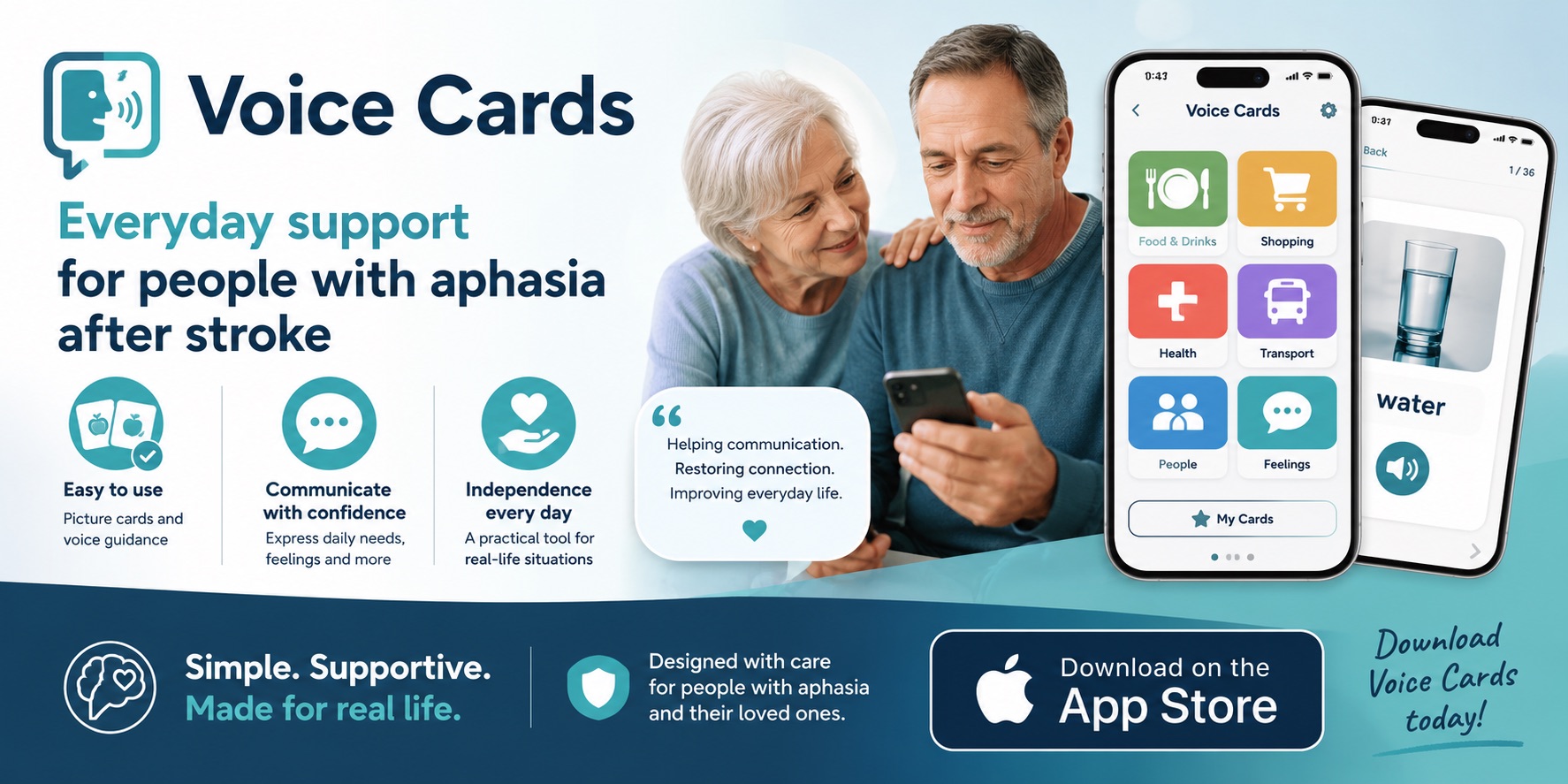
SmallDesk Voice Cards
A simple voice cards app for everyday communication. Currently available for iPhone. Android version coming soon.
Why the Words You Choose Matter
When someone has aphasia, conversation can take more time. The person may know what they want to say, but finding the exact word, saying a full sentence, or answering quickly may be difficult. That does not mean the person has nothing to say. It also does not mean the conversation has to stop. Often, the most helpful thing you can offer is patience, calm attention, and a way to answer without pressure.
The best words are usually simple, warm, and open. A short sentence can be more useful than a long explanation. A calm question can be better than several questions at once. A quiet pause can say, “I am still here with you,” without making the person feel rushed. This is why learning what to say to someone with aphasia is not about memorizing perfect lines. It is about creating a conversation where the person has room to respond in their own way.
For family and friends, the goal is not to speak for the person or take control of every exchange. The goal is to make conversation easier to enter. This may mean offering choices, using familiar topics, slowing the rhythm of the conversation, or supporting words with gestures, pictures, written keywords, or simple voice cards.
What to Say to Someone With Aphasia When You Start a Conversation
The beginning of a conversation matters because it sets the tone. If you start with a rushed question or too many details, the person may feel pressure immediately. A gentle opening gives them time to understand the topic and decide how they want to respond.
Simple phrases that feel calm and natural
You can begin with short, friendly phrases such as:
- “I’m happy to sit with you for a while.”
- “We can take our time.”
- “You don’t have to answer quickly.”
- “I’m listening.”
- “Tell me in any way you can.”
- “You can point, gesture, write, or use pictures.”
- “Let’s talk about something easy.”
These phrases work because they remove pressure. They also remind the person that communication does not have to happen only through perfect speech. A gesture, a look, a written word, a picture, a yes-or-no answer, or a selected phrase can still be meaningful communication.
Helpful openings for everyday moments
If you are not sure how to begin, choose a topic that is already present in the room or in the day. You can say, “It’s a quiet morning today,” “This coffee smells good,” “The garden looks nice,” or “I was thinking about our walk yesterday.” These simple openings are easier than sudden abstract questions because they connect to something familiar and immediate.
For many people, a conversation about the present moment feels safer than a conversation that demands memory, explanation, or long storytelling. You can still talk about memories, family, plans, and feelings, but it often helps to begin with something simple and concrete.
Aphasia Conversation Starters for Everyday Life
Aphasia conversation starters should feel natural, not childish or forced. The best conversation starters are clear, friendly, and connected to real life. They should invite the person into the conversation without making them feel examined.
Conversation starters about the day
- “How is today feeling for you?”
- “Is this a good time to talk?”
- “Would you like a quiet day or a busy day?”
- “Do you want to sit here or somewhere else?”
- “Would you like music, TV, or quiet?”
- “Do you want to go outside for a few minutes?”
These questions are useful because they give the person a chance to express preferences. They can often be answered with one word, a gesture, pointing, or a simple yes or no. When someone is tired or conversation feels difficult, this kind of starter can still keep them involved in everyday choices.
Conversation starters about feelings and comfort
- “Are you comfortable?”
- “Do you want company or quiet?”
- “Is this okay?”
- “Would you like a break?”
- “Do you want me to stay?”
- “Do you want help, or do you want to try first?”
Questions like these show respect because they do not assume what the person wants. They also help avoid one of the most common communication mistakes: doing everything too quickly because silence feels uncomfortable. Silence is not always a problem. Sometimes silence is simply the time a person needs to prepare an answer.
Conversation starters about memories
- “I found an old photo today.”
- “This song reminds me of you.”
- “Do you remember this place?”
- “Was this a happy day?”
- “Would you like to look at family pictures?”
- “Should we talk about holidays, home, or family?”
Memory-based conversation can be warm and meaningful, but it should not feel like a quiz. Instead of asking, “Do you remember exactly when this happened?” you can offer context and allow a simple response. A shared photo, object, song, or place can support the conversation without forcing the person to find many words at once.
Questions to Ask Someone With Aphasia
Good questions are one of the most important parts of better conversations with aphasia. A helpful question gives the person a clear path to answer. A difficult question may be too open, too long, too fast, or too abstract. This does not mean you should avoid real conversation. It means you can shape questions in a way that makes answering easier.
Use choice questions when possible
Choice questions are often easier than open-ended questions because they give the person a starting point. Instead of asking, “What do you want to do today?” you can ask, “Do you want to stay home or go outside?” Instead of asking, “What would you like to eat?” you can ask, “Would you like soup or a sandwich?”
SmallDesk Voice Cards
A simple voice cards app for everyday communication. Currently available for iPhone. Android version coming soon.
Examples of useful choice questions include:
- “Tea or coffee?”
- “Inside or outside?”
- “Now or later?”
- “This one or that one?”
- “Music or quiet?”
- “Family photos or television?”
- “Walk or rest?”
When you ask a choice question, show the choices if possible. You can point to two cups, two rooms, two photos, two objects, or two written words. This gives the person more than one way to answer.
Use yes-or-no questions carefully
Yes-or-no questions can be very helpful, but they work best when they are calm, clear, and asked one at a time. Instead of asking, “Do you want to go out, or are you tired, or should we call later?” ask one short question: “Do you want to go out?” Then pause.
Helpful yes-or-no questions include:
- “Are you ready?”
- “Do you want a break?”
- “Is this what you mean?”
- “Should I say it again?”
- “Do you want to point?”
- “Do you want me to write it down?”
- “Do you want more time?”
After asking, wait. The pause is part of the question. If you repeat the question too quickly, the person may have to start processing again from the beginning.
Use open questions only when there is enough time
Open questions can still be meaningful. The key is to use them when the person is relaxed and there is no rush. A question like “What did you enjoy today?” may be lovely in a quiet moment, but stressful when the person is tired or when others are waiting.
If an open question feels too hard, gently narrow it. You can say, “Was it the walk?” or “Was it the music?” or “Was it seeing Anna?” This helps the person move from a large answer to a smaller, easier response.
How to Talk to Someone With Aphasia Without Making It Feel Like a Test
One of the most important communication tips is to avoid turning every conversation into a performance. Family members often want to help, so they may ask many questions, correct words, or encourage the person to try again and again. The intention may be loving, but the experience can feel tiring.
A better approach is to treat conversation as connection, not correction. If the meaning is clear enough, you do not always need to fix the sentence. If the person points, gestures, or uses one word, you can respond to the meaning rather than focusing on what was missing.
Helpful phrases that reduce pressure
- “That’s okay, I understand.”
- “Take your time.”
- “We can come back to it.”
- “You showed me what you mean.”
- “That makes sense.”
- “I think I understand. Let me check.”
- “You don’t have to get every word.”
These phrases help the person feel that communication is successful even when speech is not smooth. They also keep the emotional tone of the conversation positive.
What not to say when someone is trying to answer
Some phrases can accidentally create pressure, even when they are said with good intentions. Try to avoid saying things like “You know this word,” “Try harder,” “Say it properly,” “We talked about this yesterday,” or “No, that’s not right.” These phrases can make the person feel corrected instead of supported.
A softer version is often better. You can say, “Let’s try another way,” “Can you show me?” “Would a picture help?” or “I’ll write down a few choices.” This keeps the conversation moving without turning the moment into a test.
Conversation Topics That Often Work Well
Choosing the right topic can make conversation easier. Some topics require long explanations, while others can be shared with short answers, gestures, pictures, or simple choices. Good aphasia conversation topics are familiar, personal, and emotionally safe.
Everyday topics
- Food and drinks
- Weather
- Music
- Family photos
- Pets
- Gardens and plants
- Television shows
- Favorite places
- Small plans for the day
- Comfort, rest, and preferences
These topics work because they can be made visual. You can point to a photo, object, window, cup, plate, song, or place. The more concrete the topic is, the easier it may be to support the conversation with something the person can see or touch.
Topics that may need extra care
Some topics are important but may feel emotionally heavy or linguistically difficult. Conversations about money, conflict, big decisions, family problems, or complex plans may need more time, fewer distractions, and a calm setting. If a topic is serious, it can help to write down keywords, offer clear choices, and check understanding gently.
You can say, “This is important, so we will go slowly,” or “I will write down the main words,” or “You can stop me if it is too much.” These phrases show respect and help make the person part of the conversation.
SmallDesk Voice Cards
A simple voice cards app for everyday communication. Currently available for iPhone. Android version coming soon.
How to Help Someone With Aphasia Communicate in a Group
Group conversations can be difficult because people speak quickly, change topics, interrupt each other, and use jokes or side comments. Someone with aphasia may need more time to follow the topic and prepare a response. Family and friends can make group conversations more inclusive with a few simple habits.
Set the person up for success
Before a group conversation begins, you can quietly explain the topic. For example, “We are going to talk about dinner plans,” or “Everyone is talking about the holiday photos.” This gives the person a starting point. During the conversation, keep the topic clear and avoid several people speaking at the same time.
If the person wants to contribute, make space. You can say, “Let’s give John a moment,” or “I think Anna wants to add something.” This should be done gently, not dramatically. The goal is to include the person without putting them on display.
Use short summaries
A short summary can help someone rejoin the conversation. You might say, “We are choosing where to eat,” or “We are talking about Saturday,” or “Tom said he liked the first idea.” Summaries are useful because they reduce the work of following every sentence.
It also helps when one person acts as a calm communication partner. This person can slow things down, repeat keywords, point to choices, or check whether the person wants to answer. The support should feel natural and respectful, not controlling.
Do People With Aphasia Know What They Want to Say?
Many people with aphasia know what they want to say, but getting the words out can be difficult. This is one of the reasons patience is so important. A person may have an idea, opinion, feeling, or memory clearly in mind, but the spoken words may not come easily or may come out differently than expected.
When you understand this, your role in the conversation changes. Instead of assuming the person has nothing to say, you make room for the message to appear in another way. That may be through pointing, choosing, drawing, facial expression, gesture, written keywords, pictures, or a communication app.
A helpful phrase is: “I know you have something to say. We can find another way.” This simple sentence can be powerful because it shows that you are not giving up on the person’s message.
Can People With Aphasia Understand What You Say?
Understanding can vary from person to person and from moment to moment. Some people may understand much more than they can say. Others may need shorter sentences, more time, visual support, or repeated keywords. Because every person is different, it is better not to guess. Instead, check understanding in a respectful way.
You can say, “Should I say that again?” or “Was that clear?” or “I will say it in a simpler way.” You can also write down one or two important words, show a picture, point to an object, or offer two choices. The goal is not to speak down to the person. The goal is to make the message easier to receive.
A good rule is to keep your tone adult, warm, and natural. Use simpler language, but do not use a childish voice. Respect is just as important as clarity.
Simple Phrases That Help When Communication Gets Stuck
Every conversation can get stuck sometimes. This can happen when the person cannot find a word, when you misunderstand, when the topic changes too quickly, or when everyone becomes frustrated. The best response is not panic. A calm reset can save the conversation.
Phrases for slowing down
- “Let’s slow down.”
- “We have time.”
- “One thing at a time.”
- “I’ll wait.”
- “Take a breath.”
- “No rush.”
Phrases for checking meaning
- “Do you mean this?”
- “Is it about today?”
- “Is it about family?”
- “Is it something you want?”
- “Is it something you don’t want?”
- “Am I close?”
Phrases for trying another way
- “Can you show me?”
- “Can you point?”
- “Should I write some words?”
- “Would pictures help?”
- “Let’s choose from two options.”
- “We can come back to this later.”
These phrases are useful because they protect the relationship. They keep the conversation cooperative instead of turning it into a struggle. Sometimes the most helpful thing you can say is simply, “We can try another way.”
Using Pictures, Written Words, and Voice Cards During Conversation
Spoken words are only one part of communication. Many families find that pictures, written keywords, printed cards, objects, gestures, and simple voice tools can make everyday conversation easier. These supports are not a replacement for the person. They are bridges that help the person express a choice, need, feeling, or idea.
For example, if you are asking about food, you can show two real items or two pictures. If you are talking about plans, you can write down “home,” “walk,” “shop,” and “visit.” If the person uses a communication board or a simple app, you can give them time to choose a phrase instead of expecting an immediate spoken answer.
On Aphasia Guide, you can also read more about communication boards for aphasia and simple apps for aphasia. These tools can support daily conversation when speaking is difficult, especially when the person wants to express common needs, feelings, choices, or familiar phrases.
The most important part is how you use the tool. Do not rush the person through the options. Do not treat the board or app like a test. Sit beside the person, offer time, and respond to the message they choose. A selected phrase is still a real message.
SmallDesk Voice Cards
A simple voice cards app for everyday communication. Currently available for iPhone. Android version coming soon.
Better Conversations With Aphasia: Small Habits That Make a Big Difference
Better conversations with aphasia often come from small habits repeated every day. These habits are simple, but they can change the emotional feeling of communication. They show the person that they are still part of family life, still worth listening to, and still included in everyday decisions.
Speak a little slower
Speaking slower does not mean speaking in an unnatural way. It means leaving more space between ideas. Use one clear thought at a time. If you need to explain something, pause after the main point before adding more detail.
Use normal adult respect
A person with aphasia should not be spoken to like a child. Simple language can still be adult, warm, and respectful. Your tone should say, “You are still you.”
Give time after each question
Waiting can feel uncomfortable at first, but it is one of the most useful things you can do. Count silently if you need to. Give the person enough time to process the question and prepare an answer.
Watch for nonverbal answers
A look, gesture, smile, head movement, hand movement, or change in expression can be part of the answer. Do not focus only on spoken words. Communication may already be happening.
Confirm without taking over
If you think you understand, check gently. You can say, “I think you mean the blue cup. Is that right?” This confirms meaning without pretending you know everything.
What Family and Friends Should Avoid
Most communication mistakes happen because people are trying too hard to help. They speak too much, ask too many questions, correct too often, or fill every silence. A calmer approach is usually more useful.
Avoid too many questions at once
Instead of asking, “Do you want to eat now, or should we wait, or do you want something else, or are you tired?” ask one question: “Do you want to eat now?” Then wait. If needed, ask the next question later.
Avoid correcting every word
If the message is clear, respond to the message. Constant correction can make conversation feel unsafe. Save correction for moments when the person asks for help or when meaning is truly unclear.
Avoid speaking about the person as if they are not there
Even when communication is difficult, include the person in the conversation. Look at them. Ask their opinion. Give them time. Do not discuss their preferences with others while they are sitting nearby without including them.
Avoid finishing every sentence too quickly
Sometimes finishing a word may be helpful, but only when the person seems to want that help. If you jump in too soon every time, the person may lose the chance to express themselves. A better approach is to wait first, then ask, “Do you want help with the word?”
Examples of Gentle Everyday Conversations
Sometimes examples are easier than rules. The following short conversations show how a family member or friend can use simple words, choices, pauses, and confirmation.
Example 1: Choosing a drink
Family member: “Would you like tea or coffee?”
Family member: “Tea?”
Family member: “Coffee?”
Family member: “You pointed to coffee. Coffee, yes?”
Family member: “Okay. I’ll make coffee.”
This conversation works because the choices are simple, the topic is clear, and the person can answer by pointing or confirming.
Example 2: Understanding a request
Friend: “You want something. I’m listening.”
Friend: “Is it in this room?”
Friend: “Is it the phone?”
Friend: “No? Okay. Is it the blanket?”
Friend: “Yes, the blanket. Thank you for showing me.”
This conversation works because the friend does not rush or become frustrated. They narrow the possibilities and treat the answer as successful communication.
Example 3: Talking about a photo
Family member: “I found this photo today.”
Family member: “This is from the beach.”
Family member: “Was this a happy day?”
Family member: “Yes. I remember it too.”
Family member: “Would you like to look at more photos?”
This conversation works because the photo supports the topic. The person does not have to explain everything. They can share the moment with a simple response.
How to Make the Person Feel Included
Inclusion is not only about asking questions. It is about allowing the person to remain part of ordinary life. This can happen during meals, family visits, walks, holidays, phone calls, hobbies, and quiet moments at home. A person does not need to speak perfectly to be included.
You can include someone by asking for small choices, sharing simple updates, showing photos, inviting their opinion, and waiting for their response. You can also tell them what is happening around them: “Sarah is coming at three,” “We are making soup today,” or “I put your favorite blanket here.” These small updates help the person stay connected to the rhythm of daily life.
If visitors come, it may help to prepare them. You can say, “Please speak slowly, ask one question at a time, and give time for answers.” This simple guidance can make visits more comfortable and prevent people from overwhelming the conversation.
FAQ: Talking With Someone Who Has Aphasia
What should I say to someone with aphasia?
Say simple, respectful, adult phrases that give the person time. Good examples include “Take your time,” “I’m listening,” “Can you show me?” and “We can try another way.” The best words are calm and supportive, not rushed or corrective.
What are good questions to ask someone with aphasia?
Good questions are short and clear. Choice questions and yes-or-no questions are often easier than long open questions. For example, “Tea or coffee?” “Do you want a break?” or “Would you like music or quiet?” can be easier than asking several things at once.
How can I start a conversation with someone with aphasia?
Start with something familiar and present. You can talk about the weather, a photo, a meal, a song, a pet, a garden, or a simple plan for the day. A good conversation starter does not feel like a test.
Should I finish the person’s sentences?
Not automatically. Wait first. If the person seems stuck, ask, “Do you want help with the word?” Some people may appreciate help in certain moments, while others may prefer more time to try.
Can pictures or written words help during conversation?
Yes, pictures, written keywords, objects, gestures, and simple voice cards can support everyday communication. They give the person more than one way to express a choice, feeling, need, or idea.
How do I know if the person understood me?
Check gently. You can ask, “Was that clear?” or “Should I say it again?” You can also repeat the main word, point to an object, write a keyword, or offer two choices. Keep your tone respectful and natural.
Final Thoughts: The Best Conversation Is Not Always the Fastest One
When you are learning how to talk to someone with aphasia, it is easy to focus on the right words. But the most important part of communication is often the feeling behind the words. A calm voice, patient silence, respectful eye contact, and a willingness to try another way can make a conversation feel safe.
You do not need to make every conversation long. You do not need to fix every word. You do not need to have the perfect answer. What matters most is that the person feels heard, included, and given enough time to communicate in the way they can.
Better conversations with aphasia often begin with one simple message: “I am here, I am listening, and we can take our time.”