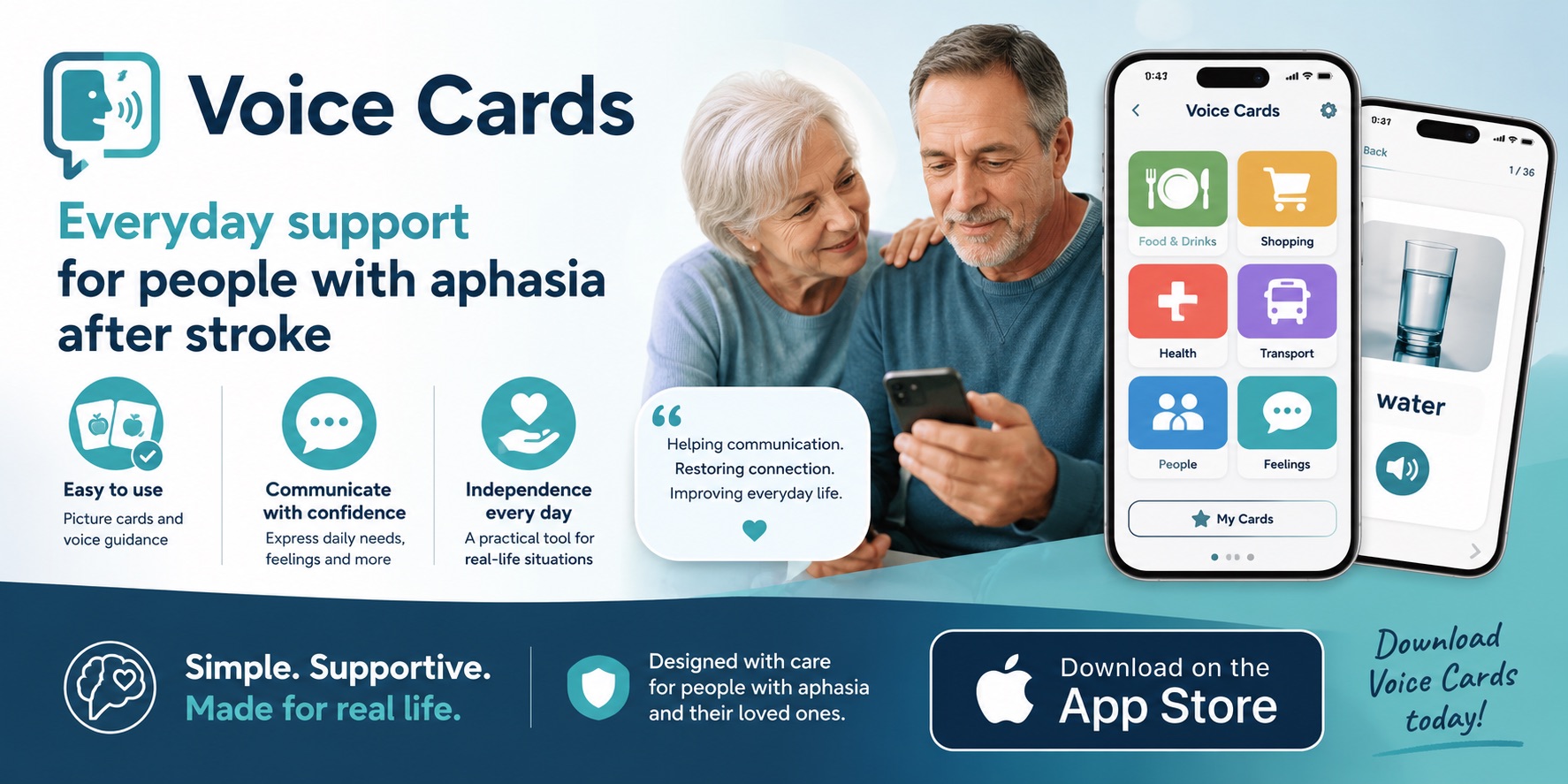
An aphasia communication passport is a short, person-approved guide that explains how someone communicates best. It can help a receptionist, healthcare worker, neighbour or new support person offer the right choices without making assumptions about understanding or decision-making ability. The most useful passport is not a detailed medical history: it is a readable page containing the person’s preferences, reliable communication methods and instructions for checking important answers.
Start with the person, not the diagnosis
Aphasia can affect speaking, understanding, reading and writing in different combinations. The presence of a language difficulty does not by itself reveal someone’s intelligence, wishes or capacity to make a particular decision. A passport should therefore use the person’s preferred name, explain which ways of communicating help, and say what other people should avoid. For example, “Please speak directly to me, use one question at a time and write down two choices” is more actionable than “Patient has expressive aphasia.”
Create the first version together with the person who will use it. If speech, reading or writing are difficult, try pictures, gestures, pointing and short spoken choices. If a family member suggests a phrase, check whether the person agrees before including it. The same principle of making the person’s own voice central is important during medical decisions and informed consent with aphasia.
Five pieces of information worth including
Preferred approach: note whether the person wants a quiet setting, slower pace, written keywords, pictures or extra time. Reliable responses: explain how they indicate yes, no, uncertainty and a request to stop. Helpful supports: list a communication book, phone app, pen and paper or picture sheet that is actually used. Communication repair: tell a partner what to do if a message is not clear. Contact preferences: identify how and when someone else may be involved, without implying that a companion should answer in the person’s place.
A compact sample statement might read: “I understand best when you say one thing at a time. Please show choices in writing. I sometimes say the wrong word; confirm important names, times and amounts with me. Do not rush my answer.” This is not a universal template. Some people find written words helpful; others have significant reading difficulties and prefer objects or photographs.
Make yes and no more reliable
A passport should not simply state that someone can nod for yes and shake their head for no. For some people with aphasia, spoken or gestured responses may be inconsistent, especially during fatigue or pressure. Test an agreed method with simple, known questions and compare it across different settings. When making a serious decision, ask the question in another form, offer written or visual alternatives and confirm the intended answer without leading the person.
Include a sentence about what happens when a response cannot be confirmed: “Please give me time or contact my speech and language therapist for communication support.” The goal is not to replace professional assessment. Guidance on repairing a conversation when the wrong word comes out offers further ways to confirm meaning while preserving dignity. The American Speech-Language-Hearing Association’s communication advice also emphasizes choices, gestures and verification rather than pretending to understand.
One page for daily use, another for emergencies
A daily passport might contain a name, two or three communication preferences, a small set of common symbols and a simple explanation of aphasia. An emergency version may need a clearly marked way to communicate pain, allergies or urgent concerns. Do not merge everything into one crowded card. A healthcare worker reading it under time pressure should find the relevant information immediately, while a café employee does not need to see private medical details.
For urgent situations, use the more focused aphasia emergency communication plan alongside the everyday passport. A passport must never delay emergency assessment. Sudden new difficulty speaking, new facial droop, weakness or confusion may be a stroke warning and warrants immediate emergency help, even if the person already lives with aphasia.
Privacy: share only what the situation requires
Before printing or sharing the passport, ask where it will be used. A wallet card can be lost; an image sent by message can be forwarded. Avoid including a full home address, passwords, financial information or unnecessary diagnoses in the version shown to strangers. A first name and communication instructions may be sufficient for everyday encounters. Consider a separate, more detailed page for clinical settings, stored securely and shared deliberately.
Agree who may update the passport and when. If a support person keeps a digital copy, the person with aphasia should understand the arrangement as far as possible and be offered choices about removing details. A passport is a communication aid, not blanket consent to share health information or to speak on someone’s behalf.
Design it for the way it will be read
Use large, clear lettering, generous space and short sentences. Place the most important instruction at the top, followed by perhaps three labelled sections. Avoid tiny icons whose meaning cannot be guessed. A photograph is useful only if the person wants one and if it serves a purpose. Test the page with someone who has not helped write it: can they identify how to offer a choice in ten seconds? If not, simplify the layout rather than adding another paragraph.
Print a small copy if the text remains readable, and keep a full-size version available for appointments. A phone screenshot is convenient but not always accessible when the battery is flat or the screen is locked. Some people prefer to point to a laminated page; others use a communication app. Choose the format that fits the person’s actual routine.
Review after real conversations
The first version is a starting point. After a medical visit or community appointment, ask what worked and where misunderstandings remained. Remove instructions that nobody uses. Add a phrase if it repeatedly prevents confusion, such as “Please write appointment times as digits” or “Please let me finish pointing before speaking.” If communication becomes harder late in the day, the advice on planning conversations around aphasia fatigue can guide the timing of important interactions.
A passport should change as abilities, preferences and daily activities change. A speech and language therapist can help tailor communication supports, particularly when important decisions are involved. The measure of success is not the number of boxes completed; it is whether the person can participate more reliably and retain control of their choices.
Frequently asked questions
Is a communication passport the same as a medical ID?
No. A medical ID provides emergency health information. A communication passport tells other people how to communicate. The two can complement one another, but their contents and privacy settings need not be identical.
Should family members fill it in?
They can support the process, suggest useful examples and help make a readable version. The person with aphasia should approve the content whenever possible; a relative’s convenient method is not necessarily the person’s preferred method.
Does everyone with aphasia need the same passport?
No. Aphasia varies greatly. Some people benefit from photographs, some from written keywords, and others from gesturing or a dedicated communication device. Test the method instead of assuming it will work.