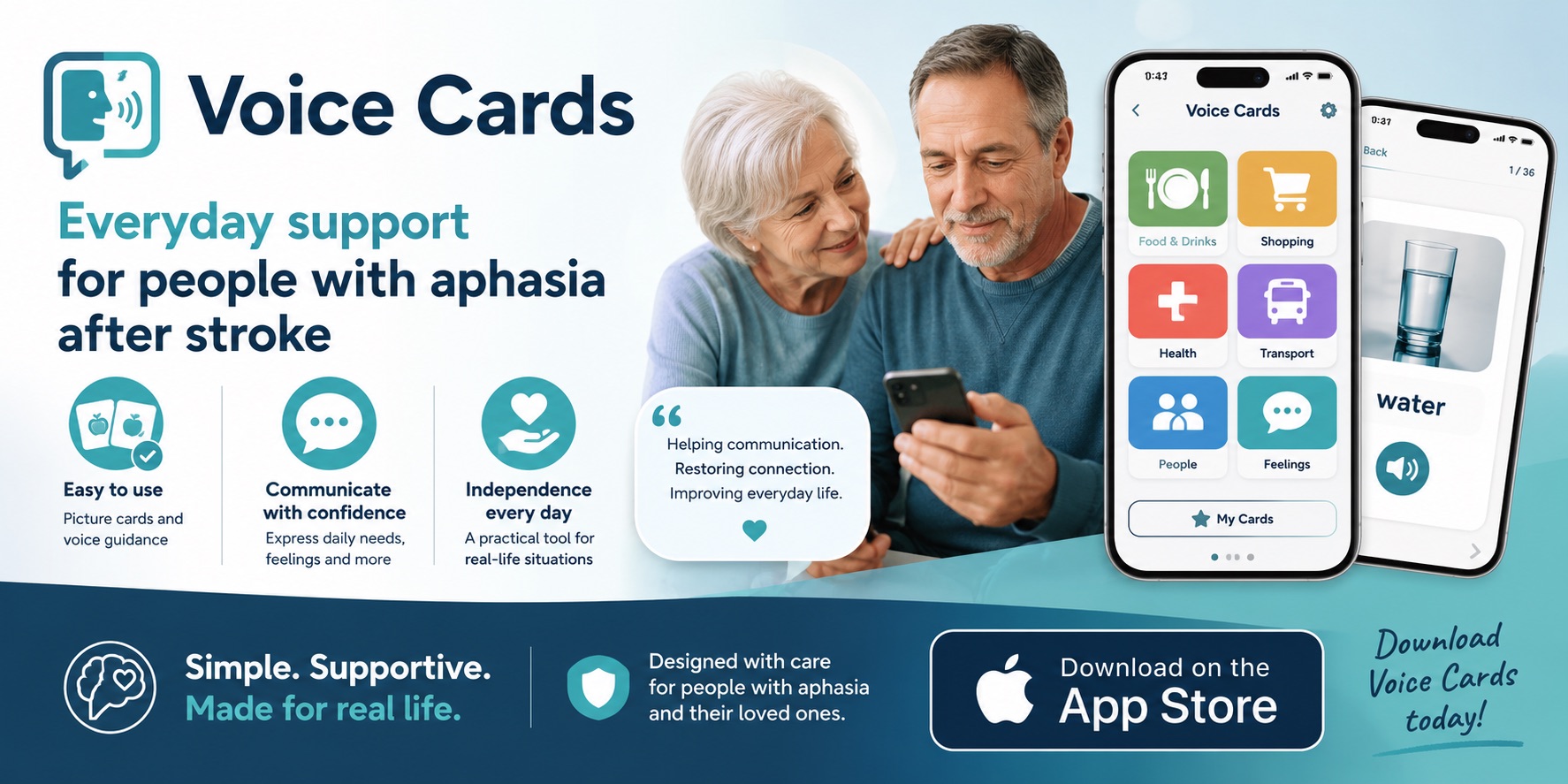
Including a person with aphasia in a group conversation requires more than speaking slowly or choosing simple words. Groups create additional challenges because several people may talk at once, topics can change quickly and there may be little time to respond.
A more accessible conversation gives the person a genuine opportunity to understand, contribute, disagree, tell stories and make decisions. It does not require perfect speech, and it should not turn an ordinary social event into a test or therapy session.
Every person with aphasia communicates differently. Some people understand group discussions but need more time to speak. Others may benefit from written keywords, gestures, pictures or a brief summary when the topic changes. The most effective approach is to ask the person what helps and adapt the group around their preferences.
Why group conversations can be difficult for someone with aphasia
A one-to-one conversation usually has a predictable pattern. One person speaks, the other responds and both participants can notice when something has not been understood.
In a group, the communication demands increase. Several people may:
- speak at the same time,
- interrupt one another,
- change the subject without warning,
- use jokes, idioms or shared references,
- speak from different parts of the room,
- expect an immediate response,
- continue talking while the person is preparing an answer.
Background music, television, dishes, traffic and side conversations can add further difficulty. The person may be trying to understand the current speaker while also identifying the topic, remembering what they want to say and finding the words to express it.
A delayed response does not mean the person has nothing to contribute. They may need more time to process the discussion or communicate their message.
Group exclusion can happen unintentionally
Friends and relatives may believe they are helping when they speak for the person, finish every sentence or move the conversation forward quickly. Over time, however, the person with aphasia may become a listener rather than a participant.
Exclusion may also happen when:
- questions are directed only to a companion,
- people discuss the person while they are present,
- the group assumes silence means agreement,
- the conversation moves on before the person can respond,
- others avoid asking for an opinion because communication may take longer.
The aim is not to force participation. It is to make participation possible whenever the person wants it.
Ask the person what helps before the conversation
General communication strategies are useful starting points, but they should not replace individual preferences. Ask the person how they would like the group to support them.
Useful questions include:
- Would you like people to speak one at a time?
- Does writing down keywords help?
- Would you like someone to tell the group what aphasia is?
- Should people wait when you are finding a word?
- When would you like a companion to help?
- Would a smaller group be more comfortable?
- Would you like to see the topics or agenda in advance?
- How should someone check that they understood you?
The answers may change according to the situation. Someone may want active support during a formal meeting but prefer minimal intervention at a relaxed family dinner.
Agree on a private signal
A simple signal can help the person control when assistance is provided. It might mean:
- please give me more time,
- please help me find the word,
- please repeat the question,
- please tell the group what I mean,
- I want to leave the conversation for a while.
The signal could be a gesture, a card, a written word or an agreed phrase. It should be easy for the person to use without drawing unnecessary attention.
Prepare an aphasia-friendly environment
The environment can make communication easier before anyone changes how they speak. Reducing unnecessary noise and visual distraction allows more attention to be directed toward the conversation.
Reduce background noise
When possible:
- turn off the television,
- lower background music,
- close a door or window if outside noise is distracting,
- avoid holding the main conversation beside a busy kitchen,
- limit side conversations,
- choose a quieter time or location.
The National Aphasia Association recommends reducing distractions, using clear language and combining speech with visual support when helpful. Its communication support guidance provides additional practical strategies.
Arrange the seating carefully
A circular or semicircular arrangement can help participants see one another. The person with aphasia may find it easier when they can clearly see:
- who is speaking,
- facial expressions,
- gestures,
- written keywords,
- pictures or other visual materials.
Good lighting is also important. Avoid placing the main speaker in front of a bright window or in another position where their face is difficult to see.
Keep communication tools within reach
Useful tools may include:
- paper and a thick pen,
- a small whiteboard,
- a communication board,
- photographs,
- a calendar,
- a map,
- a phone or tablet,
- printed names of participants,
- a short written agenda.
Do not place these materials in another room or inside a closed bag. A support tool is most useful when it can be reached quickly without interrupting the conversation.
Explain aphasia to the group when appropriate
Some participants may not know what aphasia is. A short explanation can prevent people from confusing difficulty with language with a lack of intelligence, interest or decision-making ability.
With the person’s permission, someone might say:
Alex has aphasia. Communicating may take more time, but Alex still has opinions and knows what they want to say. Please speak one at a time, allow time for an answer and use writing or gestures when helpful.
Keep the explanation relevant to the situation. The group usually does not need personal medical details.
Let the person decide what is shared
Some people are comfortable explaining aphasia themselves. Others may prefer to use a card or ask a trusted person to introduce the subject. They may also decide not to explain it at all.
An aphasia ID card can provide a brief explanation and list preferred communication strategies without requiring the person to repeat the same information.
Manage turn-taking without making the conversation unnatural
Turn-taking is one of the most important differences between a manageable group conversation and an inaccessible one. When several people speak simultaneously, the person with aphasia may lose both the words and the identity of the speaker.
Encourage one speaker at a time
A group does not need rigid rules for every casual discussion, but participants should avoid speaking over one another. This is especially important when:
- the person with aphasia is speaking,
- important information is being shared,
- a decision is being made,
- the conversation has become confusing,
- several participants are asking questions.
Use names before speaking
In a larger group, beginning with a name can make it clear who is being addressed.
Maria, would you like tea or coffee?
This is clearer than asking a question while looking generally across the room.
Protect the person’s turn
When the person is preparing a response, other participants should avoid filling the silence or starting a different conversation.
A facilitator or companion can say:
Sam is still answering. Let’s give them a moment.
This protects the person’s place in the discussion without drawing attention to every pause.
Do not require the person to compete for attention
Some groups depend on interruption. Participants begin speaking as soon as they have an idea, and quieter members may never find an opening.
A host can invite the person into the discussion:
Jordan, would you like to add anything?
The invitation should be genuine but optional. It should not create pressure to speak every time.
Keep the conversation topic clear
Topic changes can be difficult to follow, particularly when they happen quickly or are signaled only by a joke or indirect comment.
State important topic changes
Use a brief transition such as:
- We are talking about the holiday now.
- Let’s move to the next question.
- We have finished discussing the food.
- Now we need to choose a date.
This does not need to happen before every casual remark. It is most helpful when the discussion has changed significantly or the person appears unsure about the context.
Write the current topic
For longer discussions, write one or two keywords where everyone can see them.
Examples include:
- Birthday plans
- Saturday or Sunday?
- Where should we meet?
Written keywords provide a shared reference and can help the person return to the conversation after a pause.
Give a brief recap
A recap may be useful after a fast exchange or several contributions.
We have two ideas: lunch at home or lunch at the restaurant. We have not decided yet.
A recap should summarize the discussion without deciding for the person or leaving out their contribution.
Use more than speech to support the conversation
Communication is not limited to spoken sentences. Writing, pointing, drawing, gesture, facial expression, photographs and communication tools can all contribute to the same message.
The Aphasia Institute describes supported conversation as an approach that helps people exchange information and demonstrate their competence through appropriate partner support. Its overview of communicative access and Supported Conversation for Adults With Aphasia explains strategies for helping a message move into and out of a conversation.
Write keywords, not complete transcripts
Writing every spoken sentence may be overwhelming. Record the words that carry the central meaning.
For example, instead of writing:
We were considering visiting Sarah on Sunday afternoon, but only if the weather is good enough to drive.
Write:
Visit Sarah
Sunday afternoon
Depends on weather
Use drawing when a word is difficult
A simple sketch can communicate an object, place or relationship. The drawing does not need to be artistic. Lines, arrows, circles and basic shapes may be enough.
Use photographs and maps
When discussing people, places or events, familiar photographs may be more useful than generic symbols. A map can support a discussion about travel, meeting locations or directions.
Use a personalized communication board
A communication board for aphasia can provide quick access to common responses, topics, names, feelings and repair phrases.
A group-conversation board might include:
- yes,
- no,
- I agree,
- I disagree,
- I have something to say,
- please wait,
- please repeat,
- write it down,
- new topic,
- I do not understand,
- that is not what I mean,
- I need a break.
The board should contain messages the person actually wants to use. Too many symbols or words can make the correct message harder to find.
Ask questions that are easier to understand and answer
Open questions are an important part of adult conversation, but broad questions may require a long and complex response. Adapt the question without removing the person’s choices.
Begin with context
Instead of asking:
What do you think?
Provide the topic:
We are choosing a restaurant for Saturday. What do you think?
Offer clear choices when helpful
Instead of:
When should we meet?
Ask:
Should we meet on Saturday or Sunday?
Choices can be spoken, written or shown on a calendar. Do not offer an option that is not genuinely available.
Ask one question at a time
Avoid combining several decisions:
Do you want to come on Saturday, should we pick you up and would you like to stay for dinner?
Separate the questions:
- Would you like to come on Saturday?
- Would you like us to pick you up?
- Would you like to stay for dinner?
Use yes-or-no questions carefully
Yes-or-no questions can reduce language demands, but they should not be used to control the conversation or confirm an assumption.
Instead of:
You want to go home now, right?
Ask:
Do you want to go home now?
Support the options visually when necessary. Show or write stay and go home, then confirm the response.
Give enough time to understand and respond
A person with aphasia may need additional time to process a question, find words or use another communication method. Silence can be part of the conversation rather than a problem that must be filled immediately.
Pause after asking a question
Wait without repeating the question, changing it or asking someone else to answer. The person may be preparing a response.
Watch for signs that they want support. These may include:
- using the agreed signal,
- pointing to a communication tool,
- asking for a word,
- showing frustration,
- indicating that the question was not understood.
Do not finish every sentence
Finishing a sentence may occasionally help when the person requests it. Doing it automatically can interrupt their message or replace the intended word with an incorrect one.
Ask first:
Would you like help with the word?
If the person says no, continue waiting.
Allow different kinds of responses
A complete spoken sentence is not the only valid answer. The person may communicate through:
- a keyword,
- a gesture,
- a facial expression,
- pointing,
- writing,
- drawing,
- a photograph,
- a communication application.
The group should respond to the meaning rather than judging the form of the response.
Confirm the person’s message without pretending to understand
Communication partners may understand only part of a message. It is better to acknowledge uncertainty than to nod and continue with the wrong interpretation.
Repeat what you understood
For example:
You are talking about your trip to Spain. Is that right?
Then allow the person to confirm or correct the interpretation.
Separate confirmed and uncertain information
A partner might say:
I understand that you met someone yesterday. I am not sure where you met them.
This preserves the successful part of the exchange instead of asking the person to begin again.
Use written alternatives
When one word is unclear, write two or three possibilities:
- café,
- shop,
- park.
The person can point to the intended option or reject all of them.
Give the person a way to reject an interpretation
Every communication tool should include a clear option such as:
- no,
- not that,
- wrong word,
- let me try again.
Confirmation is not genuine when the only easy response is agreement.
Include the person in group decisions
Group conversations often lead to decisions about meals, visits, finances, travel, household tasks or social plans. The person with aphasia should have access to the information and an opportunity to express a preference.
Make the decision visible
Write the question and the realistic options.
For example:
Family lunch
- Saturday at home
- Sunday at the restaurant
Separate information from the final choice
Explain each option before asking for a decision. Include relevant conditions such as cost, transport, timing or accessibility.
Do not treat silence as consent
The absence of a spoken objection does not automatically mean agreement. Check the person’s preference using their chosen communication method.
Return to the person after an interruption
When the conversation moves away before the person has answered, bring the question back:
We have heard from everyone else. Taylor, we still want to know what you prefer.
Including someone with aphasia at family gatherings
Family meals, birthdays and celebrations can be particularly demanding because conversations are fast, emotional and spread across the room. Several generations may speak at once, and the person may be expected to follow jokes, stories and rapid topic changes.
Prepare relatives before the event
With permission, remind guests to:
- speak one at a time,
- address the person directly,
- allow time for responses,
- avoid testing memory or language,
- accept writing, pointing and gestures,
- avoid correcting every word,
- include the person in adult topics and decisions.
Create smaller conversations
A group of three or four may be easier than a conversation involving the entire room. Smaller groups also make it easier to identify the speaker and protect turns.
This does not mean isolating the person. Ask whether they prefer a quieter conversation and allow them to move between smaller and larger groups.
Share names and topics in advance
Before a larger gathering, it may help to review:
- who will attend,
- recent family news,
- the schedule,
- photographs of less familiar guests,
- important decisions that may be discussed.
Preparation should support participation, not require the person to rehearse correct answers.
Plan a quiet place for breaks
Group communication can be tiring. Make it possible to move to a quieter space without treating the break as a sign that the person no longer wants to be included.
Ask whether they would like someone to join them or prefer time alone.
Continue speaking about meaningful adult topics
Do not limit the conversation to health, basic needs or repeated questions about recovery. Discuss family news, work, sport, politics, entertainment, hobbies, travel and other subjects that interest the person.
For ideas that may help begin a comfortable exchange, see conversation starters for family and friends.
Making meetings and community groups more accessible
A structured meeting can be easier than a casual conversation when participants know the topic, speaking order and expected decisions. It can also become inaccessible when information is presented too quickly or only through speech.
Send the agenda in advance
An accessible agenda should show:
- the meeting date and time,
- the location or online link,
- the names of key participants,
- the topics in order,
- which decisions will be made,
- what the person should prepare.
Use direct wording, short sections and clear headings. The guide to making written information aphasia-friendly explains how to adapt agendas, instructions and other documents.
Assign a facilitator
A facilitator can:
- identify the current speaker,
- prevent people from speaking over one another,
- state when the topic changes,
- record keywords,
- summarize decisions,
- make sure everyone has an opportunity to contribute.
The facilitator should support the entire group rather than publicly correcting or monitoring only the person with aphasia.
Display key information
Write names, topics, options and decisions on a board or shared screen. Spoken discussion can then be connected to a visible reference.
Provide accessible minutes
After the meeting, share a concise summary containing:
- what was discussed,
- what was decided,
- who will complete each action,
- important dates,
- the next meeting time.
Allow alternative contributions
The person may prefer to:
- send a comment before the meeting,
- show a prepared statement,
- use a communication device,
- ask someone to read their written message,
- respond after seeing the options in writing.
A contribution does not need to be spontaneous to be valuable.
Making online group conversations easier
Video calls remove some environmental noise but introduce other barriers. Audio delays, small faces, unstable connections and rapid changes between speakers can make the conversation harder to follow.
Use a simple platform
Choose a system the person already knows when possible. Send the link early and test the microphone, camera and speakers before the conversation.
Ask participants to identify themselves
Participants can say their name before speaking, particularly when several voices sound similar or some cameras are turned off.
This is Chris. I have a question about Saturday.
Use the chat for keywords
The chat can display:
- names,
- dates,
- choices,
- links,
- the current topic,
- a summary of the decision.
Avoid filling the chat with long paragraphs while someone else is speaking. Too much simultaneous information may create another distraction.
Use screen sharing selectively
A photograph, calendar or short list can provide useful context. A crowded presentation with small text may make participation more difficult.
Pause after connection problems
If the audio freezes or several people speak at once, summarize the missing information instead of continuing immediately.
Consider shorter sessions
Online communication can be tiring. Two shorter calls may be more manageable than one long meeting, depending on the person’s preference.
What to do when a group conversation breaks down
A communication breakdown is a shared problem. It does not mean that the person with aphasia has failed or that the subject should automatically be abandoned.
- Pause the group. Stop side conversations and reduce pressure.
- Keep the successful information. Identify what has already been understood.
- Focus on one missing part. Do not ask the person to repeat the entire message.
- Change the method. Try writing, drawing, pointing, gesture or photographs.
- Offer limited possibilities. Present two or three realistic words or choices.
- Confirm the interpretation. Give the person a clear way to accept or reject it.
- Take a break when needed. Return to the subject later if the person wants to continue.
Useful phrases for group members
- I understand this part, but I missed the last word.
- Would writing help?
- Can you show us?
- Do you want more time?
- Are you talking about a person or a place?
- Let me check that I understood.
- We can return to this in a moment.
Useful messages for the person with aphasia
- Please wait.
- I have something to say.
- That is not what I mean.
- Please write it down.
- Ask me one question.
- Please repeat the topic.
- I need help.
- I need a break.
Common mistakes in group conversations with aphasia
Talking to the companion instead of the person
Speak directly to the person with aphasia. A companion may provide support, but should not automatically become the main participant.
Speaking more loudly
Aphasia is a language difficulty, not necessarily a hearing difficulty. Use a normal adult volume unless the person has also asked you to speak louder.
Repeating the same sentence in the same way
When a message is not understood, change its structure. Use fewer words, emphasize keywords, write the central idea or show a relevant object or picture.
Asking several questions at once
Multiple questions create several language and memory demands. Separate them and wait for each answer.
Moving on too quickly
A pause may mean that the person is still preparing a response. Allow enough time before changing the topic.
Correcting every error
Focus on the intended meaning during ordinary social conversation. Constant correction can interrupt participation and turn a social exchange into an unwanted exercise.
Pretending to understand
An inaccurate response may be more frustrating than an honest request for clarification. State which part you understood and ask about the missing information.
Using childish language
Keep sentences manageable, but continue using an adult tone and discussing adult subjects.
Speaking for the person without permission
Ask whether help is wanted. When a companion does interpret a message, allow the person to confirm the interpretation.
Making aphasia the only topic
The person may want to discuss many parts of life that have nothing to do with aphasia. Follow their interests rather than repeatedly asking about communication difficulties or progress.
Turning every interaction into practice
Social conversations should remain social. The person should not need to demonstrate a skill, repeat a word or complete an exercise unless they have chosen that activity.
Aphasia-friendly group conversation checklist
Before the conversation
- Ask the person what support they prefer.
- Explain aphasia to the group only with permission.
- Choose a quieter environment.
- Arrange seating so participants can see one another.
- Prepare paper, pens or communication tools.
- Share important topics or an agenda in advance.
- Agree on a signal for help, more time or a break.
During the conversation
- Speak one at a time.
- Use names to identify speakers and listeners.
- Keep sentences focused on one idea.
- State significant topic changes.
- Write important keywords.
- Allow time for responses.
- Accept speech, writing, gesture, pointing and pictures.
- Protect the person’s turn.
- Invite participation without creating pressure.
- Confirm messages honestly.
When making decisions
- Write the question clearly.
- Show the realistic options.
- Explain relevant conditions.
- Do not assume silence means agreement.
- Give the person time to make their choice.
- Confirm the final decision.
After the conversation
- Provide a short written summary when useful.
- Record decisions, names and dates clearly.
- Ask privately what worked well.
- Change strategies that were not helpful.
- Add useful words to the person’s communication board.
Frequently asked questions
How do you include someone with aphasia in a group conversation?
Speak one at a time, reduce background noise, make topic changes clear and allow enough time for responses. Use writing, gestures, pictures or a communication board when helpful, and continue directing questions to the person rather than only to their companion.
Why are group conversations difficult for people with aphasia?
Groups often involve overlapping speech, background noise, rapid topic changes and limited time to respond. The person may need to understand several speakers while preparing their own message, which can increase the communication demands.
Should everyone speak slowly to a person with aphasia?
A natural but unhurried pace can be helpful. Speakers should pause between ideas and avoid rushing. Speaking extremely slowly or exaggerating every word may sound unnatural and is not helpful for everyone.
Should group members finish the person’s sentences?
Not automatically. Allow the person time to finish and ask whether they want help. A suggested word should be treated as a possibility that the person can accept or reject.
What should I do when I do not understand someone with aphasia?
Say which part you understood and identify the missing information. Try another method such as writing keywords, drawing, pointing or offering a few relevant options. Confirm the final interpretation with the person.
Can a person with aphasia participate in meetings?
Yes. Accessible agendas, visible keywords, structured turn-taking, alternative ways to contribute and concise written summaries can support participation. The required adjustments should reflect the person’s individual preferences.
How can I include someone with aphasia at a family gathering?
Reduce background noise, create opportunities for smaller conversations and remind guests to speak one at a time. Include the person in adult topics and decisions, allow breaks and avoid turning the gathering into a language test.
What questions are easiest for a person with aphasia?
The answer depends on the person. Questions with clear context and one idea at a time are often easier to follow. Written or visual choices may help, but open questions should still be used when the person wants to share a fuller opinion or story.
Can pictures help during a group conversation?
Yes, when the pictures are relevant and recognizable. Photographs, maps, calendars and personalized symbols can provide context or support a choice. Pictures should not be assumed to work for everyone.
Should I correct the speech of a person with aphasia?
During an ordinary social conversation, focus on meaning unless the person asks for correction. Repeatedly correcting words can interrupt the exchange and discourage participation.
How can online group calls be made more accessible?
Use a familiar platform, ask one person to speak at a time and identify speakers by name. Place keywords in the chat, share simple visual materials and summarize information that was lost because of audio or connection problems.
What is the role of a companion in a group conversation?
A companion can protect the person’s turn, write keywords, explain a question or help repair a misunderstanding. The level of support should be agreed with the person, and the companion should avoid speaking for them without permission.
The goal is participation, not perfect speech
An inclusive group conversation does not depend on everyone communicating in the same way. A contribution made through one spoken word, a gesture, a drawing or a communication device can be as meaningful as a complete sentence.
The group can remove many barriers by controlling background noise, speaking one at a time, making topics visible and allowing enough time. When communication becomes difficult, participants can change the method rather than abandoning the message.
Most importantly, continue treating the person with aphasia as an adult participant with knowledge, preferences, humor and opinions. Speak to them directly, involve them in decisions and let them determine how much support they want.
A successful group conversation is not the fastest conversation. It is one in which every participant has a fair opportunity to understand, contribute and be heard.