An aphasia ID card is a small printed or digital card that explains that its owner has aphasia and may need more time, shorter sentences, written key words, clear choices or another way to communicate. It can help unfamiliar people understand the situation quickly without forcing the person with aphasia to explain everything aloud.
Last updated: July 18, 2026
What is an aphasia ID card?
An aphasia ID card is a wallet-sized communication card that tells another person that the cardholder has aphasia and explains how to make the conversation easier. It may include a short sentence such as “I have aphasia,” followed by practical requests such as “Please give me time,” “Ask one question at a time,” or “Write down the key words.”
The card does not replace the person’s own voice, official identification or a communication device. Its purpose is to provide immediate context during everyday encounters in shops, cafés, public transport, customer service situations, appointments, travel and other places where a conversation may begin quickly.
Small and portableIt can be carried in a wallet, pocket, handbag, phone case or car and shown only when it is useful.
PersonalizedThe wording should reflect the cardholder’s actual communication preferences rather than using the same instructions for everyone.
Practical, not clinicalIts main job is to explain how another person can communicate respectfully in an ordinary real-life situation.
Why an aphasia ID card can be useful
Aphasia can affect speaking, understanding spoken language, reading, writing or using numbers. The experience is different for every person. Someone may know exactly what they want to say but need more time to find the words. Another person may speak easily but find a fast or complicated explanation difficult to follow.
If you are new to the subject, the Aphasia Guide article Aphasia Meaning: What Aphasia Means and How It Affects Communication explains the term in plain language and describes how communication can be affected without defining the person’s intelligence, personality or value.
In a familiar conversation, friends and relatives may already know what helps. They may wait, write down a word, offer two choices or reduce background noise. A stranger in a store, bus station or reception area does not have that context. The stranger may mistake a long pause for uncertainty, repeat the same question too quickly or begin speaking to the person accompanying the cardholder instead.
An identification card can provide the missing context in a few seconds. It allows the cardholder to communicate a useful message before the interaction becomes stressful.
The card should create access, not take control away. Its message should encourage the other person to slow down, listen and communicate directly with the cardholder rather than speaking over them or making decisions on their behalf.
It can reduce the need for repeated explanations
Explaining aphasia may itself require the kind of speaking, reading or writing that is difficult at that moment. A card allows the explanation to be prepared in advance. The cardholder can show it, point to one instruction or place it on a counter while the other person reads.
It can make an unfamiliar interaction more predictable
A clear card tells the other person what to do next. “Please give me time” is more useful than a label alone. “Ask me yes-or-no questions” gives the communication partner an immediate method. “Please write down the total” turns a general request for patience into a specific action.
It can protect dignity and independence
The goal is not to announce private information to everyone. The person chooses when to use the card, whom to show it to and what information appears on it. A well-designed card can make it easier to complete ordinary tasks without requiring a companion to explain the situation every time.
What should an aphasia ID card say?
A useful card normally answers three simple questions:
- What is happening? The person has aphasia or has difficulty communicating with spoken or written language.
- What should the other person understand? The cardholder may need more time or another communication method.
- What should the other person do? Wait, use short sentences, write key words, offer choices or follow another clear instruction.
The card does not need to contain a long definition of aphasia. The person reading it may be standing at a checkout, ticket desk, reception counter or bus stop. The first message should be understandable within a few seconds.
A clear opening statement
The front of the card can begin with one short statement:
Other possible opening statements include:
- I have aphasia and may have difficulty finding words.
- I understand more than I can say.
- I have a communication difficulty called aphasia.
- Reading, writing or speaking may be difficult for me.
- Please be patient while I communicate.
The wording should be chosen with the person who will carry the card. It should describe their experience accurately and use language they are comfortable showing to other people.
Two to four practical communication requests
After the opening sentence, add a small number of instructions. Too many instructions can make the card difficult to scan. Choose the actions that are most useful for that individual.
- Please give me time to answer.
- Please speak slowly and clearly.
- Please use short, direct sentences.
- Please ask one question at a time.
- Please ask yes-or-no questions.
- Please offer two clear choices.
- Please write down the key words.
- Please point or use gestures.
- Please let me use my communication aid.
- Please reduce background noise if possible.
- Please check that you understood me.
- Please speak directly to me.
Do not assume that every communication strategy works for every person with aphasia. A request such as “Ask yes-or-no questions” should appear only if yes-or-no questions are genuinely helpful for the cardholder.
A short statement about respect
Some cards include a sentence that prevents common misunderstandings:
A card can also say, “I may use gestures, writing, pictures or my phone.” This reminds the reader that successful communication does not have to depend on spoken sentences alone.
Examples of clear aphasia card wording
The following examples are not universal templates. They show how card wording can be adapted to different everyday communication preferences.
Example for someone who mainly needs more speaking time
Example for someone who benefits from written key words
Example for someone who uses choices
Example for someone who uses a phone or communication aid
Example for someone who has difficulty understanding fast speech
Example for a busy public setting
Front
I have aphasia
Speaking and understanding may take more time.
- Please speak directly to me.
- Please ask one question at a time.
- Please give me time to answer.
Back
What helps me
- Write down key words and numbers.
- Offer two clear choices.
- Let me point, gesture or use my phone.
- Check that you understood my message.
Keeping the front simple makes the purpose of the card immediately clear. The back can contain personalized communication preferences or optional contact information.
Aphasia ID card, communication board, medical ID or phone app?
These tools can support different parts of an interaction. One is not automatically a replacement for another.
| Tool | Main purpose | What it may contain | Best suited to |
|---|---|---|---|
| Aphasia ID card | Explains the communication situation to an unfamiliar person. | A short explanation and personalized communication instructions. | Quick encounters, public places, services, travel and introductions. |
| Communication board | Helps the person express needs, choices, feelings and messages. | Pictures, words, topics, letters, numbers, yes/no options or common phrases. | Longer or more detailed everyday communication. |
| Medical ID | Provides selected emergency or health-related information. | Information chosen for emergency identification, which may include a contact. | Situations where emergency personnel need quick identifying information. |
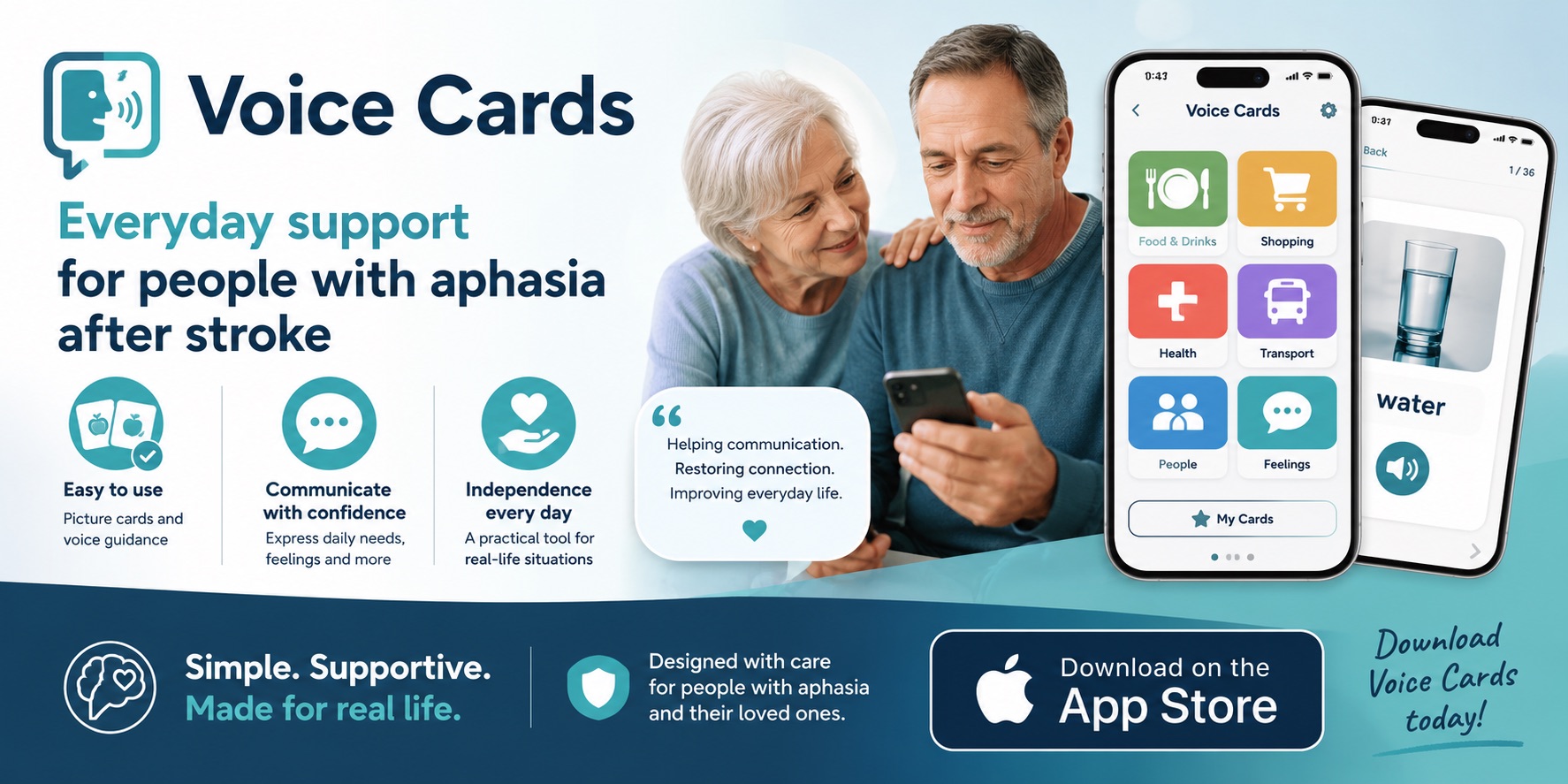
| Communication app | Displays or speaks messages selected by the user. | Custom phrases, typed text, pictures, voice cards or frequently used requests. | Flexible communication when a phone or tablet is available. |
An aphasia ID card usually explains why communication may be different and how the other person can help. A communication board helps the person build or select the actual message. You can learn more in Communication Board for Aphasia: Picture Cards, Simple Choices and Everyday Conversation Support.
A phone can perform both roles. It can display a digital identification card and also provide communication phrases. The Aphasia Guide article Apps for Aphasia: Simple Communication Tools for Everyday Life explores simple ways a phone can support ordinary conversations.
An aphasia card is not government-issued identification. It does not replace a passport, driving license, state ID, ticket, bank card or another official document. It is a communication aid that can be carried alongside those items.
What personal information should appear on the card?
A card can be useful without displaying a full name, address, date of birth or medical history. The safest approach is to include only information that serves a clear purpose and that the cardholder is comfortable showing to a stranger.
Information that may be useful
- A first name or preferred name.
- A short statement explaining aphasia.
- Two to four communication preferences.
- An optional emergency contact name.
- An optional emergency contact telephone number.
- A preferred language.
- A note that the person may use a communication board, notebook or phone.
Information that may be unnecessary
Think carefully before adding:
- a full home address,
- a full date of birth,
- financial information,
- account numbers,
- insurance numbers,
- a long medical history,
- passwords or security codes,
- information that the cardholder does not want strangers to see.
Never place a PIN, password, bank login, security answer or access code on the card. A communication card may be shown in public and could be lost.
Should the card include an emergency contact?
An emergency contact can be useful, but it is optional. The cardholder should decide whether the benefit outweighs the privacy concern. A simple line such as “If necessary, please call Anna: 555-000-0000” may be enough.
The contact should know that their details appear on the card and understand what kind of call they may receive. The card should not suggest that the contact must be called during every routine interaction.
Who should own the final decision?
Whenever possible, the person who will carry the card should choose the wording, information and design. A relative may help with typing, printing or layout, but the card should communicate the cardholder’s preferences rather than the helper’s assumptions.
When can an aphasia wallet card be useful?
The card can be used anywhere a quick conversation begins with someone who does not know the cardholder. It does not need to be shown during every interaction. Some people may carry it for reassurance and use it only occasionally.
Shops and supermarkets
The card may help when asking where an item is, discussing a return, answering a question at checkout or explaining why entering a PIN, reading a receipt or responding quickly may take more time.
Cafés and restaurants
It can explain why the person is pointing to the menu, using written choices, taking longer to order or asking staff to repeat one question at a time.
Buses, trains and taxis
A card can support questions about destinations, platforms, tickets, times and directions. Writing down a destination or showing it on a phone can be used alongside the card.
Reception and customer service
Showing the card at the beginning can encourage the staff member to slow down, write key information and avoid asking several questions at once.
Banking and important transactions
The card may help request extra time, written key points or a quieter conversation. It does not replace identity checks, consent or the need to understand an important decision.
Airports and travel
A card can provide context at check-in, security, boarding gates, hotels and transport desks. A second-language version may be helpful when travelling internationally.
Community events
The card may make introductions easier at clubs, libraries, classes, volunteer activities, religious gatherings or local events.
Unexpected situations
If communication suddenly becomes stressful, the card can provide a prepared message when producing a spoken explanation is difficult.
Using the card during an important conversation
The card can be shown before the main conversation begins. This creates a calmer starting point. The cardholder may then use written notes, a communication board, gestures, pictures or an app to discuss the actual subject.
For ideas about respectful questions and conversation pacing, see What to Say to Someone With Aphasia: Simple Conversation Starters for Family and Friends.
How to show an aphasia card naturally
Using the card should feel simple and ordinary. The cardholder does not need to make a long introduction or apologize for using it.
Show it early
If the conversation is likely to involve several questions, show the card before confusion develops. At a reception desk, the card can be placed beside the appointment letter. At a café, it can be shown before ordering. On public transport, it can be displayed together with the written destination.
Point to the most important instruction
The cardholder can point to “Please give me time” or “Please write it down.” This makes it clear which support is needed in that moment.
Keep control of the card
The other person may need to hold the card briefly to read it, but it should be returned. Carrying a second copy can be useful if one is lost or damaged.
Combine it with another communication method
The card introduces the communication situation. The message itself may then be shared by pointing, writing, drawing, choosing between options or using a phone.
Do not feel obliged to show it
The card is an optional tool. The cardholder can decide that a particular conversation does not require it. Carrying a card does not create an obligation to disclose aphasia to every person.
What should you do when someone shows you an aphasia ID card?
If someone gives or shows you an aphasia card, read it before continuing. The card is telling you both what is happening and how to make the interaction easier.
- Speak directly to the cardholder.
Keep your attention on the person, even when a relative or companion is present. - Follow the instructions on the card.
If it says to write down key words, write them. If it asks for one question at a time, avoid combining several questions. - Keep your language clear and adult.
Use shorter sentences without using a childish tone. - Pause after speaking.
Allow enough time for the person to understand the question and prepare an answer. - Accept different forms of communication.
A gesture, written word, picture, phone message, selected card or head movement may be part of the answer. - Confirm the meaning.
Repeat the message in a short sentence and ask whether you understood correctly. - Do not pretend to understand.
If the message is unclear, say so calmly and try another method.
The American Stroke Association recommends patience, simple communication, reduced distractions and the use of writing, gestures, pictures or devices when communicating through aphasia-related barriers. Its printable guidance is available on the Aphasia: Communicating Through Barriers resource page.
What not to do
- Do not immediately speak only to the companion.
- Do not raise your voice unless the person asks you to.
- Do not repeat the same long sentence faster or louder.
- Do not finish every answer without permission.
- Do not assume silence means a lack of understanding or opinion.
- Do not take the card away and continue the conversation elsewhere.
- Do not rush because other people are waiting.
How to design a readable printable aphasia card
A card can contain excellent wording and still be difficult to use if the text is crowded, pale or too small. The design should support fast reading in ordinary conditions.
Use a familiar wallet size
A card close to the size of a bank card is easy to store in a wallet or card holder. A slightly larger version may be easier to read and can be kept in a bag, notebook or car.
Make the first line immediately visible
“I HAVE APHASIA” or “I HAVE A COMMUNICATION DIFFICULTY” should be the easiest line to find. The cardholder can decide whether capital letters feel appropriate. Avoid using capital letters for long paragraphs because they can become harder to scan.
Use strong contrast
Dark text on a light background is usually easier to read than pale text, patterned backgrounds or text placed over a photograph. Decorative design should never compete with the message.
Use a simple typeface
Choose a clear sans-serif font with open letter shapes. Use the largest practical text size and generous spacing. A card containing fewer, larger instructions is often more useful than a card containing every possible communication strategy.
Place one instruction on each line
Short lines are easier to scan:
Consider a two-sided card
The front can explain aphasia and contain the two most important requests. The back can include additional preferences, an optional contact and a second language.
Protect the printed card
Thicker paper, a card sleeve or lamination can protect it from moisture and repeated handling. Keep a spare copy at home and save the original digital file so the card can be printed again.
Test it in a real situation
Before relying on the card, ask someone unfamiliar with the wording to read it for a few seconds. Can they explain what they should do? Is the text readable at arm’s length? Is the most important instruction obvious?
Can an aphasia ID card be kept on a phone?
Yes. A digital version can be saved as an image, PDF, note or dedicated communication card. It can be shown directly on the screen when a printed card is unavailable.
Simple ways to store it
- Save the card image in a clearly named photo album.
- Keep it in a note pinned to the top of the notes app.
- Create a home-screen shortcut to the card.
- Store it in a communication app with other frequently used messages.
- Keep an offline copy that does not require an internet connection.
Make it quick to reach
A digital card is useful only when it can be opened without navigating through many folders or menus. Practice opening it before using it in a busy environment. A printed backup remains helpful if the battery is empty, the phone is locked or the screen is difficult to see outdoors.
Protect private information
A phone screen may be visible to people nearby. The digital card should contain only information the user is comfortable displaying publicly. Avoid linking to a document containing unnecessary personal details.
Should the card use a QR code?
A QR code can lead to a longer public communication profile, but it should be optional. The essential message must still appear directly on the card because another person may not be able or willing to scan a code.
If a QR code is used, the linked page should be simple, mobile-friendly and free from sensitive information. The cardholder should remain able to update or remove the page.
Should the card be bilingual?
A bilingual card can be useful for travel, multilingual households or communities where more than one language is commonly used. Each language version should remain short enough to read comfortably.
Options for a bilingual card
- Place one language on the front and another on the back.
- Use two separate cards and show the appropriate one.
- Keep several digital versions on the phone.
- Include a short opening sentence in the local language and fuller instructions in the cardholder’s preferred language.
Ask a fluent speaker to review important wording. Automatic translation can be a useful starting point, but a short communication instruction should sound natural and unambiguous in the language used.
How can family members help prepare the card?
A family member or friend can help with layout, typing, printing and keeping spare copies. The most important responsibility is to preserve the cardholder’s choices and independence.
Ask what the person wants strangers to know
Do not begin by writing a card for the person without involving them. Offer clear choices:
- Would you like the card to say “I have aphasia” or “I have difficulty communicating”?
- Do you want your name on the card?
- Which instruction is most important: more time, written words, choices or another method?
- Do you want an emergency contact included?
- Would you prefer a printed card, phone version or both?
Use the person’s own priorities
A relative may believe that speaking slowly is the main need, while the cardholder may prefer written numbers or two visible choices. The card should reflect what works for the user in real conversations.
Practice without turning it into a test
Practice can be simple. One person plays the role of a café worker or receptionist. The cardholder shows the card and points to the relevant instruction. The goal is to make the process familiar, not to judge performance.
Review the card after real use
After several outings, ask what worked. Perhaps the text was too small, the opening statement was too long or the most useful instruction was hidden on the back. Update the card as preferences and routines change.
Where can you get a free printable aphasia ID card?
Several established aphasia and stroke organizations provide printable or customizable identification cards. Their layouts, available fields and wording options differ, so it is worth comparing them before choosing one.
American Stroke Association
The American Stroke Association and National Aphasia Association provide a customizable wallet-sized card that can be generated as a PDF.
National Aphasia Association
The NAA presents its joint card with the American Stroke Association and lists additional printed and wearable identification options.
Australian Aphasia Association
This free generator allows the user to select communication difficulties, preferred support strategies and optional personal information.
Before printing any generated card, read every line carefully. Remove fields that are unnecessary, confirm all telephone numbers and make sure the communication instructions genuinely match the user’s preferences.
How to create a personal aphasia wallet card step by step
- Choose the main purpose.
Decide whether the card is mainly for shops, public transport, travel, appointments, social situations or general everyday use. - Write one clear opening sentence.
Use a short statement such as “I have aphasia and communication may take more time.” - Select the most useful instructions.
Choose two to four actions that help the cardholder communicate. - Decide whether to include personal information.
Add a preferred name or contact only when the cardholder wants it and the information has a clear purpose. - Arrange the information in reading order.
Put the explanation first, the most important instruction second and optional details last. - Use a clear visual design.
Choose high contrast, large text, generous spacing and one instruction per line. - Print and test the card.
Check whether another person can understand it quickly in normal lighting. - Create a second version if useful.
Save a phone version, bilingual version or larger-print copy. - Use it in an ordinary low-pressure situation.
Try the card somewhere familiar before relying on it during a complicated interaction. - Review and update it.
Change the wording if the instructions are unclear or the cardholder’s preferences change.
Common aphasia ID card mistakes to avoid
Putting too much information on one small card
A long explanation, full contact details and ten communication instructions can make the card difficult to use. Prioritize the information a stranger needs in the first few seconds.
Using generic instructions that do not help the cardholder
A professionally designed card is not useful if its instructions do not match the person. Personalization matters more than including every possible strategy.
Making the text too small
If the card can be read only at very close range, it may be awkward to use across a counter or in dim lighting. Reduce the number of words before reducing the text size.
Including unnecessary sensitive information
A full address or extensive personal history is rarely needed for routine communication. Remember that the card can be lost or photographed.
Writing only “I have aphasia”
Many people may not know what aphasia means. Add at least one direct instruction explaining how they should communicate.
Allowing the helper to take over
The presence of a card should not become a reason to ignore the cardholder. The conversation should remain directed to the person unless they ask someone else to speak.
Relying on only one copy
Keep a printable file and a spare copy. A digital version can support the printed card, but each format has situations in which it may be unavailable.
Never updating the wording
The first version does not have to be permanent. Real-world use may show that a different instruction, larger text or simpler opening works better.
Frequently asked questions about aphasia ID cards
What is an aphasia ID card?
An aphasia ID card is a small printed or digital communication card. It explains that the cardholder has aphasia and may need more time, shorter sentences, written key words, clear choices or another way to communicate.
What should an aphasia card say?
It should contain one short explanation and two to four personalized instructions. A simple example is: “I have aphasia. Please speak directly to me, ask one question at a time and give me time to answer.”
Is there a free printable aphasia wallet card?
Yes. The American Stroke Association and National Aphasia Association provide a customizable printable card. The Australian Aphasia Association also offers a free personalized card generator.
Is an aphasia ID card the same as a medical ID?
No. An aphasia ID card primarily explains a communication difficulty and tells another person how to communicate more effectively. A medical ID is generally intended to provide selected health or emergency information. Some people may choose to carry both.
Should the card include an emergency contact?
An emergency contact is optional. It may be useful in some situations, but the cardholder should decide whether to include it. The contact person should know that their name and telephone number appear on the card.
Can an aphasia ID card be stored on a phone?
Yes. It can be saved as an image, PDF, note or communication card. It should be easy to open and available offline. A printed backup is still useful if the phone is unavailable.
What size should a printable aphasia card be?
A wallet-sized card close to the size of a bank card is convenient to carry. A larger version may be easier to read and can be stored in a bag, notebook or car.
When should a person show the card?
The person can show it whenever an unfamiliar conversation may be easier with immediate context. Common examples include shops, restaurants, public transport, reception desks, customer service, travel and community events.
Can a family member create the card?
A family member can help with typing, design and printing, but the wording should reflect the cardholder’s own preferences. Whenever possible, the person carrying the card should approve what it says and what personal information it contains.
Does the card replace a communication board or app?
No. The ID card provides context and communication instructions. A board or app may help the person express the actual message, choice, need or question. The tools can be used together.
Does every person with aphasia need an ID card?
No. It is an optional everyday communication tool. Some people may find it very useful, while others may prefer a phone message, communication app, notebook, wearable ID or no identification tool at all.
The most useful card is the one that reflects the person
An aphasia ID card should be short, clear, respectful and personal. It should explain the communication situation without defining the person by it. The best card tells a stranger exactly what will help: more time, one question at a time, written key words, clear choices or space to use another communication method.
A printed card, phone version or both can make unfamiliar interactions calmer. The cardholder remains in control of when the card is shown, what information it contains and how the conversation continues.
Continue reading on Aphasia Guide
- Communication Board for Aphasia: Picture Cards, Simple Choices and Everyday Conversation Support
- Apps for Aphasia: Simple Communication Tools for Everyday Life
- What to Say to Someone With Aphasia: Simple Conversation Starters for Family and Friends
- Aphasia Meaning: What Aphasia Means and How It Affects Communication
- Browse all Aphasia Guide articles
This article focuses on everyday communication, identification, privacy and practical use. It does not provide medical advice, diagnosis, treatment recommendations or therapy instructions.