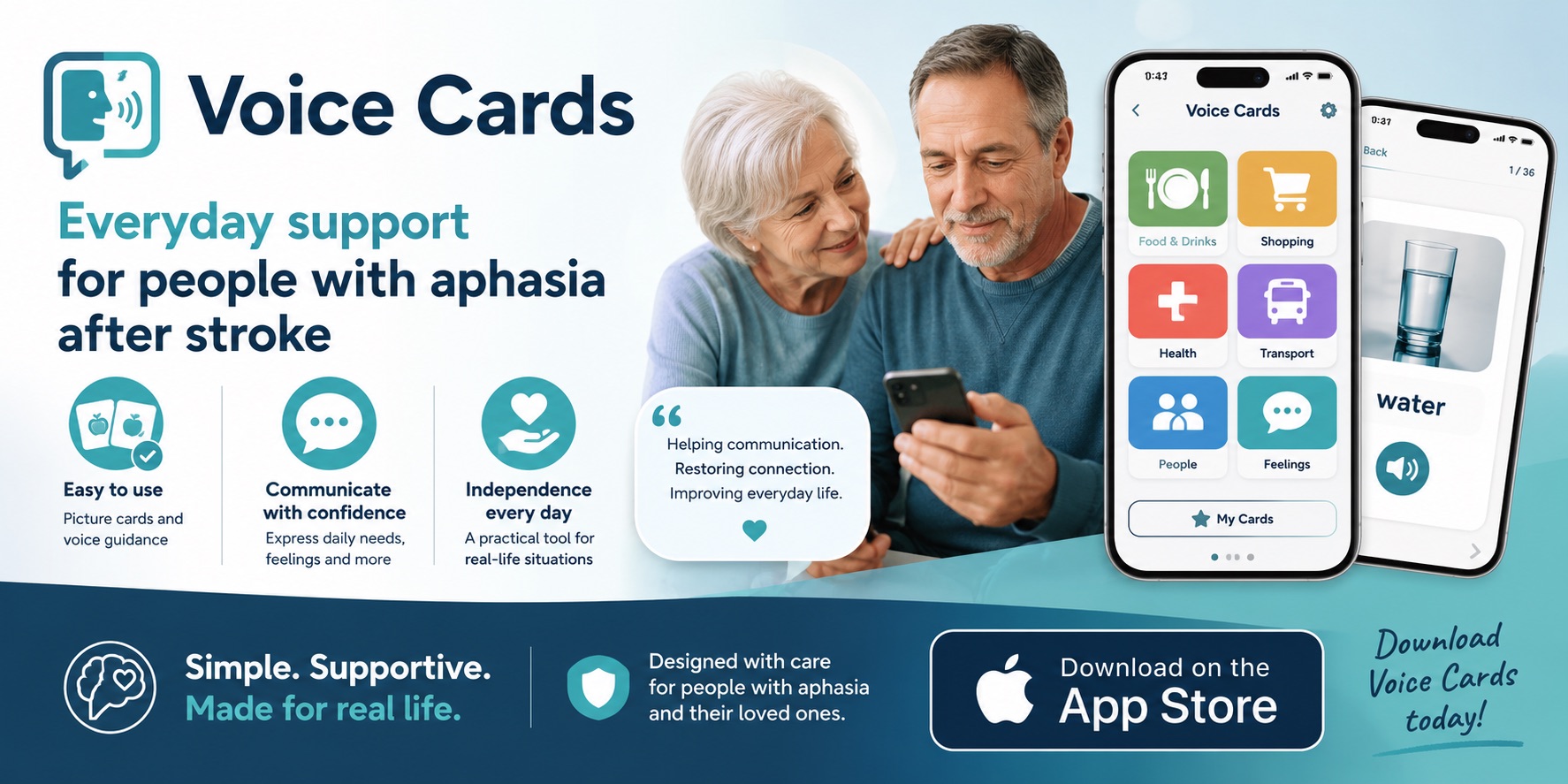
Eating out with aphasia can feel easier when the experience is planned around clear choices, enough time and more than one way to communicate. A person may speak, point to a menu, show a prepared message, write a keyword, use a picture or ask a companion for support.
The goal is not to create a perfect restaurant visit or avoid every misunderstanding. It is to reduce unnecessary pressure and make it easier for the person with aphasia to choose their own food, communicate with staff and take part in the social experience.
Every person with aphasia communicates differently. Some people can read a menu but find speaking difficult. Others may understand familiar spoken questions yet struggle with long descriptions, unexpected choices or a noisy room. The most useful strategies are the ones chosen and tested by the individual.
Why eating out with aphasia can be difficult
A restaurant combines several communication tasks in one place. A customer may need to read unfamiliar words, compare options, remember a decision, answer questions, speak to several people and follow a conversation in background noise.
Common challenges may include:
- long or visually crowded menus,
- unfamiliar names of dishes,
- small text or weak contrast,
- servers speaking quickly,
- several questions being asked together,
- music and nearby conversations,
- pressure to decide quickly,
- difficulty saying a specific food word,
- difficulty explaining a change to an order,
- confusion when the expected item is unavailable,
- difficulty checking whether the order was understood correctly.
A person may communicate successfully in a quiet and familiar setting but find the same task harder in a busy restaurant. This does not mean that they have lost their preferences or cannot make decisions. The environment has simply increased the communication demands.
Planning can remove some of these demands before the meal begins.
Choose a restaurant that makes communication easier
The food is not the only factor to consider. The layout, noise level, ordering system and availability of an online menu can affect how manageable the experience feels.
Consider a familiar restaurant
A familiar place may reduce the number of unexpected decisions. The person may already know:
- where to enter,
- where to sit,
- how orders are placed,
- which dishes they like,
- how payment works,
- where the bathroom is located.
Familiarity is not essential, but it can be useful when someone is beginning to eat out again or testing a new communication tool.
Look for an online menu
An online menu allows the person to read at their own pace. It may be possible to enlarge the text, use a screen-reading function, save a screenshot or select a dish before leaving home.
Check whether the online menu is current. Prices, ingredients and available items can change, so the final choice may still need to be confirmed at the restaurant.
Choose a quieter time
A restaurant may be calmer before or after the busiest lunch and dinner periods. Fewer customers can mean less background noise, shorter queues and more time for staff to communicate.
When booking, a simple request may be:
One guest has aphasia and may need extra time to communicate. Could we have a quiet table if one is available?
A quiet table cannot always be guaranteed, but asking in advance gives the restaurant an opportunity to help.
Think about the ordering system
Different systems create different communication demands.
| Ordering system | Possible advantage | Possible difficulty |
|---|---|---|
| Table service | The customer can remain seated and point to the menu. | The server may ask several follow-up questions. |
| Counter service | The menu may be visible above the counter. | A queue can create time pressure. |
| Self-service screen | The person may choose without speaking. | The screen may move quickly or contain many steps. |
| Mobile ordering | The order can be prepared slowly on a phone. | The application may be visually complicated. |
| Buffet | Food can often be selected by looking and pointing. | Labels, payment rules or serving procedures may be unclear. |
There is no universally best system. Choose the one that suits the person’s reading, speaking, attention and technology preferences.
Review the menu before you go
Choosing a meal in advance can reduce pressure at the table. It also gives the person time to find a dish, check unfamiliar words and prepare how they want to order it.
Reduce the number of choices
A long menu can be difficult to scan. A companion can help identify a smaller number of relevant options without making the final decision for the person.
For example, create a short list:
- chicken with rice,
- vegetable pasta,
- fish and potatoes.
The person can then compare three realistic choices instead of searching through every page.
Save the chosen item
Useful options include:
- taking a screenshot of the dish,
- writing the exact name on a card,
- saving the menu page on a phone,
- printing the relevant section,
- marking the item with a removable note,
- saving a photograph when the restaurant provides one.
Include any important changes, such as:
I would like the grilled chicken with rice.
No onions, please.
Water to drink.
Prepare a second choice
The preferred dish may be unavailable. Choosing one backup option in advance can prevent the person from having to restart the entire decision process under pressure.
A simple note can show:
- First choice: vegetable pasta
- Second choice: tomato soup and bread
Preparing too many alternatives can recreate the original problem. One backup is often enough.
Prepare communication tools for the restaurant
A person does not need to rely on speech alone. The best restaurant communication kit is usually small, familiar and easy to reach.
It may include:
- an aphasia identification card,
- a printed order,
- a small communication board,
- a notebook and pen,
- a phone with saved messages,
- screenshots of menu items,
- pictures of common drinks or foods,
- a card describing an allergy or dietary restriction,
- a payment card or cash prepared in advance.
An aphasia ID card can briefly explain why a customer may need more time. It can also tell staff which communication methods are helpful.
A card might say:
I have aphasia.
I may have difficulty speaking, reading or understanding quickly.
Please give me time.
Please ask one question at a time.
I may point, write or show you my order.
The wording should reflect the individual. Do not include a communication difficulty that the person does not experience or a strategy they do not want staff to use.
Prepare a restaurant communication board
A small board can include words or pictures for:
- yes,
- no,
- not that,
- please wait,
- please repeat,
- please write it down,
- water, tea, coffee or another preferred drink,
- starter, main course and dessert,
- hot and cold,
- small and large,
- the bill,
- bathroom,
- help.
The guide to making a printable aphasia communication board and communication book explains how to select useful vocabulary and organize it for real conversations.
A smaller communication board for aphasia can also be customized specifically for eating out.
Keep digital tools simple
A phone may be useful for stored phrases, photographs, notes or text-to-speech. Place the restaurant tools in one clearly named folder so the person does not need to search through many applications at the table.
Useful saved notes may include:
- “I would like this item.”
- “Please give me more time.”
- “What are the two choices?”
- “Please write the price.”
- “That is not what I ordered.”
- “Please bring the bill.”
Review these apps for aphasia for more ideas about using stored phrases, pictures and alternative communication methods.
Arriving at the restaurant
The first exchange may involve a reservation name, the number of guests and a choice of table. Preparing these details can make the entrance calmer.
A reservation note may show:
- Name: Alex Taylor
- Time: 6:30 p.m.
- Guests: 3
- Request: A quiet table, if available
The person can show the note, say the information or combine both methods.
Choose a supportive seat
When possible, choose a position that makes communication easier. This may mean sitting:
- away from speakers or the kitchen,
- with good lighting on the menu,
- where the server can be seen clearly,
- beside a supportive companion rather than opposite them,
- where the person can easily reach their communication tools.
Do not assume that a corner is always best. Some people may prefer a clear view of the room or easier access to the exit and bathroom.
Reading and using a restaurant menu with aphasia
A menu can be difficult even when the person understands the type of food. Decorative fonts, long descriptions and unfamiliar dish names can hide the essential information.
Find the correct section first
Instead of reading from the first page to the last, locate the relevant category:
- breakfast,
- soups,
- sandwiches,
- main courses,
- vegetarian dishes,
- drinks,
- desserts.
Covering unrelated sections with a blank piece of paper may reduce visual distraction.
Highlight keywords
Focus on the parts that influence the decision:
- main ingredient,
- side dish,
- sauce,
- portion size,
- price,
- important dietary information.
A companion can write a shorter version while preserving the meaning.
| Menu description | Shorter version |
|---|---|
| Roasted chicken breast served with seasonal vegetables, herb potatoes and a creamy mushroom sauce | Chicken, vegetables, potatoes, mushroom sauce |
| Fresh pasta with tomato, grilled zucchini, basil and aged cheese | Pasta, tomato, zucchini, cheese |
| Pan-fried fish accompanied by rice, green beans and lemon butter | Fish, rice, beans, lemon butter |
Do not remove information that affects the choice. The shorter version should still show important ingredients, sauces and additional costs.
Use pictures carefully
A photograph can support recognition, but it may not show every ingredient or the exact portion. Use pictures as one source of information rather than assuming that the final dish will look identical.
When a menu is difficult to read, the principles in How to Make Written Information Aphasia-Friendly can help a companion or restaurant create a clearer short version.
Ordering food with aphasia
There is no requirement to place an order in one particular way. A person may speak part of the order, point to the menu and show a prepared note for the remaining details.
Point to the exact item
Keep a finger, card or marker beside the selected item while speaking. This gives the server a visual reference if the dish name is difficult to say.
A useful phrase is:
I would like this one, please.
The National Aphasia Association recommends practical supports such as pointing to menu items, carrying communication cards and showing a written order on paper or a phone. Its guide to ordering at a restaurant with aphasia provides additional examples.
Show a complete written order
A clear order note may contain:
My order
Grilled fish
Rice
No sauce
Still water
Place each change on a separate line. Avoid long sentences when the server needs to identify the essential details quickly.
Order one part at a time
The interaction may be easier when divided into stages:
- Choose the main dish.
- Answer questions about sides or size.
- Choose a drink.
- Confirm the complete order.
A companion or customer can ask:
One question at a time, please.
Ask the server to confirm the order
Confirmation can identify a misunderstanding before the food arrives.
The person may say or show:
Please repeat my order.
The customer can then point to yes, no or the item that needs correcting.
Answering common server questions
Even a prepared order may lead to additional questions. A server may ask about sides, cooking preferences, sauces, portion sizes or drinks.
Questions are easier to answer when choices are presented separately.
Ask for two or three choices
Instead of:
What would you like with that?
A clearer question may be:
Would you like rice or potatoes?
The person can answer by saying the word, pointing to it or looking at the preferred option.
Write unfamiliar choices
When spoken words are difficult to process, ask the server to write the options:
- rice,
- potatoes,
- salad.
The person can then point to the choice.
Do not rush a delayed response
A pause does not necessarily mean that the person did not understand or does not have an answer. Allow time before repeating the question or asking a companion to respond.
When the question needs to be changed, simplify it rather than saying the same sentence more loudly.
How a companion can help without taking over
A companion can reduce pressure, but support should not remove the person from the conversation. Restaurant staff should still speak directly to the customer with aphasia.
Agree on support before the meal
Discuss what the person wants the companion to do.
The person may prefer the companion to:
- help review the menu,
- write two or three choices,
- wait while they place the order,
- repeat only the part that was unclear,
- confirm the final order,
- take over only after a private signal,
- handle payment,
- avoid helping unless requested.
A discreet signal can mean:
- please wait,
- please help,
- I want to answer,
- please explain this choice.
Wait before stepping in
Give the person time to try their chosen communication method. Speaking immediately on their behalf may make the interaction faster, but it can also remove control and participation.
A useful companion response is:
Please give them a little more time. They would like to answer.
Confirm instead of guessing
Do not complete an order based on what the companion assumes the person wants. Show or repeat the understood choice and allow the person to confirm it.
For more guidance about supporting an interaction respectfully, see what to say to someone with aphasia.
What to do when communication breaks down
A communication breakdown does not mean that the restaurant visit has failed. It means that the current method is not working and another method is needed.
- Pause. Reduce the pressure before trying again.
- Identify one problem. Focus on the dish, drink, price or question that is unclear.
- Show the aphasia card. Explain the need for time or a different method.
- Point to the menu. Use the printed item as a shared reference.
- Write a keyword. Use a word, number or simple drawing.
- Offer limited choices. Compare two relevant options.
- Move away from noise. Ask to speak in a quieter position when practical.
- Ask another staff member. A different communication style may help.
- Confirm the result. Repeat or show the final understood message.
Useful repair phrases include:
- That is not what I mean.
- Please wait.
- Please let me try again.
- Please write the choices.
- Please show me on the menu.
- I want this one.
- I do not want this ingredient.
- Please ask my companion to help.
When the wrong food arrives
Point to the order note or menu item and identify one specific difference.
For example:
I ordered rice.
This has potatoes.
Another option is:
This is not my order. Please check.
A photograph or the original written order may make the problem easier to explain.
Communicating dietary needs and food allergies
Food preferences and safety-related dietary information should be communicated clearly. Do not depend only on a generic picture, an unclear gesture or the assumption that a dish is safe because it looks familiar.
A written card may include:
- the ingredient that must be avoided,
- whether it is an allergy or another dietary requirement,
- a request to check with the kitchen,
- a clear confirmation question.
For example:
I have a serious peanut allergy.
I must not eat peanuts or food containing peanuts.
Please check with the kitchen.
Is this dish safe for me?
When eating in another country, have important allergy information translated accurately before the visit. The person or companion should still confirm the information directly with the restaurant because ingredients and food preparation methods can vary.
A communication card supports the conversation, but it does not guarantee that a restaurant can meet a dietary request.
Paying the bill with less communication pressure
Payment may involve several questions about splitting the bill, adding a tip, choosing a currency or using a card terminal. Prepare the preferred method in advance when this is helpful.
Useful payment phrases
- The bill, please.
- I will pay for this meal.
- We will pay separately.
- We will pay together.
- Please write the total.
- I will pay by card.
- I will pay with cash.
- Please give me the receipt.
Check the total visually
Ask for a printed or clearly displayed bill. Match the main items with what was ordered and look for unfamiliar charges.
When a card terminal displays several choices, allow time to read each screen. A companion or staff member can explain the options, but the person should make their own payment decision whenever possible.
Communication tips for restaurant staff
Small changes in communication can make the experience more accessible without creating a separate or patronizing service.
- Speak directly to the customer with aphasia.
- Use a natural adult tone.
- Ask one question at a time.
- Allow enough time for an answer.
- Keep sentences short and specific.
- Show the relevant item on the menu.
- Write down two or three choices when helpful.
- Accept pointing, writing, gestures or a communication device.
- Repeat the completed order for confirmation.
- Do not pretend to understand when the order is unclear.
- Ask how you can make the interaction easier.
- Speak to the companion only when the customer requests support.
A useful question is:
Would you like me to write the choices?
A less useful approach is to ask several rapid questions, repeat them more loudly or immediately direct the conversation to the companion.
Example restaurant communication card
The following card can be adapted to the person’s needs. Remove any line that is not relevant.
I have aphasia.
I know what I want, but communicating may take longer.
Please:
- give me time,
- ask one question at a time,
- show me the choices,
- write important words,
- let me point to the menu,
- speak directly to me.
Please repeat my order so I can check it.
Example prepared order card
My order
Main dish: grilled chicken
Side: rice
Change: no onions
Drink: still water
Please repeat the order.
Example choice card
| Question | Choice 1 | Choice 2 | Choice 3 |
|---|---|---|---|
| Drink | Water | Tea | Coffee |
| Side | Rice | Potatoes | Salad |
| Portion | Small | Regular | Large |
| Response | Yes | No | Not sure |
Test the card before using it in a restaurant. The person should be able to find each message quickly and understand every word or picture included.
Eating out with aphasia checklist
Before choosing the restaurant
- Check the noise level and ordering system.
- Look for an online menu.
- Consider a quieter time.
- Ask for a quiet table if helpful.
- Choose a familiar place for an easier first visit.
Before leaving home
- Review the menu.
- Select a first and second choice.
- Save or print the chosen item.
- Prepare any changes to the order.
- Pack the aphasia card.
- Pack a communication board, pen or phone.
- Prepare dietary or allergy information.
- Agree on how a companion should help.
At the restaurant
- Choose a suitable seat.
- Keep communication tools within reach.
- Point to the exact menu item.
- Ask for one question at a time.
- Use written or visual choices.
- Ask the server to repeat the order.
- Allow time for the person to respond.
- Change the communication method when necessary.
Before paying
- Ask for a clear bill.
- Check the main items and total.
- Confirm whether the bill will be split.
- Allow time to use the payment terminal.
- Request a receipt when needed.
After the visit
- Discuss what worked well.
- Identify any difficult part of the interaction.
- Add useful phrases to the communication card.
- Remove messages that were confusing or unnecessary.
- Save the name of a helpful dish or restaurant.
Frequently asked questions
Can a person with aphasia order food independently?
Yes, many people with aphasia can order independently when they have enough time and suitable communication support. The person may speak, point to a menu, show a written order, use pictures or combine several methods.
What should an aphasia restaurant card say?
It should briefly explain that the person has aphasia and describe the support they prefer. This may include asking one question at a time, allowing more time, writing down choices and accepting pointing or gestures.
How can someone with aphasia use a restaurant menu?
They may review the menu online, enlarge the text, focus on one section, highlight keywords, use photographs or ask someone to create a shorter list of relevant options. The person should remain responsible for the final choice.
Is it better to order for a person with aphasia?
Not automatically. Give the person an opportunity to order using their preferred method. A companion can support the interaction when requested, but should avoid taking over simply because the response takes longer.
What is the best communication tool for eating out?
There is no single best tool. A practical combination may include an aphasia ID card, a saved menu screenshot, a written order, a small communication board and a notebook or phone.
How can restaurant staff help a customer with aphasia?
Staff can speak directly to the customer, use short questions, allow time, show or write choices and confirm the complete order. They should accept alternative communication methods and avoid assuming that speech difficulty means the person cannot decide.
What should I do if the restaurant is too noisy?
Ask whether a quieter table is available, reduce unnecessary conversation during ordering and use written information. If communication remains too difficult, the person may choose takeaway service or another restaurant without treating the change as a failure.
Should the restaurant be told about aphasia in advance?
This is a personal choice. Advance notice may help when requesting a quiet table or additional time, but a person can also show an aphasia card after arriving. Only share the information needed to support the interaction.
How should food allergies be communicated?
Use precise written information naming the ingredient and ask the restaurant to confirm with the kitchen. For international travel, prepare an accurate translation. Do not rely only on a picture or assume that a familiar-looking meal is safe.
What happens if the person cannot say the name of the dish?
They can point to the menu item, show a screenshot, write a keyword or use a prepared order card. Saying the complete dish name is not necessary when another method communicates the choice clearly.
A successful meal is about participation, not perfect speech
Eating out with aphasia does not require the person to communicate in the same way as every other customer. Pointing, writing, pictures, prepared messages and communication devices are all valid ways to place an order and express a preference.
A manageable restaurant, a reviewed menu and a small set of familiar tools can remove much of the pressure. Restaurant staff and companions can help by slowing the interaction, asking one question at a time and speaking directly to the person with aphasia.
Some visits will still include delays, unavailable dishes or misunderstandings. When that happens, pause and change the communication method. The purpose of the meal is not to produce flawless conversation. It is to choose food, share time with other people and participate with as much independence and comfort as possible.