Traveling with aphasia can be more manageable when the journey is planned around clear information, extra time and more than one way to communicate. A person may use speech, writing, gestures, pictures, maps, prepared messages or a communication app at different stages of the trip.
The goal is not to prepare for every possible conversation. It is to reduce avoidable pressure during important moments such as checking in, passing through security, finding a platform, ordering food or explaining a problem.
This guide covers practical preparation for airports, hotels, public transport, restaurants and international travel. Assistance policies differ between countries, airports and transport providers, so travelers should always confirm current arrangements directly with the organizations involved.
In this guide
- Why travel can feel difficult
- How to choose a simpler journey
- Documents and essential information
- Building a travel communication kit
- Useful travel phrases
- Requesting assistance
- Airports and flights
- Trains, buses and taxis
- Communicating at a hotel
- Restaurants and directions
- Traveling with a companion
- Traveling alone with aphasia
- Handling a communication breakdown
- Emergency preparation and privacy
- International travel
- Printable travel checklist
- Frequently asked questions
Why traveling with aphasia can feel difficult
Aphasia can affect speaking, understanding spoken language, reading or writing. The pattern is different for every person. Someone may communicate comfortably in a familiar place but find it harder when people speak quickly, several instructions are given together or an unexpected problem occurs.
Travel often combines several communication demands:
- unfamiliar names, addresses and transport terms,
- time pressure and queues,
- background noise, announcements and competing conversations,
- questions from unfamiliar staff,
- changes to gates, platforms or schedules,
- forms, ticket machines and digital check-in systems,
- communication in another language,
- tiredness after a long day.
A communication difficulty should not be mistaken for a lack of intelligence, preferences or decision-making ability. Staff and travel companions should speak directly to the person with aphasia, provide time and use additional communication methods when needed.
The National Aphasia Association also emphasizes preparation, written messages, advance research and a reasonable travel pace in its travel tips for people with aphasia.
Choose a simpler journey before booking
A simpler itinerary can remove many communication demands before the journey begins. The cheapest or fastest option is not always the easiest option for a person who needs additional time to process information or express a message.
Reduce the number of changes
A direct flight or train may be easier than an itinerary with several connections. When a connection is necessary, allow enough time to find the next gate or platform without rushing.
Consider whether the traveler would benefit from:
- a direct route,
- a familiar departure airport or station,
- travel during a quieter part of the day,
- a longer connection between services,
- a reserved seat,
- arrival during daylight,
- transport booked from the arrival point to the accommodation.
Compare communication demands
Look beyond journey time. A route may involve online forms, self-service machines, border questions, shuttle transfers or several different ticket providers. Review the full journey step by step and identify where the person may want written information, a communication tool or assistance.
Create a visual itinerary
A clear itinerary can show one step at a time:
- Leave home.
- Arrive at the airport or station.
- Check in.
- Go through security if required.
- Find the gate or platform.
- Board the service.
- Collect luggage.
- Meet the driver or find local transport.
- Check in at the accommodation.
Add recognizable logos, booking references, departure times, seat numbers, addresses and simple maps. Keep the same information on paper and on a phone so that one format remains available if the other is lost, damaged or out of power.
Prepare documents and essential information
Place important travel information in one predictable location. A small folder, travel wallet or clearly named phone folder may be easier to use than searching through several emails and applications.
Useful items may include:
- passport or official identity document,
- tickets and booking confirmations,
- accommodation name, address and telephone number,
- transport details from the arrival point,
- travel insurance information where applicable,
- emergency contact details,
- a list of important medications or health information when personally necessary,
- copies of assistance requests and provider responses,
- a short explanation of aphasia and preferred communication methods.
Carry an aphasia ID card
An aphasia ID card can quickly explain why communication may take longer. It may be useful at a ticket counter, hotel reception, security checkpoint, restaurant or during an unexpected interaction.
A practical card can state:
I have aphasia. I may have difficulty speaking, understanding, reading or writing. Please give me time, use short sentences and write down important information. Speak directly to me.
The wording should reflect the individual. One person may want written choices. Another may prefer gestures, pictures or yes-and-no questions. An aphasia card supports communication, but it does not replace a passport, identity document, ticket or any document required by local authorities.
Build a travel communication kit
A travel communication kit provides several ways to share information when speech alone is difficult. It should be small enough to carry and simple enough to use in a busy environment.
A practical kit may contain:
| Tool | Possible use |
|---|---|
| Aphasia ID card | Explaining communication needs quickly |
| Printed itinerary | Showing the next destination, time or booking |
| Travel communication board | Pointing to transport, hotel, food and help-related messages |
| Notebook and thick pen | Writing keywords, drawing or asking another person to write |
| Phone or tablet | Displaying bookings, maps, photographs and prepared messages |
| Portable charger | Keeping digital communication tools available |
| Address card | Showing a driver or staff member the destination |
| Emergency information | Contacting a trusted person when necessary |
Make a travel communication board
A travel board might include:
- yes, no, maybe and not that,
- please wait,
- I need more time,
- please say that again,
- please write it down,
- show me on the map,
- ticket, passport, gate, platform and luggage,
- hotel, taxi, bus, train and airport,
- bathroom, food, water, quiet place and help,
- lost, delayed, cancelled and wrong direction,
- emergency contact and telephone.
The guide to making a printable aphasia communication board and communication book explains how to choose vocabulary, organize pages and test a board in real conversations. A smaller communication board for aphasia can also be adapted specifically for airports, hotels or restaurants.
Prepare digital backups
Save important documents locally rather than assuming internet access will always be available. Take screenshots of bookings, maps, addresses and QR codes. Test any translation or communication app before leaving home.
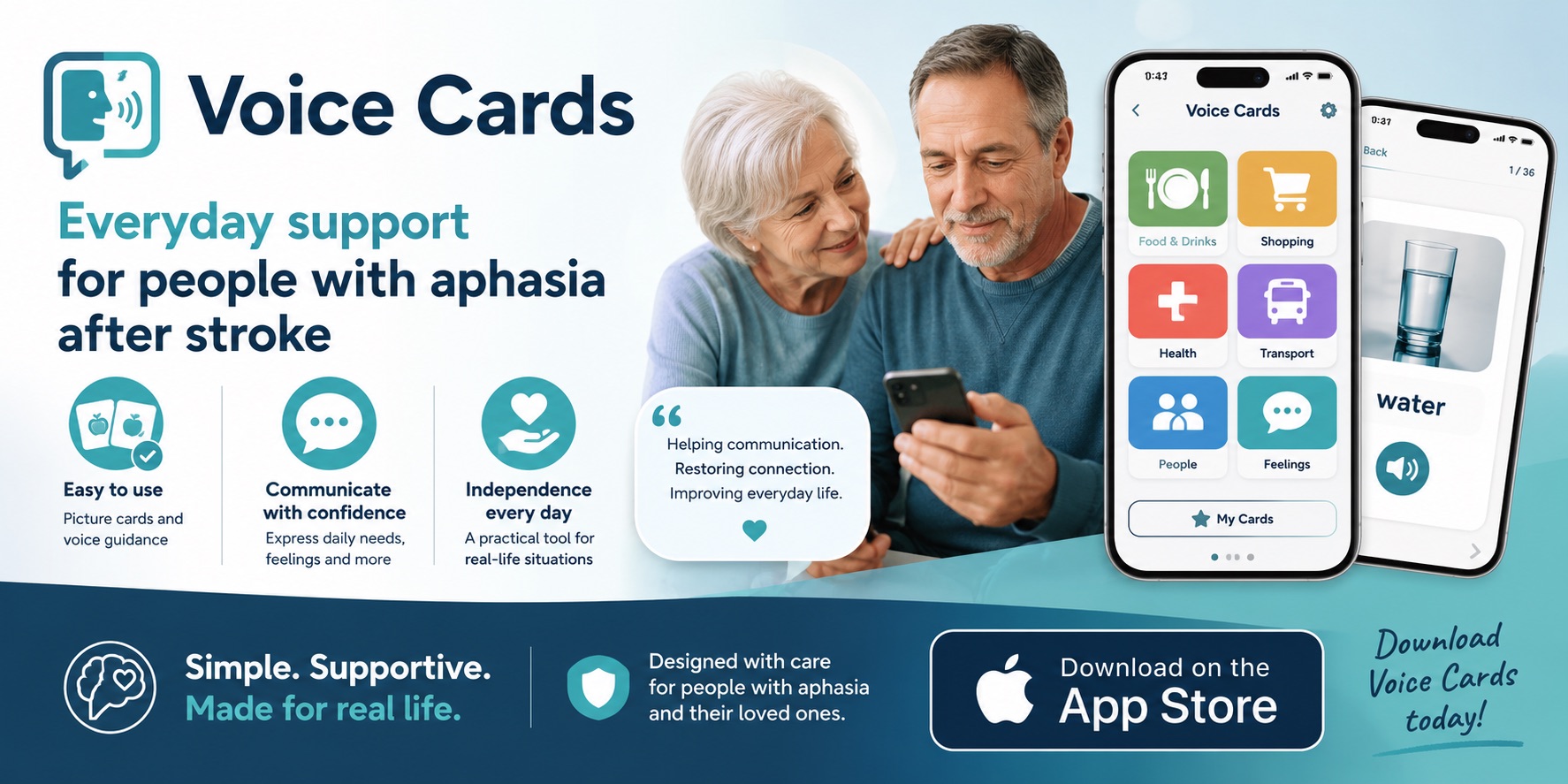
Some apps for aphasia can support typed messages, pictures, text-to-speech or stored phrases. A paper backup remains useful when a device is charging, damaged or difficult to unlock under pressure.
Prepare useful travel phrases
Short, specific phrases are usually easier to find and show than long explanations. Save the most important messages on one page or in a clearly labeled phone note.
Communication phrases
- I have aphasia.
- Please give me more time.
- Please speak slowly.
- One question at a time, please.
- Please use a short sentence.
- Please write down the important words.
- Please show me two choices.
- I understand, but I am having difficulty speaking.
- I do not understand. Please explain another way.
- Please speak directly to me.
Transport phrases
- Where is my gate?
- Where is the platform?
- Has the departure time changed?
- Is this the correct train or bus?
- Where should I get off?
- Please show me on the map.
- I need help finding this address.
- My luggage is missing.
- My service has been cancelled.
- Please contact my travel companion.
Hotel and restaurant phrases
- I have a reservation.
- Please write down my room number.
- What time is breakfast?
- Please show me where this is.
- I would like to order this item.
- Please give me more time to read the menu.
- I need a quiet table.
- Please write down the total price.
Only include phrases that the traveler understands and is likely to use. Too many messages can make the right one difficult to find.
Request assistance before the journey
Airlines, airports, rail companies and other transport providers may offer assistance, but available services, eligibility rules and request procedures differ. Contact each provider directly and ask what support is available for a person with a non-visible communication disability.
The International Air Transport Association notes that disability legislation and minimum service expectations are not harmonized worldwide. Its air travel accessibility information provides a global overview, but the traveler still needs to confirm arrangements with the specific airline and airports.
Questions to ask a provider
- How should assistance be requested?
- Is there a deadline for making the request?
- Where is the assistance meeting point?
- Can staff help with check-in, directions or boarding?
- How will the request appear on the booking?
- Should the traveler arrive earlier than usual?
- Does the arrival airport receive the same request?
- What should the traveler do if the service is not available on arrival?
Describe the actual communication need rather than relying only on the word “aphasia.” For example:
The passenger has aphasia and may need additional time to answer questions. Please use short sentences, write down essential information and speak directly to the passenger.
Keep written confirmation of any arrangement. Check it again shortly before departure because schedules, terminals and operating procedures can change.
Navigating airports and flights
Before arriving at the airport
Complete any familiar online steps in advance when this makes the journey easier. Save the boarding pass and booking reference in an accessible location. Review the airport layout, terminal, check-in area and assistance meeting point.
Wear comfortable clothing, allow additional time and avoid placing every essential item in checked luggage. Keep the communication card, documents, medication, phone, charger and itinerary in a small bag that remains with the traveler.
At check-in
Place the passport, booking details and aphasia card together before reaching the counter. Show the booking first, then the communication card if needed.
Ask staff to write down:
- the gate number,
- the boarding time,
- any baggage information,
- where to go next,
- what to do if the gate changes.
Repeat or point to the information to confirm it. Do not rely only on remembering a spoken instruction given in a noisy area.
At security and border control
Security and border procedures vary by country. An aphasia card may explain why a response is slow or incomplete, but it does not remove the need to complete required checks.
Helpful strategies include:
- showing the card before a complicated exchange begins,
- asking for one question at a time,
- requesting that important words be written down when permitted,
- using gestures or pointing to documents,
- asking for a quieter place if communication is breaking down and staff can provide one,
- allowing the person with aphasia to answer before a companion adds information.
Travelers should answer official questions truthfully. Prepared communication supports should clarify the interaction, not provide memorized answers to questions the person does not understand.
At the gate
Check the display regularly because gates and boarding times can change. Sit where the information screen is visible and where staff can be approached without crossing a crowded area.
If announcements are difficult to understand, ask a staff member to write down any change or show it on the screen. A simple message such as “Please tell me if the gate changes” can be shown when arriving at the waiting area.
On the plane
Keep essential communication items within reach rather than in the overhead locker. A small card may contain common requests such as water, bathroom, feeling unwell, help with a connection or needing more time.
When a connection is short or complicated, show the onward booking to cabin staff before arrival and ask where assistance will be available after leaving the plane.
Using trains, buses and taxis
Create a route card
A route card can show:
- the starting point,
- the destination,
- the service number,
- the departure time,
- the platform or stop,
- where to change,
- where to get off,
- the final address,
- a small map or photograph of the destination.
For a taxi or ride service, show the written address even when it has already been entered into an app. Confirm the destination on the driver’s screen or map before leaving.
Track the journey visually
Follow the route on an offline map or transport application. Set an alarm shortly before the expected arrival. On a bus or train, a prepared message can ask a driver, conductor or nearby passenger to indicate the correct stop.
Avoid giving a stranger unnecessary personal information. Share only what is needed to complete the immediate journey.
Communicating at a hotel
Contacting the accommodation before arrival can reduce the amount of information that must be exchanged at reception. Confirm the booking, expected arrival time, payment arrangements and any relevant communication request by email.
Prepare for check-in
Keep the booking confirmation, identification and payment method together. Ask reception staff to write down:
- the room number,
- breakfast times,
- Wi-Fi information,
- check-out time,
- the location of elevators or stairs,
- how to contact reception,
- any door or key-card instructions.
Take a photograph of the hotel entrance and save the address on the phone. Carry an address card when leaving the property.
Report a problem clearly
Photographs can help explain a practical problem such as a key card that does not work, missing towels or an incorrect room. Pair the photograph with a short written message rather than trying to describe every detail verbally.
Eating out and asking for directions
Review the menu in advance
Online menus can give the traveler time to read without someone waiting for an immediate decision. Save a screenshot or photograph of the preferred item and show it when ordering.
At the restaurant:
- request a quieter table when available,
- point to the item on the menu,
- ask the server to repeat the order for confirmation,
- use written numbers when discussing quantity or price,
- ask for one question at a time.
When a food allergy or another important dietary restriction is involved, do not rely only on an unclear picture or improvised explanation. Carry a precise written message in the relevant language and confirm directly with the restaurant.
Ask for directions with a map
Open the destination on a map before approaching someone. Use a simple question such as “Please show me where to go.” Ask the person to point, mark the map or write a transport number.
Repeat the first step rather than trying to remember a long series of spoken directions. For example: “First, go left?” Then confirm the next step after reaching that point.
Traveling with a companion without losing independence
A travel companion can reduce pressure, but support should not automatically turn into speaking for the person with aphasia. Agree on roles before leaving.
The person with aphasia may choose to:
- present their own passport and ticket,
- show their communication card,
- answer the first question,
- choose meals and activities,
- ask for help using a prepared message,
- decide when the companion should step in.
The companion can:
- allow enough response time,
- write down key information,
- reduce distractions,
- confirm rather than guess,
- remind staff to speak directly to the traveler,
- help only after receiving permission when the situation allows.
A discreet signal can indicate “please help,” “please wait” or “I want to answer.” This prevents the pair from negotiating support in front of unfamiliar staff during every interaction.
Family and friends can also review practical guidance on supporting conversations with someone who has aphasia before the trip.
Traveling alone with aphasia
Some people with aphasia travel independently. Whether a particular journey is suitable depends on the individual’s communication methods, confidence, route familiarity, ability to manage unexpected changes and any other personal support needs.
Start with a practice journey
Before a complex trip, practice a shorter local route using the same tools:
- show a ticket or booking,
- ask for a platform or stop,
- use the aphasia card,
- follow a visual itinerary,
- contact a trusted person,
- recover from a small route change.
The practice journey may reveal missing phrases, confusing pages or phone settings that need to be changed.
Build in check-in points
Agree on simple contact points with a trusted person, such as after check-in, after boarding and after arriving at the accommodation. A short preset message or location-sharing feature may reduce the need to compose a new explanation each time.
Keep the itinerary and emergency contact accessible even when the phone is locked, provided this can be done without exposing unnecessary sensitive information.
Prepare for changes
Write down what to do if:
- a service is cancelled,
- a connection is missed,
- the phone battery is low,
- the traveler cannot find the hotel,
- luggage is missing,
- the traveler feels overwhelmed,
- the planned contact cannot be reached.
A backup plan should be short and actionable. Too many alternatives can be difficult to use during a stressful moment.
What to do after a communication breakdown
A communication breakdown does not mean the journey has failed. It means the current method is not working. Change the method instead of repeating the same sentence more loudly.
- Pause. Take a few seconds before trying again.
- Reduce the message. Focus on one question or one problem.
- Show the aphasia card. Explain the need for more time.
- Move away from noise. Ask for a quieter place when possible.
- Use another method. Write, point, draw, gesture or show a photograph.
- Offer limited choices. Use two or three relevant options.
- Confirm the result. Repeat the understood message in a short form.
- Ask for another staff member. A different communication style may help.
- Contact the agreed support person. Use this option when the issue cannot be resolved independently.
Useful repair phrases include:
- That is not what I mean.
- You are close.
- Please let me start again.
- Please write the choices.
- I need a quiet place.
- Please call this person.
Emergency preparation and privacy
Emergency information should be easy to find but limited to what is genuinely useful. The traveler can carry:
- their preferred name,
- a brief explanation of aphasia,
- preferred communication methods,
- one or two emergency contacts,
- important health information personally needed in an emergency,
- the accommodation address,
- travel insurance or assistance contact information where applicable.
Do not place passwords, banking details or unnecessary medical history in a communication book that may be shown to many people. Keep copies of passports and financial information in a more secure location.
Before traveling, decide who may receive personal information and when a companion should speak on the traveler’s behalf. In an urgent situation, follow local emergency instructions and use the clearest available communication method.
International travel with aphasia
International travel may add immigration procedures, unfamiliar transport systems and another language. Preparation should focus on the most important interactions rather than trying to translate an entire communication book.
Translate essential messages
Prepare translations of:
- I have aphasia.
- I understand more than I can say.
- Please give me time.
- Please write it down.
- Please show me on the map.
- I need help.
- Please contact this person.
- I have an important food allergy or dietary restriction.
Machine translation can be useful for everyday messages, but important safety information should be checked by a fluent speaker or another reliable language service whenever possible.
Use pictures and numbers
Transport logos, photographs, maps, dates and booking numbers may be easier to recognize across languages than a long written explanation. Use an unambiguous date format and show the complete booking rather than reading reference numbers aloud.
Check local procedures
Assistance arrangements, disability identification programs, security rules and emergency numbers vary. Confirm information with the airline, airport, railway, accommodation and official destination guidance before departure.
Traveling with aphasia checklist
Before booking
- Choose a manageable route with enough transfer time.
- Compare the communication demands of different options.
- Check assistance policies with each provider.
- Consider arrival time and onward transport.
- Discuss whether a companion is needed.
After booking
- Request assistance when appropriate.
- Save written confirmation.
- Create a step-by-step itinerary.
- Confirm the hotel address and check-in arrangements.
- Arrange transport from the airport or station.
- Prepare an aphasia ID card.
- Make a travel communication board.
- Save essential phrases on the phone.
- Prepare paper copies of important information.
- Download offline maps and documents.
Pack in hand luggage
- Passport or identity document
- Tickets and booking information
- Aphasia ID card
- Printed itinerary
- Communication board or book
- Notebook and pen
- Phone and portable charger
- Medication and personally necessary health information
- Accommodation address
- Emergency contacts
On the day of travel
- Allow additional time.
- Keep communication tools within reach.
- Confirm assistance at the meeting point or check-in desk.
- Ask staff to write down important changes.
- Check gates, platforms and departure times visually.
- Take breaks before communication becomes exhausting.
- Confirm each completed stage with the travel companion or trusted contact when planned.
Frequently asked questions
Can a person with aphasia travel alone?
Some people with aphasia can travel alone, while others prefer or require a companion. The decision depends on the individual, the complexity of the route, their communication strategies and their ability to manage unexpected changes. A shorter practice journey can help identify which supports are useful.
Does aphasia qualify for airport assistance?
Available assistance and eligibility rules differ between countries, airports and airlines. Travelers should describe their specific communication needs and ask the provider what support can be arranged. Do not assume that the same service will be available at every airport.
What should an aphasia travel card say?
It should briefly identify aphasia and explain the person’s preferred communication support. Useful instructions may include giving more time, speaking slowly, asking one question at a time, writing down keywords and speaking directly to the traveler.
Is an aphasia card an official identity document?
No. An aphasia card explains communication needs. It does not replace a passport, national identity card, visa, boarding pass or another document required for travel.
What is the best communication tool for travel?
There is no single best tool. A combination is often more practical: an aphasia ID card, a small paper board, written phrases, a phone, photographs and a visual itinerary. The tools should be tested before the trip and personalized to the traveler.
How can a travel companion help?
A companion can organize information, write down instructions, reduce distractions and assist when requested. They should still speak to the person with aphasia as an adult, allow time for a response and avoid taking over every interaction automatically.
How can a traveler handle flight or train changes?
Ask staff to write down the new time, gate, platform or route. Update the visual itinerary, confirm the next single step and contact the agreed support person when necessary. A prepared message such as “My service has changed. Please write down what I should do next” can make the situation clearer.
Should important information be available offline?
Yes. Internet access, roaming and Wi-Fi may be unreliable. Save tickets, addresses, maps, phrases and emergency contacts on the device and carry essential paper copies.
A prepared journey can support confidence and independence
Traveling with aphasia does not require a perfect script for every situation. It requires a small number of reliable tools, clear information and a plan for changing communication methods when the first attempt does not work.
A manageable route, an aphasia ID card, a personalized communication board, offline documents and written assistance arrangements can reduce unnecessary pressure. The traveler should remain at the center of decisions, whether traveling alone or with a companion.
Preparation cannot prevent every delay or misunderstanding. It can, however, make the next step easier to identify and give the person with aphasia more ways to communicate throughout the journey.