Aphasia means a language and communication difficulty that can affect speaking, understanding speech, reading or writing. It is usually connected with damage to parts of the brain involved in language. Aphasia does not mean that a person has lost their personality, intelligence, memories, emotions or desire to communicate. It means that the pathway between thoughts and language can become harder to use.
This article explains aphasia meaning, aphasia definition and related terms in clear everyday language. It is an educational article, not a diagnosis, not an individual assessment and not medical advice. It does not discuss medicines, does not recommend treatment and does not replace information from qualified health professionals. Its purpose is to help readers understand what the word “aphasia” means and why communication can look very different from one person to another.
What is aphasia?
Aphasia is commonly described as an acquired language disorder. In simple terms, this means that a person previously had language ability, but later experienced a change that affected how they use or understand language. The National Institute on Deafness and Other Communication Disorders explains that aphasia can impair expression and understanding of language, as well as reading and writing. Read the NIDCD explanation of aphasia.
People often search for phrases such as “aphasia meaning,” “what is aphasia,” “aphasia definition” and “define aphasia” because they hear the term for the first time and want a simple explanation. Many people know that aphasia has something to do with speech, but aphasia is broader than speech alone. It can affect spoken words, written words, understanding, naming objects, following a conversation, reading a message or writing a sentence.
A helpful way to understand aphasia is this: the person may know what they want to say, but the words may not come out correctly. In other cases, the person may speak fluently, but the words may not match the intended meaning. Some people may have difficulty understanding what others say. Others may understand simple everyday speech but struggle with long sentences, fast conversation, abstract language or written text.
Aphasia definition in plain English
A plain English definition of aphasia is: aphasia is a communication condition that affects the use or understanding of language after language-related areas of the brain are affected. It can change how a person speaks, understands, reads or writes.
This definition matters because aphasia is sometimes misunderstood as a general problem with thinking. That is not accurate. Aphasia is specifically connected with language and communication. A person with aphasia may still have clear preferences, emotions, opinions, humor, memories and awareness, even when words are difficult to produce or understand.
Another misunderstanding is that aphasia always looks the same. It does not. One person may speak only a few words but understand much of what is said. Another person may speak in long sentences but use words that are difficult to follow. Another may mainly struggle with naming objects or finding the right word. The word “aphasia” is therefore an umbrella term, not one single communication pattern.
What does aphasia mean literally?
The word aphasia is connected with language and speech. In everyday use, it refers to a loss or impairment of language ability. However, the modern meaning is not limited to complete loss of speech. Many people with aphasia can speak, read, write or understand to some degree, but those abilities may be changed, inconsistent or harder to access.
This is why the phrase “aphasia meaning” is broader than simply “cannot talk.” Aphasia may involve word-finding difficulty, incomplete sentences, trouble understanding spoken language, difficulty reading, difficulty writing, confusing one word with another, or needing extra time to process what has been said.
Is aphasia the same as a speech problem?
Aphasia is related to communication, but it is not exactly the same as a speech sound problem. Speech is the physical production of sounds. Language is the system of words, meanings, grammar and understanding. Aphasia mainly concerns language. That is why a person with aphasia may have difficulty finding words, understanding sentences or reading text, even if the muscles used for speech are not the central issue.
Some people may have aphasia together with other communication or speech-related difficulties, but the meaning of aphasia itself is focused on language. This distinction is important because it explains why aphasia can affect more than talking. A person may also have trouble understanding a question, reading a note, writing a message or naming a familiar object.
How aphasia can affect communication
Aphasia can affect communication in several different ways. The exact pattern depends on the person. Some people experience mostly expressive difficulty, which means that putting thoughts into words is hard. Others experience mostly receptive difficulty, which means that understanding spoken or written language is hard. Many people experience a combination.
Aphasia may affect everyday conversations in ways that are easy to overlook. A person may pause for a long time before answering. They may use a related word instead of the intended word. They may say “thing” or “that one” because the specific word is hard to find. They may understand familiar topics better than unfamiliar ones. They may become tired during long conversations. They may need more time when several people are speaking at once.
These communication differences can be frustrating for both the person with aphasia and the people around them. However, frustration does not mean that communication is impossible. It often means that the conversation needs more time, clearer context, fewer distractions and more patience.
Common language areas affected by aphasia
Aphasia can involve several parts of language. The most common areas include speaking, understanding, reading and writing. Some people experience difficulty in only one or two of these areas. Others experience changes across several areas at once.
Speaking
Speaking can become slower, more effortful or less precise. A person may know the idea but struggle to form the sentence. They may use short phrases, leave out small grammar words or produce only key words. In other cases, speech may sound fluent but contain incorrect, invented or misplaced words.
Understanding speech
Some people with aphasia have difficulty understanding what others say, especially when speech is fast, noisy, complicated or unexpected. They may understand familiar words but miss the full meaning of a longer sentence. They may need repetition, written keywords or a slower pace to follow the conversation.
Reading
Aphasia can affect reading because reading is also language. A person may recognize some words but struggle with longer text. They may understand headlines or familiar words more easily than paragraphs. Reading emails, forms, instructions or signs may require more effort than before.
Writing
Writing can also be affected. A person may have difficulty spelling, choosing words, forming sentences or organizing written thoughts. Some people can say a word but not write it. Others can recognize a written word but not produce it independently.
Different types of aphasia in simple terms
Searches for “aphasia definition” often lead quickly to searches about different types of aphasia. These labels describe broad communication patterns. They are useful for understanding the topic, but real people do not always fit perfectly into one neat category.
Expressive aphasia
Expressive aphasia usually means that expressing language is especially difficult. A person may understand more than they can say. Speech may be slow, effortful or limited to short phrases. The person may know what they want to communicate but have difficulty producing the words.

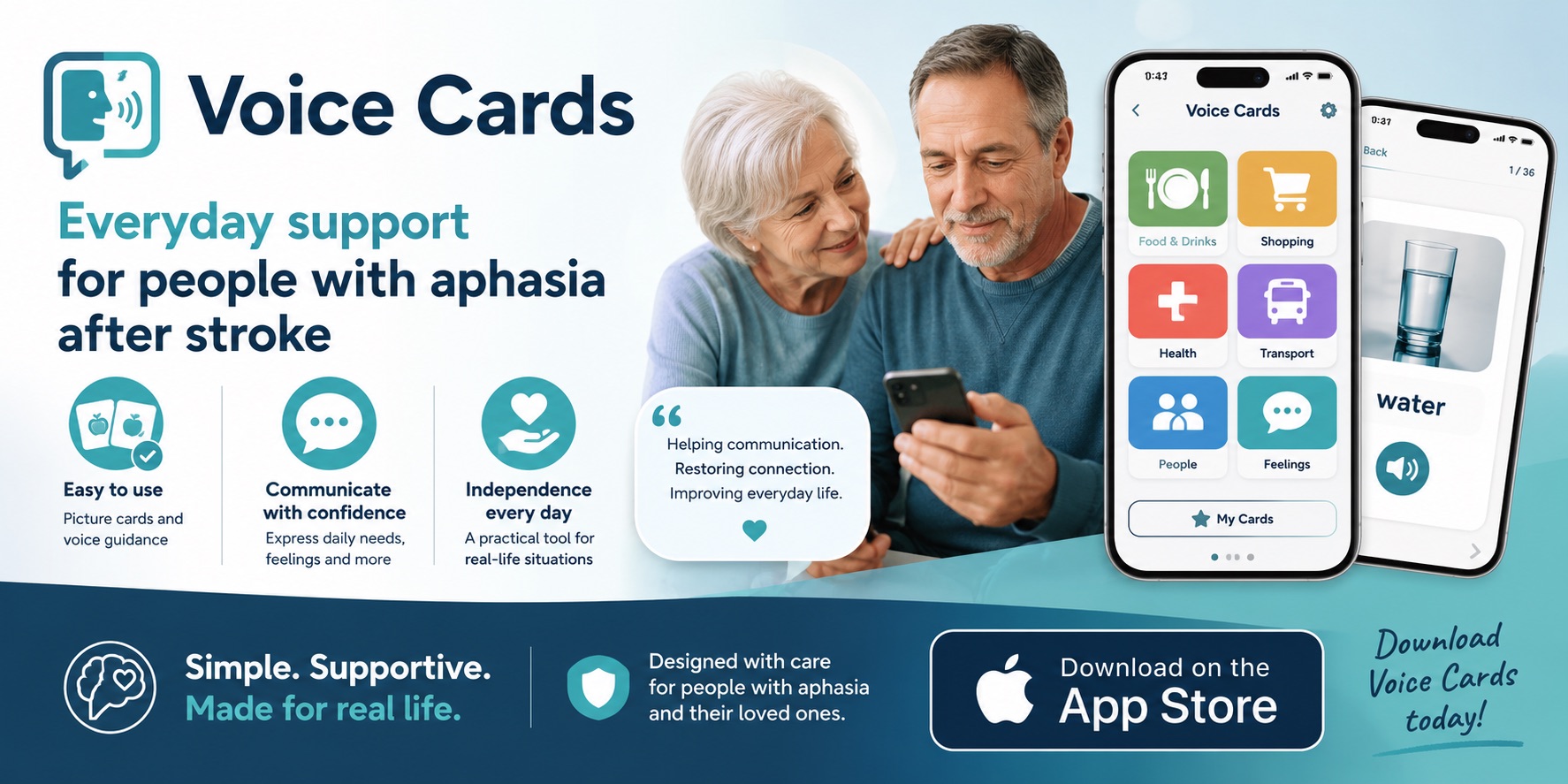
SmallDesk Voice Cards
A simple voice cards app for everyday communication. Currently available for iPhone. Android version coming soon.
Receptive aphasia
Receptive aphasia usually means that understanding language is especially difficult. A person may hear words but struggle to connect them with meaning. Speech may sound fluent, but it may be hard for others to understand because words may be misplaced, unrelated or confusing.
Global aphasia
Global aphasia generally refers to a more severe pattern affecting both expression and understanding. A person may have major difficulty speaking and understanding spoken or written language. This term describes a broad communication impact rather than one small language difficulty.
Anomic aphasia
Anomic aphasia is often associated with word-finding difficulty. A person may speak relatively fluently but struggle to name objects, people, places or specific words. They may describe the word instead of saying it directly.
Primary progressive aphasia
Primary progressive aphasia is a term used for a language-led pattern that changes gradually over time. It is different from sudden aphasia after an event such as stroke or brain injury. Because the term can be confusing, it is often discussed separately from other aphasia types.
Aphasia meaning versus dysphasia meaning
Some readers also search for “aphasia vs dysphasia.” These words are closely related and are sometimes used differently depending on country, source or professional context. In many everyday explanations, aphasia is the more commonly used term, especially in American English. Dysphasia may be used to describe impaired language ability, while aphasia is often used as the broader familiar term for acquired language impairment.
For readers, the most important point is not the label itself, but the language difficulty being described. If a person struggles with speaking, understanding, reading or writing after a change affecting language areas of the brain, the topic is within the broader field of aphasia and related language disorders.
Is aphasia about memory or intelligence?
Aphasia is not the same thing as losing intelligence. A person may have trouble saying a word even when they know what they mean. They may understand a situation but be unable to explain their thoughts clearly. They may become quiet not because they have nothing to say, but because the language pathway is difficult to access.
This distinction is one of the most important parts of understanding aphasia meaning. Communication difficulty can make a person appear confused, but appearance is not the same as inner experience. People around the person should be careful not to assume that limited speech means limited understanding, limited emotion or limited awareness.
At the same time, aphasia can exist alongside other changes depending on the broader situation. That is why general articles can explain the term, but they cannot interpret one individual case. A person’s real communication pattern may be simple or complex and may involve more than one factor.
What aphasia may look like in everyday life
In everyday life, aphasia may appear during normal conversations. A person may stop mid-sentence because the next word is unavailable. They may point instead of speaking. They may say one word repeatedly. They may use a word that sounds similar to the intended word. They may understand a simple greeting but not a long explanation. They may become frustrated when several people speak at once.
Aphasia may also appear in written communication. A person may struggle to read a text message, fill out a form, write a birthday card or understand a letter. They may recognize familiar names but struggle with unfamiliar written words. They may prefer short written choices instead of long paragraphs.
It can also affect social confidence. Conversation is not only about exchanging information. It is also about humor, timing, personality and connection. When words become difficult, a person may withdraw from group conversations, not because they do not care, but because participating has become demanding.
Why aphasia can be different from person to person
Aphasia can differ because language itself is complex. Speaking, understanding, reading and writing involve many connected skills. A change affecting one language pathway may look very different from a change affecting another. This is why one person may mostly struggle with word-finding, while another may mostly struggle to understand what others say.
Differences can also appear depending on fatigue, stress, background noise, topic familiarity and emotional pressure. A person may communicate better in a calm one-to-one conversation than in a crowded room. They may say familiar names more easily than unfamiliar terms. They may do better with routine phrases than with unexpected questions.
Aphasia and everyday misunderstanding
One of the hardest parts of aphasia is that it can be misunderstood by people who have never seen it before. If someone gives short answers, uses the wrong word or pauses for a long time, others may wrongly assume that the person is not listening, not interested or not aware of what is happening. Aphasia can create this false impression because language is one of the main ways people show what they understand.
In reality, a person with aphasia may be following more than they can express. They may understand the emotional tone of the room, recognize familiar people, know what they want and feel frustration when words do not cooperate. This is why respectful communication matters. The person should not be talked over, ignored or treated as if they are absent from the conversation.
How to explain aphasia to someone simply
A simple way to explain aphasia is: “Aphasia affects language. The person may know what they want to say, but speaking, understanding, reading or writing may be harder than before.” This explanation avoids two common mistakes. It does not reduce aphasia to “cannot speak,” and it does not suggest that the person has lost who they are.
Another clear explanation is: “Aphasia can make communication slower, harder or less reliable, but the person still deserves time, respect and a chance to express themselves.” This version is especially useful for family members, friends and caregivers who are learning how to understand everyday communication differences.
General communication context, without medical advice
Because this article is educational, it does not give individual communication instructions or personal recommendations. Still, public aphasia resources often explain that aphasia affects communication across speaking, understanding, reading and writing. The American Speech-Language-Hearing Association describes aphasia as a language disorder that affects how a person communicates and is caused by damage to language centers of the brain. Read ASHA’s public information about aphasia.
SmallDesk Voice Cards
A simple voice cards app for everyday communication. Currently available for iPhone. Android version coming soon.
In general educational terms, aphasia-friendly communication is often discussed in relation to patience, context and respect. Many communication breakdowns become worse when people rush, interrupt, speak over the person or assume that silence means absence of thought. Communication may become easier to understand when the interaction is slower, calmer and more focused.
This does not mean every person needs the same approach. Aphasia is individual. Some people use spoken choices. Some use written keywords. Some use gestures. Some use pictures. Some use a mix of several communication methods. The best way to understand the meaning of aphasia is to remember that it changes access to language, not the person’s value.
Aphasia, speech, writing and understanding: quick comparison
| Area | How aphasia may appear | Simple explanation |
|---|---|---|
| Speaking | Words may be hard to find, sentences may be short or speech may contain incorrect words. | The person may know the idea but struggle to express it in language. |
| Understanding | Fast, long or complex speech may be difficult to follow. | The spoken words may be heard, but the language meaning may be harder to process. |
| Reading | Messages, forms, signs or paragraphs may become harder to understand. | Reading uses language, so it can be affected by aphasia too. |
| Writing | Spelling, word choice or sentence building may become difficult. | The person may have thoughts but struggle to put them into written words. |
| Conversation | Group conversations, noise or quick topic changes may be tiring or confusing. | Real-life communication requires speed, memory, context and language at the same time. |
What aphasia is not
Aphasia is not simply being shy, quiet or unwilling to talk. It is not the same as forgetting one word occasionally in a normal conversation. It is not a personality change by itself. It is not proof that a person has no thoughts or opinions. It is a language and communication difficulty that can make those thoughts harder to express or understand through words.
Aphasia is also not always visible at first glance. Some people may look physically well and still have major difficulty with conversation. Others may speak fluently enough that listeners do not immediately realize the person is struggling with meaning, comprehension or word choice. This hidden aspect can make aphasia socially difficult because people may expect communication to be easier than it is.
Why the meaning of aphasia matters
Understanding the meaning of aphasia matters because language is central to independence, relationships and everyday choices. A person uses language to ask for help, express pain, refuse something, make jokes, explain memories, choose food, follow news, read messages and stay connected with family. When language becomes harder, daily life can become more tiring and more dependent on patient communication from others.
A clear definition also helps reduce stigma. If aphasia is wrongly understood as lack of intelligence, the person may be excluded from conversations and decisions. If aphasia is understood as a language access difficulty, the same person may be given more time, clearer context and more respectful opportunities to communicate.
Common questions people ask after hearing the word aphasia
Many people first search “what is aphasia” because the term sounds unfamiliar. The next questions are often very practical. Does aphasia mean the person cannot understand me? Does it mean they cannot speak at all? Can they read? Can they write? Why do they use the wrong word? Why do they seem better in one conversation and worse in another?
The answer is that aphasia is variable. It can affect different language skills to different degrees. A person may have a good conversation in the morning and struggle later when tired. A familiar topic may be easier than a new topic. A quiet room may be easier than a noisy one. A simple sentence may be easier than a long explanation. These differences are part of why aphasia can be confusing for families and friends.
Aphasia in medical terms
In medical and clinical language, aphasia is usually described as an acquired language disorder caused by damage to brain regions involved in language. Public medical resources commonly explain that aphasia can affect speech, writing and the understanding of spoken and written language. Mayo Clinic describes aphasia as a disorder that affects communication and can affect speech, writing and understanding spoken and written language. Read Mayo Clinic’s overview of aphasia.
For general readers, the important point is simple: “medical definition” does not mean the person should be reduced to a diagnosis. The definition explains the language difficulty, but the person remains a full human being with preferences, relationships, identity and a need to be included.
Aphasia meaning in one sentence
Aphasia means a change in language ability that can make speaking, understanding, reading or writing difficult, while the person’s thoughts, identity and need for connection remain important.
FAQ about aphasia meaning
What does aphasia mean?
Aphasia means difficulty with language and communication. It can affect speaking, understanding speech, reading or writing. It is usually connected with damage to language-related areas of the brain.
What is the simplest aphasia definition?
A simple aphasia definition is: aphasia is an acquired language disorder that makes it harder to use or understand words. It may affect spoken and written communication.
Does aphasia mean a person cannot talk?
Not always. Some people with aphasia speak very little, but others can speak fluently while still having difficulty with meaning, word choice or understanding. Aphasia can affect language in different ways.
Does aphasia affect intelligence?
Aphasia is not the same as loss of intelligence. It affects language access and communication. A person may know what they want to say but have difficulty producing or understanding the words.
Can aphasia affect reading and writing?
Yes. Aphasia can affect reading and writing because both are language skills. A person may struggle with written words, sentences, spelling or understanding text.
Why are there different types of aphasia?
There are different types because aphasia can affect different parts of language. Some patterns mainly affect expression, some mainly affect understanding, and others affect several language abilities at once.
Is aphasia the same as dysarthria?
No. Aphasia is mainly a language difficulty, while dysarthria is usually related to the physical production of speech sounds. The two terms can appear in similar contexts, but they do not mean exactly the same thing.
Can someone with aphasia understand more than they can say?
Yes, this can happen. Some people have more difficulty expressing language than understanding it. Others may have more difficulty understanding language. Aphasia patterns vary from person to person.
Summary
Aphasia is best understood as a language and communication difficulty. It can affect speaking, understanding, reading and writing, but it does not erase a person’s intelligence, personality or need to connect with others. The meaning of aphasia is broader than “cannot talk,” because language includes many abilities beyond speech alone.
For readers searching for “aphasia meaning,” “what is aphasia,” “aphasia definition” or “define aphasia,” the key point is simple: aphasia changes how language works for a person. It may make communication slower, harder or less predictable, but respectful communication remains possible and deeply important.