Free Aphasia Practice Resource
Free Printable Aphasia Worksheets and Workbook for Adults
Download a free 34-page aphasia workbook PDF for adults. The printable worksheets include word-finding activities, comprehension tasks, functional reading, writing practice, conversation planning and communication-partner guidance. Every exercise is original, uses adult-appropriate language and can be adapted for supported home practice or speech therapy.
What is included in the free aphasia workbook?
The downloadable aphasia workbook contains 34 printable pages covering five areas of adult communication. It begins with a communication profile and instructions for supported practice, continues through structured language activities, and ends with partner guidance, answer keys and a weekly practice log.
| Workbook section | Example activities | Communication skills |
|---|---|---|
| Getting started | Communication profile and preferred supports | Self-advocacy and personalized practice |
| Word finding | Definitions, categories, verbs, first-letter cues and semantic features | Word retrieval and strategy use |
| Comprehension | Yes/no questions, directions and a short listening passage | Understanding spoken words and sentences |
| Reading and writing | Signs, short paragraphs, sentence building and sentence expansion | Functional literacy and written expression |
| Everyday communication | Appointment card, menu, shopping list, calendar and phone-call planner | Using language in daily activities |
| Conversation and carryover | Personal vocabulary, topic planning, partner tips and weekly log | Participation and supported conversation |
Designed for adults, not children
The activities use adult situations such as medical appointments, shopping, menus, calendars, phone calls and conversation planning. The workbook avoids childish clip art, school-style rewards and language that talks down to the user. Its large print, high contrast, short instructions and generous writing space are intended to make each page easier to approach.
Original and ready to print
The workbook does not reproduce pages from a standardized assessment or a commercial speech-therapy product.
Who are these printable aphasia worksheets for?
The workbook is intended for adults with acquired language difficulties who can benefit from structured practice. It may be used:
- by an adult with aphasia together with a speech-language pathologist;
- as part of a clinician-designed home-practice program;
- with a trained family member, friend, volunteer or care partner;
- in an aphasia group when activities are adapted to individual needs;
- for low-pressure independent practice when the person can understand the instructions safely.
Aphasia can affect speaking, understanding, reading and writing in different combinations. Someone with relatively mild word-finding difficulty may complete a page independently, while a person with more severe aphasia may need written choices, pictures, modeling or one item at a time. Learn more about different aphasia types and communication patterns.
When the workbook may need substantial adaptation
Ask a clinician to adapt activities when the person has severe comprehension difficulty, visual-field loss, hearing loss, limb weakness, apraxia of speech, dysarthria, significant fatigue, a different primary language or a reading level that does not match the worksheets. Performance may reflect these factors rather than language ability alone.
What types of aphasia exercises are included?
1. Word-finding worksheets
The word-retrieval pages ask the user to identify words from definitions, complete familiar sentences, sort vocabulary into categories, retrieve action words and use first-letter cues. A semantic feature map encourages the person to describe a target word by its category, function, location, appearance, parts and related words.
These strategies offer several ways to continue communicating even when the exact word is unavailable. The goal is not to force a perfect response. Saying a related word, describing the object, pointing, writing or gesturing can all contribute to a successful message.
2. Auditory comprehension worksheets
The comprehension section includes factual yes/no questions, one-step directions, two-step directions and a short listening passage. The tasks can be presented verbally by a partner or read independently, depending on the skill being practiced.
3. Reading exercises
Reading pages progress from familiar public words such as “exit” and “closed” to a short paragraph and fictional practical documents. The appointment card, cafe menu, shopping list and weekly calendar require the reader to locate useful information rather than decode isolated words without context.
4. Writing exercises
Writing activities include arranging words into sentences, expanding a short sentence and recording key information for a phone call or appointment. Writing can also be supported with copying, choices, a first letter, speech-to-text or a communication partner acting as a scribe.
5. Functional communication practice
Functional pages connect practice with real participation. The person can prepare important vocabulary, plan a conversation, record questions for an appointment and identify the support they prefer. This complements the broader ideas in our guide to aphasia activities for adults.
How should you use an aphasia workbook at home?
Choose a small number of relevant activities and prioritize successful communication over completing every page. Aphasia practice should match the person’s energy, current ability and personal goals. ASHA describes treatment as individualized and person-centered, with home and community practice supporting carryover when communication partners are appropriately trained. [1]
- Start with a real goal. Choose an activity connected to something the person wants to do, such as ordering lunch or preparing for an appointment.
- Reduce distractions. Turn off the television, clear unnecessary materials and have one person speak at a time.
- Use a manageable session length. Ten focused minutes may be more useful than a long session that causes fatigue.
- Give time before helping. Wait quietly. Do not repeat the question immediately unless repetition is requested.
- Ask what kind of help is wanted. Offer a first sound, written choice, gesture or description only with permission.
- Accept multiple communication methods. Speech, writing, drawing, pointing, facial expression and communication tools can work together.
- End with something useful. Apply one word or strategy in a real conversation, message, list or plan.
The National Institute on Deafness and Other Communication Disorders explains that aphasia treatment aims to improve communication and may include participation by family members. [2] Worksheets are most valuable when they form one part of that wider communication program.
A simple weekly plan
| Day | Short activity | Everyday carryover |
|---|---|---|
| Monday | One word-finding page | Use three target words during a familiar routine |
| Wednesday | Short reading or menu activity | Read one real sign, label or menu together |
| Friday | Conversation-planning page | Have a short conversation using prepared key words |
This is only an example. The appropriate frequency and intensity vary widely. Follow the plan provided by the treating clinician when one is available.
How can you make aphasia worksheets easier or harder?
| To make a task easier | To make a task harder |
|---|---|
| Present one item at a time | Present the full page |
| Offer two written or picture choices | Remove choices and ask for independent retrieval |
| Provide the first sound or letter | Ask the person to generate their own cue |
| Read the instruction aloud and demonstrate | Use a longer instruction or less familiar vocabulary |
| Accept pointing or yes/no responses | Ask for a complete spoken or written explanation |
| Use familiar personal words and photographs | Practice new topics or communication settings |
Adaptation should reduce irrelevant barriers without making the activity childish. Large print, fewer items and clearer spacing can support access while preserving adult content. See our practical guide to making written information aphasia-friendly.
How can a communication partner help?
A partner should support the exchange of meaning rather than behave like an examiner. The American Stroke Association recommends patience, reduced distractions, confirmation and flexible methods such as writing, drawing and gesture. [3]
- Wait: allow enough time for a response.
- Ask: “Would you like a clue, choices or more time?”
- Confirm: repeat the message you understood.
- Keep an adult tone: simplify the format, not the person.
- Write key words: use large, clear print and plenty of space.
- Accept alternatives: encourage pointing, gesture, drawing and communication aids.
- Watch for fatigue: stop before practice becomes overwhelming.
Family members can find additional examples in our conversation guide for family and friends. A personalized aphasia communication board can also provide reliable choices and essential messages when a worksheet is not the right tool.
What can aphasia worksheets not do?
Printable worksheets can provide structure, repetition and an easy record of practice. They cannot determine why a communication problem is happening, establish a diagnosis, replace standardized assessment or predict recovery.
Worksheets also provide only a limited sample of communication. A person might complete a naming page successfully but still struggle in a fast group conversation. Another person might find written tasks difficult but communicate ideas effectively through speech, gesture and drawing.
Contact a qualified clinician when:
- the communication difficulty is new, changing or unexplained;
- the person has not received a language and communication assessment;
- activities cause persistent frustration or appear much too easy or difficult;
- hearing, vision, movement, memory or motor-speech difficulties affect performance;
- the person wants goals related to work, education, driving, finances or complex medical communication;
- the family needs training in supported conversation or communication tools.
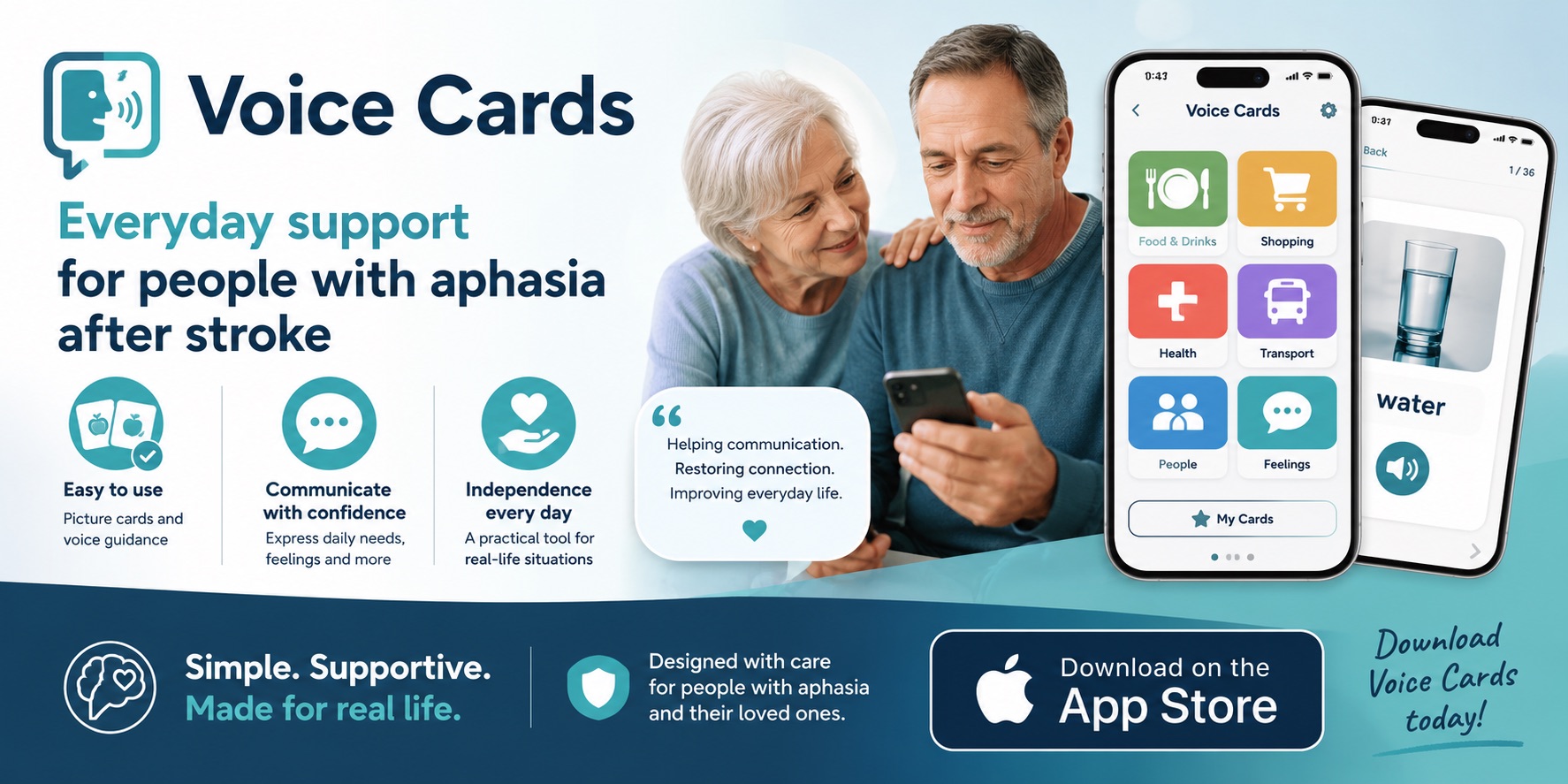
Our guide to choosing an aphasia speech therapist explains what professional therapy may include. Digital tools may also complement printed practice; see these aphasia apps for everyday communication.
Get the complete aphasia workbook PDF
The PDF includes all 34 pages, answer keys, partner guidance and printable planning sheets.
Frequently asked questions about aphasia worksheets
Are these aphasia worksheets really free?
Yes. The complete 34-page aphasia workbook PDF is free to download without registration. It may be printed and shared unchanged for personal, educational or clinical use, but it may not be resold.
What does the aphasia workbook include?
It includes adult exercises for word finding, auditory comprehension, reading, writing and functional communication. It also contains a communication profile, phone and appointment planners, partner tips, a weekly practice log and answer keys.
Can worksheets improve aphasia?
Worksheets can support structured practice of selected skills, but their usefulness depends on the person, the task and how practice connects with everyday communication. They should complement, not replace, individualized assessment and treatment.
How often should an adult use aphasia worksheets?
There is no single schedule that is right for everyone. Short, manageable and personally relevant sessions may be more useful than completing many pages at once. Follow the treating clinician’s recommendations when available.
Can these worksheets be used for severe aphasia?
Some pages can be adapted by showing one item at a time, adding pictures or written choices, accepting pointing and using partner modeling. A speech-language pathologist should help select suitable activities for severe or complex communication difficulties.
Are aphasia worksheets a diagnostic test?
No. These worksheets are not standardized and cannot diagnose aphasia, determine its cause or measure intelligence. Sudden language difficulty requires emergency medical care, and ongoing concerns should be evaluated professionally.
Can speech therapists print this workbook for clients?
Yes. Clinicians may print and share the unchanged workbook for educational or clinical use. The workbook may not be repackaged, sold or presented as a standardized assessment.
Is this workbook suitable for children?
It was designed specifically for adults with acquired language difficulties. The situations, vocabulary and visual style are adult-oriented and may not match a child’s developmental or educational needs.
Clinical sources