Returning to work with aphasia is usually easier when it is treated as a communication-planning process rather than a test of whether someone can speak exactly as before. A useful plan identifies the essential tasks of the role, the communication barriers that appear in real situations, the supports the person prefers, and a gradual way to learn what works.
What does returning to work with aphasia mean?
Returning to work does not have one correct definition. It may mean resuming a previous role, changing duties, starting with fewer hours, moving into a different position, volunteering as a bridge, or choosing a new kind of work. The person’s goals, identity, finances, energy, communication profile, and work environment all matter.
Recent qualitative research on workplace reentry has emphasized that people with aphasia define successful return to work in different ways and often bring their own ideas about roles, barriers, and possible solutions. The broader ASHA aphasia guidance also treats employment and participation in daily life as important functional concerns.
No article can decide whether a particular person is ready for a particular job. That decision may involve the person, employer, speech-language pathologist, rehabilitation team, and other qualified professionals. This guide focuses only on practical communication planning and self-advocacy.
Start with the real job, not a general idea of “work”
Write down the essential tasks of the role. Then identify the communication demands within each task. A broad description such as “office work” is less useful than a list such as:
- read and respond to 15 short emails;
- join a 20-minute team meeting;
- enter information into a form;
- ask a coworker for clarification;
- answer occasional customer questions;
- follow a written safety sequence;
- report when a task is complete.
Mark which tasks already feel manageable, which need a support, and which remain unclear. This creates a concrete starting point for discussion. It also avoids assuming that one communication difficulty affects every part of the job in the same way.
For reading-heavy roles, the principles in our guide to aphasia-friendly written information can help identify useful formatting. For email-heavy roles, review the step-by-step approach to writing emails with aphasia.
How do you build a practical workplace communication plan?
List strengths as well as barriers
A plan should not become a catalog of deficits. Record what the person does effectively: recognizing familiar procedures, demonstrating a task, using drawings, reading key words, organizing visual information, making decisions with time, or communicating well one-to-one.
Choose supports for specific moments
Match each support to a task. A written agenda may help in meetings. A saved email template may help with routine updates. A checklist may support a multistep process. A photo or diagram may be better than a paragraph. A prepared phrase may make it easier to request clarification.
Useful phrases can include:
- “Please give me a moment to answer.”
- “Could you write the key point?”
- “Please ask one question at a time.”
- “I understand the task, but I need help finding the word.”
- “Let me show you instead.”
- “I want to confirm the deadline: Thursday at 3 p.m.”
Plan how to repair misunderstandings
Communication will not always go smoothly, and that is not a failure. Agree on a repair sequence: pause, confirm the topic, use one keyword or visual, restate what was understood, and check the final meaning. Our communication rescue plan can be adapted to workplace conversations.
What workplace supports might be worth discussing?
The right support depends on the person and job. Possible discussion points include:
- written agendas sent before meetings;
- short written summaries after important conversations;
- one speaker at a time in meetings;
- extra time for reading, writing, or responding;
- quiet space for language-heavy tasks;
- templates for routine messages and forms;
- visual checklists, diagrams, labels, or examples;
- a consistent contact person for questions;
- gradual changes in hours or responsibilities when appropriate;
- alternative ways to demonstrate knowledge, such as showing a process instead of explaining every step aloud.
In the United States, official ADA information lists examples of possible reasonable accommodations, including modified schedules, job restructuring, and changes to equipment, training materials, or policies. Coverage and the appropriate process depend on the individual situation, employer, role, and applicable law, so obtain qualified employment or legal guidance when needed.
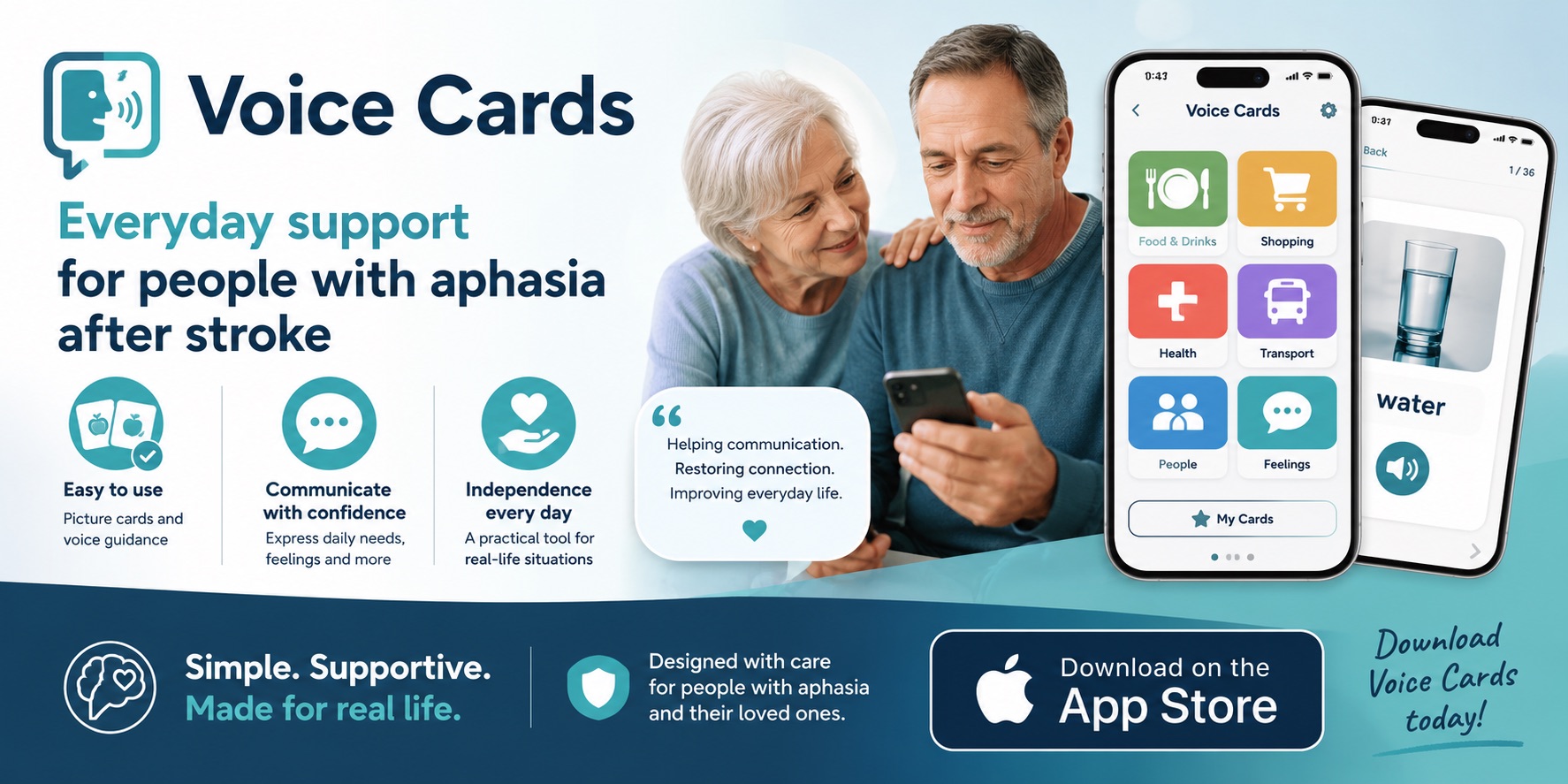
Technology can support a task, but it should not be chosen simply because it is new. Our guides to communication apps for everyday life and using ChatGPT with aphasia explain both practical possibilities and the need to review generated text carefully.
Three realistic return-to-work scenarios
Scenario 1: A desk-based role with meetings and email
Jordan’s main barriers are fast group discussion and writing from a blank screen. Before each meeting, the team sends a five-point agenda. Jordan receives time to review it and notes two ideas in advance. During the meeting, one person speaks at a time and decisions are written in the chat. For routine email, Jordan uses approved templates and a short checklist: recipient, purpose, date, action, review.
Scenario 2: A customer-facing role
Rosa knows the products and procedures but finds unexpected questions difficult. She prepares short scripts for common requests and keeps a visual reference sheet nearby. When a question is unclear, she says, “Please ask one part at a time,” or invites the customer to point to an option. A coworker is available for unusual situations, but Rosa remains the main speaker unless she requests help.
Scenario 3: A practical or technical role
Malik performs familiar physical tasks accurately but finds long verbal instructions difficult. His supervisor provides a numbered visual checklist and demonstrates new procedures. Malik repeats the key step in his preferred way before beginning. Safety-critical changes are documented clearly, and questions are handled in a quiet one-to-one setting rather than shouted across a busy room.
These scenarios are examples, not prescriptions. A support that helps one person may be unnecessary or distracting for another.
How can someone explain aphasia at work?
The person with aphasia should decide how much to share and with whom. A short explanation may be enough:
“I have aphasia. It affects language, not my intelligence. I may need extra time, written key points, or another way to show what I mean.”
A personalized card can make this easier. The article about aphasia ID cards explains how to create a respectful version without disclosing more information than the person wants.
Coworkers can help by speaking normally, pausing, using concise language, writing key words, and checking meaning. They should not complete every sentence, talk about the person as if they are absent, or assume a language difficulty means the person cannot understand the work.
Meetings may need additional structure. The strategies for including a person with aphasia in group conversations translate well to team discussions: visible topics, one speaker at a time, clear turn-taking, and more than one way to contribute.
Common return-to-work planning mistakes
- Choosing a return date before understanding the job demands: map the actual tasks and communication situations first.
- Focusing only on speech: reading, writing, numbers, memory load, noise, fatigue, and technology may also affect a workday.
- Assuming the previous role is the only successful outcome: hours, duties, work setting, or the definition of work may change.
- Making decisions without the person: support self-advocacy and ask what works instead of speaking only to family or professionals.
- Introducing too many tools at once: test one support in the task where it is needed.
- Treating every misunderstanding as evidence of inability: repair the message and examine the environment.
- Relying on informal promises: write down agreed communication supports, responsibilities, and review dates.
- Expecting a perfectly linear process: learning from a difficult day can improve the next version of the plan.
Return-to-work communication checklist
- The person has defined what “return to work” means to them.
- Essential job tasks and communication demands are listed.
- Strengths, preferred communication methods, and barriers are documented.
- Supports are matched to specific tasks.
- Useful scripts, templates, visuals, or checklists are ready.
- The person has a way to request clarification or a pause.
- A plan exists for meetings, email, phone calls, and unexpected questions.
- The employer contact and review process are clear.
- Any legal, employment, or clinical questions are directed to qualified professionals.
- The plan can be reviewed and changed based on real experience.
Frequently asked questions
Can a person with aphasia return to the same job?
Some people do, while others change duties, hours, setting, or type of work. Aphasia varies widely, and jobs have different communication demands. A task-specific plan is more useful than a general prediction.
Should coworkers be told about aphasia?
The person with aphasia should have a central role in deciding what to disclose. It may be useful for selected coworkers to understand the preferred communication supports, but the amount of personal information shared should be considered carefully.
What if meetings are the hardest part?
Ask for an agenda in advance, written key points, visible decisions, one speaker at a time, and an option to contribute in writing. A short follow-up may also help confirm tasks and deadlines.
Can AI write workplace messages for someone with aphasia?
AI may help create a first draft, organize points, or simplify a message. It can also change meaning, invent details, or expose confidential information if used carelessly. The person should review every message and follow workplace privacy and technology policies.
Where can someone find peer support about work and aphasia?
Aphasia groups can provide lived experience, ideas, and social connection, although they cannot decide an individual work plan. Start with our US guide to aphasia support groups and ask whether a group discusses employment or volunteering.
Who can help make an individual plan?
Depending on the situation, useful people may include a speech-language pathologist, rehabilitation professional, vocational rehabilitation counselor, employer or human-resources contact, disability specialist, union representative, or qualified legal adviser. The person with aphasia should remain central to the process.
Plan the next conversation
Choose one real job situation—such as a team meeting, routine email, or customer question—and write down the goal, barrier, and one support to test. A focused conversation about one task is usually more productive than trying to solve an entire return to work at once. If forms or phone calls are part of the role, the guide to supporting forms and calls without taking over offers another practical model.